
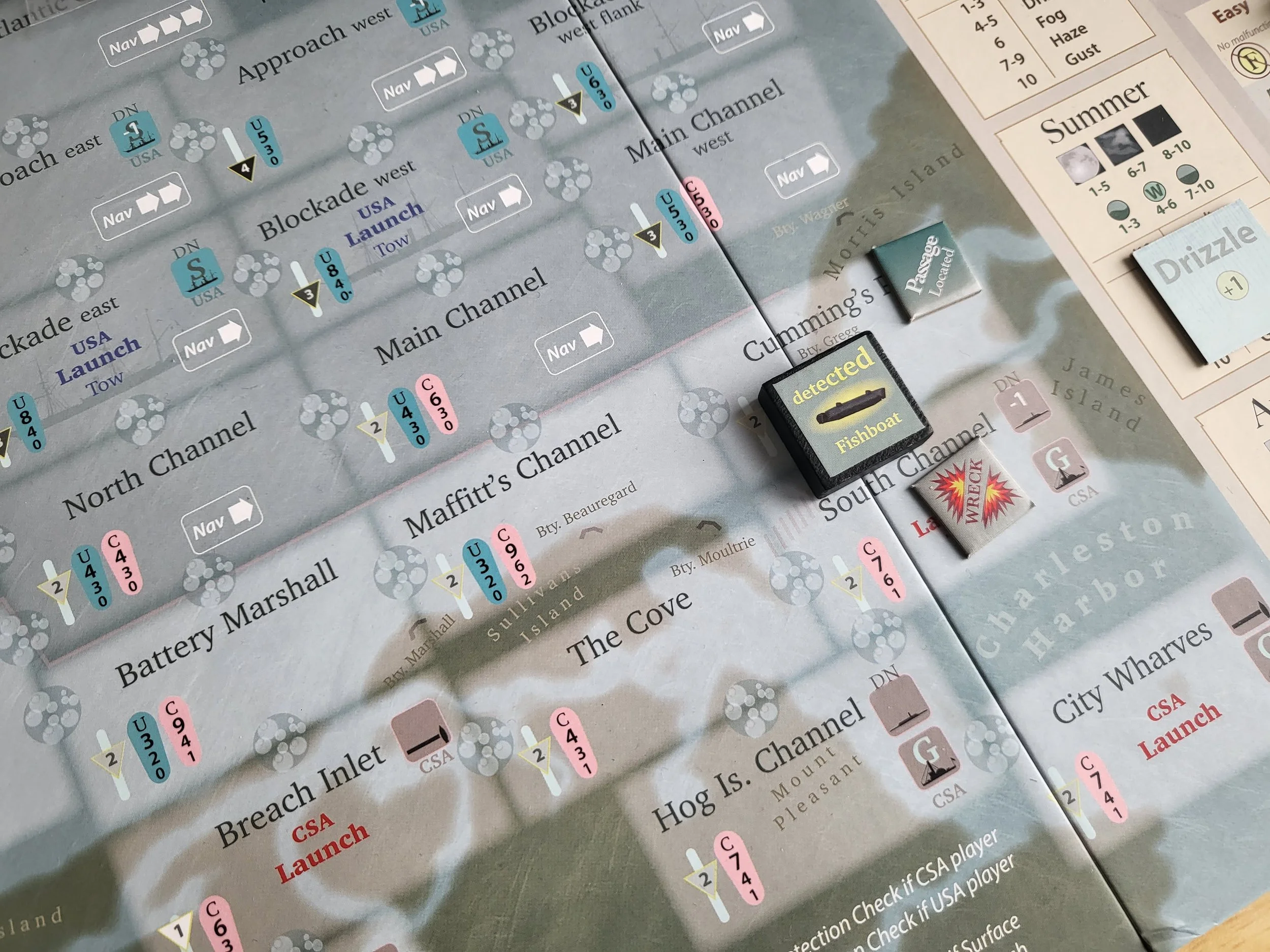
As part of my journey through the American Civil War in tabletop games, I have spent a non-zero amount of my life playing solitaire games set in America during the years 1861-1865. This has been one of the less pleasant aspects of my project, because an overwhelming number of these games focus on the Confederacy, and their designers have generally shown little interest in exploring why that is or what they are saying by designing a solitaire Confederacy simulator. This has led to some truly bizarre gaming experiences, although also maybe some of my better reviews, if I’m allowed to toot my own horn a bit.
I was, of course, immediately curious when I saw the announcement from GMT Games that they would be publishing a solitaire game about building submarines (or fish boats, as they were called at the time) during the American Civil War (ACW). The C.S.S. Hunley has had a surprising afterlife despite its non-existent impact on the war as a whole – it manages to warrant a piece in Ben Madison’s Jeff Davis, for example, even if it isn’t really worth including at the strategic scale. However, a more zoomed in examination of this topic, especially one partly by Jerry White, who has some experience working with difficult topics, suggested that Infernal Machine might be worth a look. That all said, I was also very pleased to hear that Infernal Machine would also feature a campaign as the Union, so you are not forced to fight for slavery if that isn’t something you are comfortable with. I am getting ahead of myself, though, for now let’s look at the game itself.
GMT Games kindly provided me with a complimentary review copy of Infernal Machine.
Infernal Machine is a bit of a beast. The main rulebook is over 60 pages long, and the box also includes a lengthy cyclopedia with more information on boat parts and personality cards, a learn to play scenario book, and two campaign booklets (one each for USA and CSA). This will come as no surprise to fans of Jerry White’s earlier designs and co-designs, he is famous both for his incredibly long rulebooks and for how effectively he onboards the players to his games despite (or because of) those lengthy rulebooks. While I have not played any of his earlier efforts, I could see how Infernal Machine is a continuation of that process, and, honestly, it’s impressive.
Infernal Machine is played across three different scales – which is an unusual and kind of fascinating choice. You have the tactical level, where your fish boat is attempting to blow something up; the operational level, where you are sailing around a river or a bay to try and find something to blow up, or to complete another mission; and the strategic level, where you manage your workshop by trying to make money so you can hire staff and build working fish boat that can go on missions for your respective side of the war.
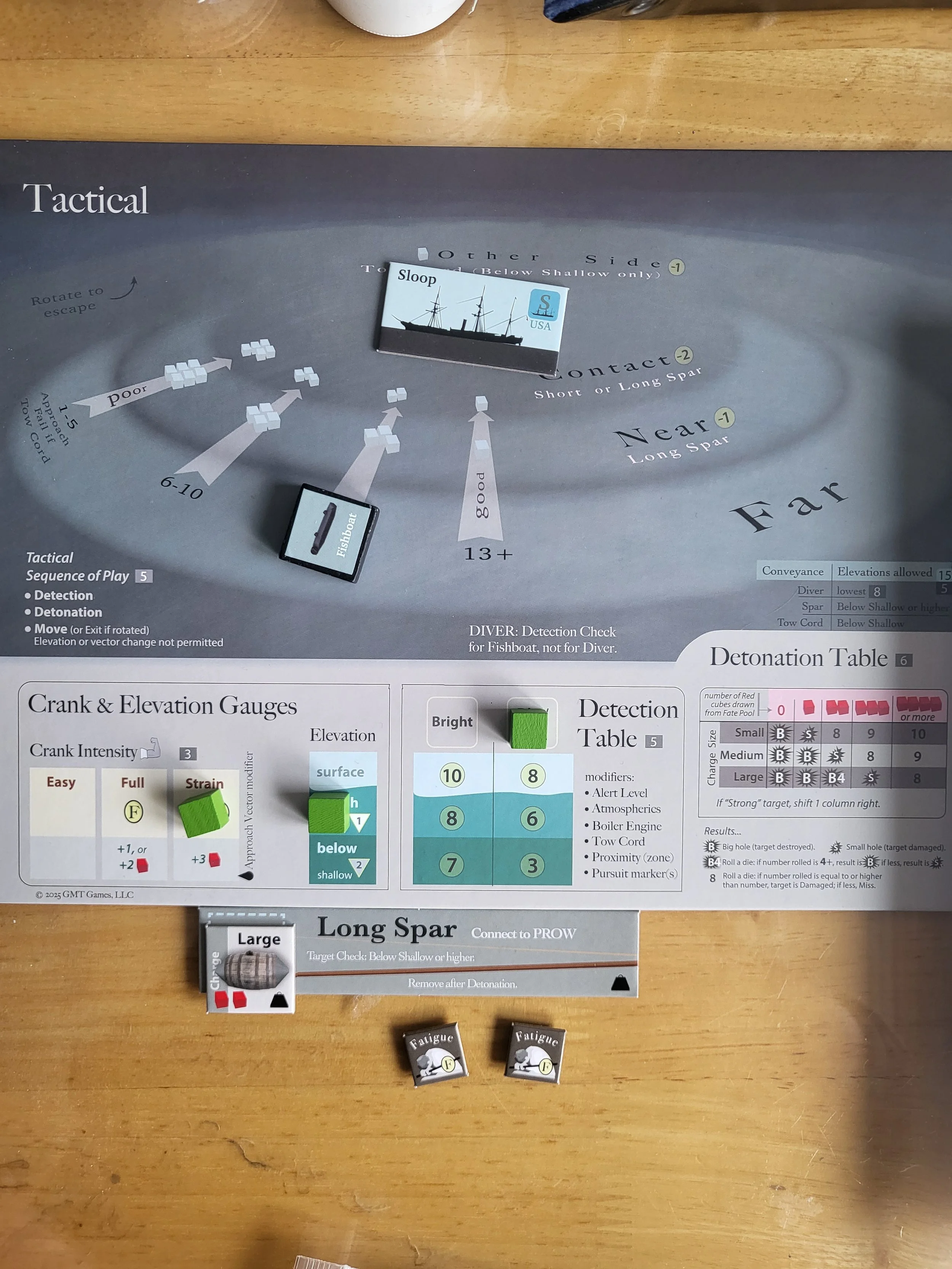
The tactical board during a practice scenario, where you don’t use the entire fish boat but instead focus just on the mechanisms and the part that explodes.
The rulebook then teaches you via these different scales. First you read the rules for tactical missions, and then you can play through several practice ones via the scenario book. Once you’re comfortable with all the likely permutations of the tactical game (mostly the different means by which you can trigger an explosion), then you can learn the rules for the operational game played on the mission boards – which in turn have their own scenarios to try. Finally, you learn the campaign level strategic game, and there is a little mini-campaign in the scenario book for you to practice that. Once you’ve completed this process, congrats, you know how to play!
No individual rule in Infernal Machine is all that complex and the game guides you through learning it very well. However, it is still a lot to remember, and it is easy to forget a small rule that might have had a significant impact on your mission. Did you remember to apply the alert level DRM to all your checks? Did you remember to add a pursuit marker after resolving that attack?
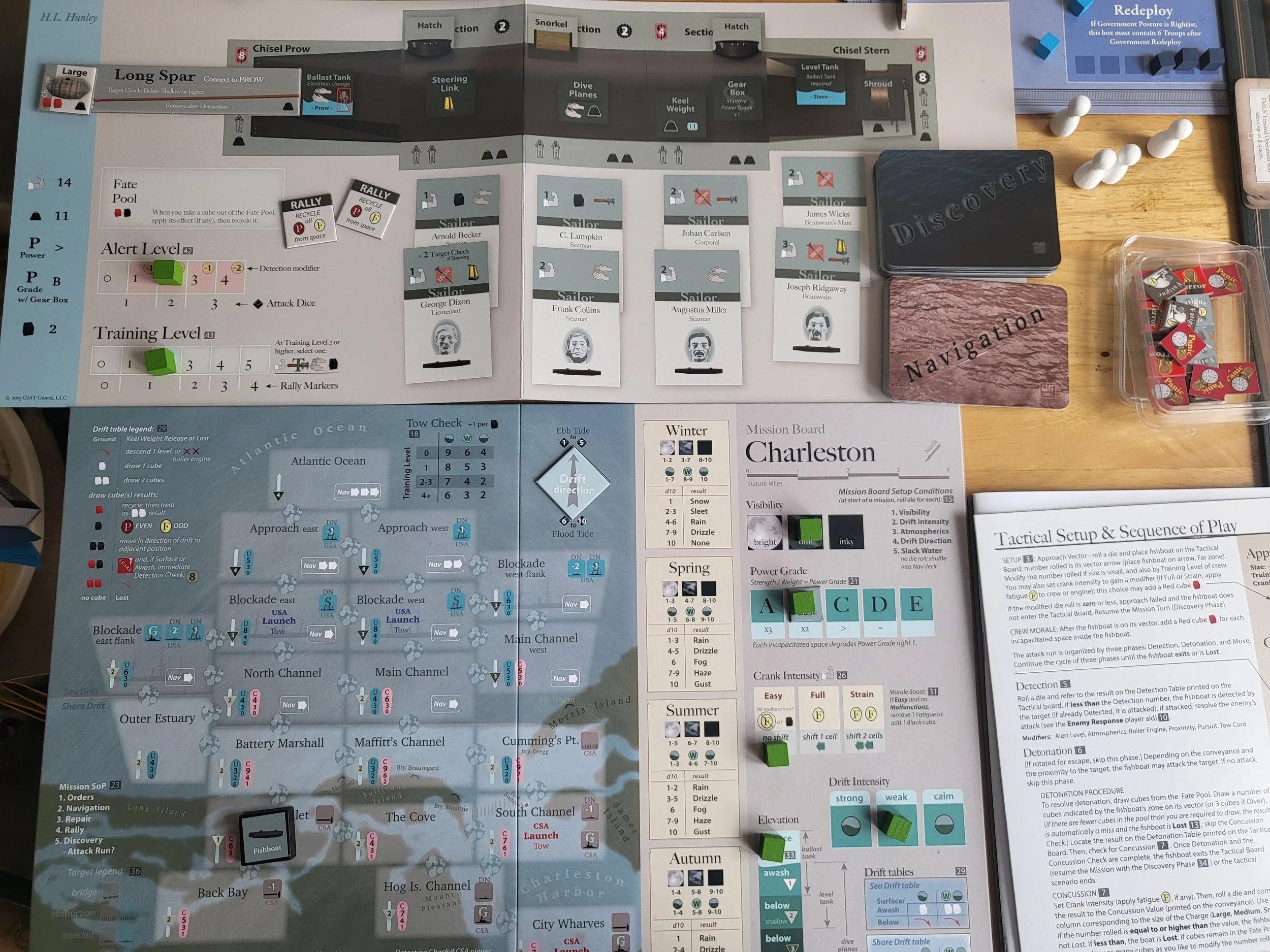
The mission board with one of the pre-printed historical fish boat mats that you use when practicing. These are a fun inclusion, as they show you what designs were actually used during the war.
As with many wargames, a slight oversight of one of these rules won’t cause the game to break down, but over the course of a campaign it can have unfortunate knock on effects. For me, though, the greatest tension lies in how long it took me to learn how to play Infernal Machine along with the eternal fear of “will I remember this game in the future?”
It took me several weeks to progress from tactical missions to the full campaign – albeit fitting the game in around my job and parental responsibilities – but I don’t begrudge it that time. It was fun to dig into different aspects of the game and become comfortable with them before moving on to the next level. However, I don’t know how eager I would be to do it again. In six months’ time, when I next get an urge to load men into an underwater death trap, will I remember how to play this game? Probably I will remember the overall gist of it, but all those little extra rules will elude me and it will be a struggle. This is, of course, a risk with all complex wargames so I can’t hold it against Infernal Machine specifically, but I wanted to note it as it is a lingering concern I have. There are play aids to help you remember core rules, and they are mostly quite good – except that I wish the malfunctions table was on a play aid and not the back of the cyclopedia booklet since you are referencing that table all the time during missions.
The choice to spread the game across multiple scales is fascinating, and a good idea given the topic. When you are playing the full campaign, it feels like you are periodically zooming in as the action focuses on specific objectives, and I really like this feeling. I also made it somewhat literal at times, as I would stack boards on top of each other so I could fit them on my little table in my tiny Korean apartment.
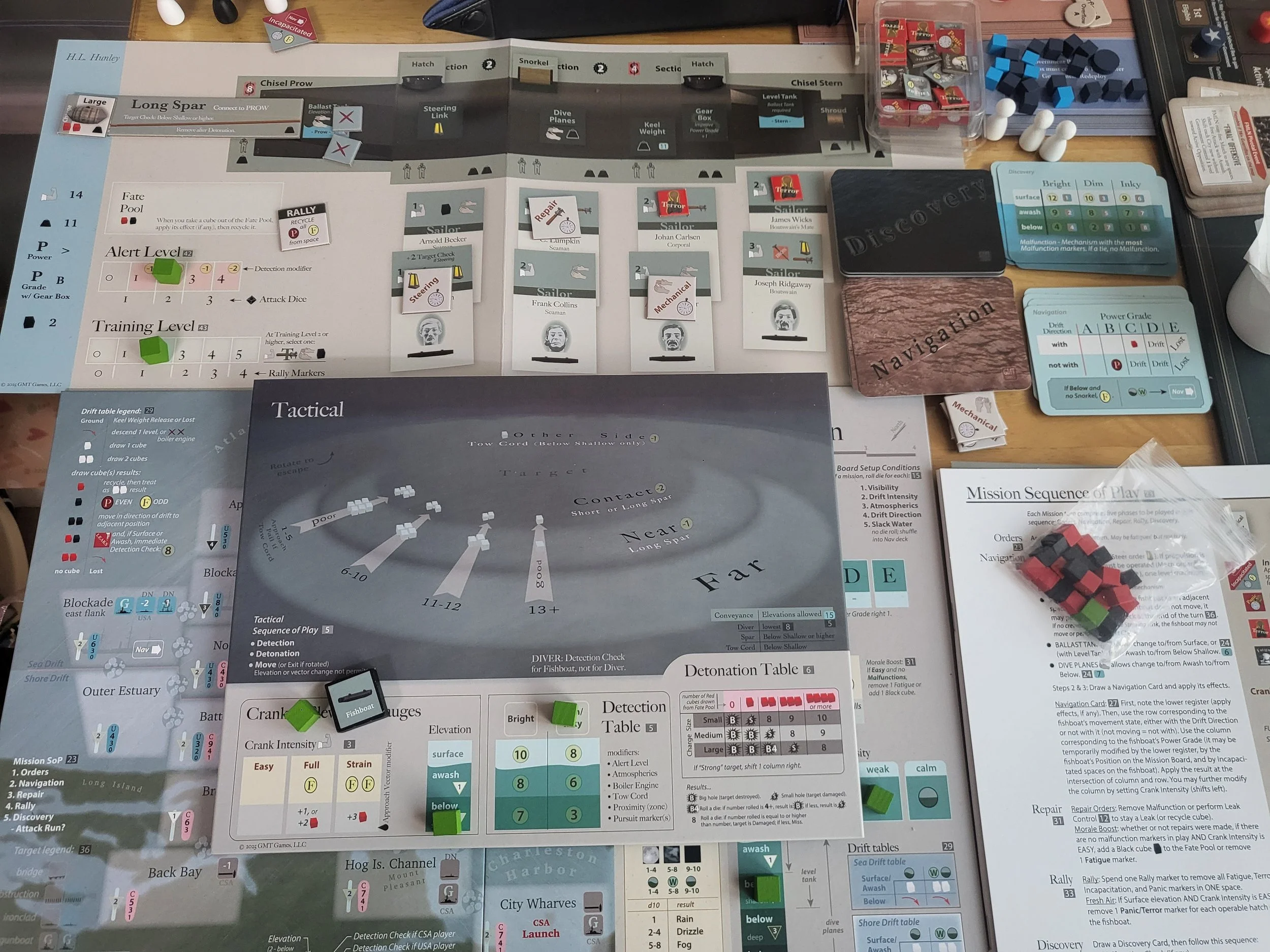
Talk about stacking limits.
While it is one of the game’s most unique choices, it does also create some confusion as to where the game’s heart truly lives. The tactical game is a good way of creating a “was the attack successful” and “did your fish boat improbably survive setting off a huge explosion right next to itself” narratives, but it is not a particularly interesting game on its own. Once you’ve done a couple of runs, you’ve seen what it has to offer.
The operational game does a good job at threading a needle in terms of not being too complex but still including interesting choices, but it is also not the most exciting game on its own. For example, the risk that your boat can sink with all hands is much more interesting because the game continues beyond that. Infernal Machine really requires the full campaign game to hold it all together, but I think, for me, that is also where the game struggles most.
I just don’t think the campaign is all that interesting from moment to moment. I don’t think it’s uninteresting, I wasn’t bored during my play, but I’m not sure it is interesting enough to hold everything together into a game that fascinates me. The campaign sits at an odd level of complexity, and I can’t decide if I want it to be a little more expansive or for it to be a little more focused. It feels like it is meant to be the main game, but at the same time it also only feels like it is bridging the gap between missions – and sometimes that gap can be quite long. There aren’t any exciting mechanical game loops here like you’d expect from a Eurogame about running a business, which could be fine but it meant that my decisions rarely felt that interesting. The most interesting decisions were around building and designing my fish boat and deciding when to launch it, but that was only a fraction of what I did. It just felt a little out of whack in terms of balance of things I was doing.
The campaign is not an overly long commitment – I think in modern board gaming we hear “campaign” and imagine a month-long, multi-session experience. You could play through a campaign of Infernal Machine in a single day if you sat down and set yourself that task. You play from mid-1861 to mid-1865, with four turns per year (one for each season). In a given turn you might have between 1 and 4 actions. Some actions take basically no time at all to resolve, but if you launch a mission that one action will involve pulling out a mission board and resolving the other levels of the game. Even then, individual missions hardly take more than 20-30 minutes to resolve, and you may only do a few of those in an individual campaign, at least if you’re a bad fish boat entrepreneur like me.
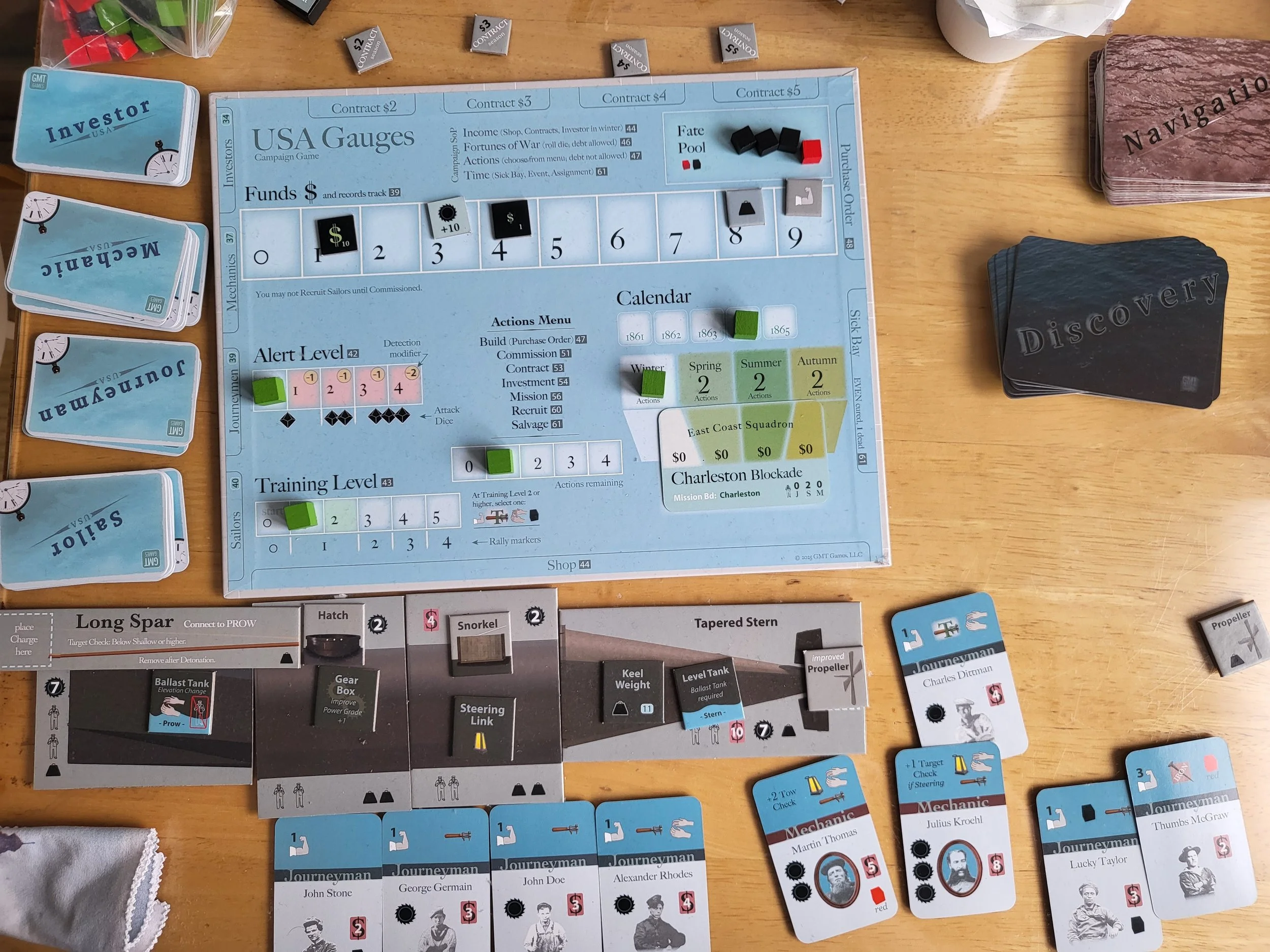
This was not a successful business, maybe I should stick to blogging.
Bear with me on this, but the type of game that Infernal Machine’s campaign reminded me of the most was a rogue-like. For those unfamiliar, rogue-likes are a type of video game inspired by the game Rogue (1980), which focus on exploring procedurally generated locations and which usually feature permanent character death and random power ups. Infernal Machine doesn’t have many of the most common features of rogue-likes (procedurally generated levels, permadeath, etc.). However, the similarity for me is that it seems like a game where you should play it in “runs”. You set up and play through a campaign, and then next time you try something different to see if you can do better.
You won’t have the time or resources to build every type of possible fish boat in a single playthrough of Infernal Machine, and depending on how your luck goes (both in missions and via the random events every turn) you may only participate in a relatively modest number of missions over the course of the whole game. There is a lot of randomness at play in this game, and you have to ride the tides of lady luck’s whims as you play. As a result, I think your best option when playing is probably to pick a general strategy for this campaign, try it, and then make a new plan for the next one. In this way, it reminds me of how in a rogue-like you may have a general idea of what you want to try, but you have to react to the random elements the game throws at you and if this playthrough is a total disaster, maybe the next one will be better.
In general, the trend for your campaign is probably going to be towards underwhelming – especially if you, like me, are not very good at the game. I was pretty good at not letting my fish boats sink, but my meagre successes at blowing stuff up did not impress my commanders very much. In this way, though, the game mirrors history. The fish boats had basically no impact at all on the outcome of the ACW. You can read many ACW histories (and I have) that will not mention them at all. Unlike developments in gun boat technology, especially the newfangled ironclads that dominated the war’s naval battles, the fish boats as a technology would only really come into their own half a century after the end of the ACW with the submarine warfare of WWI. In Infernal Machine you are pioneers of a technology that is a long way off from becoming impactful, and so it would be a little bit ridiculous if you achieved staggering, war-changing success in the game’s campaign.
In fact, the capacity to change the war lies entirely outside your ability in this game. As the CSA, you cannot win the war – not so much because it was unwinnable on a grand strategic scale, but because nothing your little boats do can have any real impact. A successful mission for you is sinking a single enemy ship – a useful contribution in a way, but hardly something that will change the outcome of the war. You can’t even stop the fall of New Orleans to Admiral Farragut’s navy, although you could find your shop captured and you forced either into early retirement or switching to the Union if you don’t flee the city in time. Your objectives are more about establishing prestige for your own work and carving out a post-war future for you and this infant technology than they are in swinging the fate of the wider war, and I think this is a very clever way to scope the game. I have previously complained about games that put you in the shoes of the CSA and then in glowing text describe how your victory in the game has paved the way for Confederate victory as a whole (and, they conspicuously do not say, preserving the enslavement of fellow humans for years to come). In Infernal Machine you have no such power, and it is better for it.
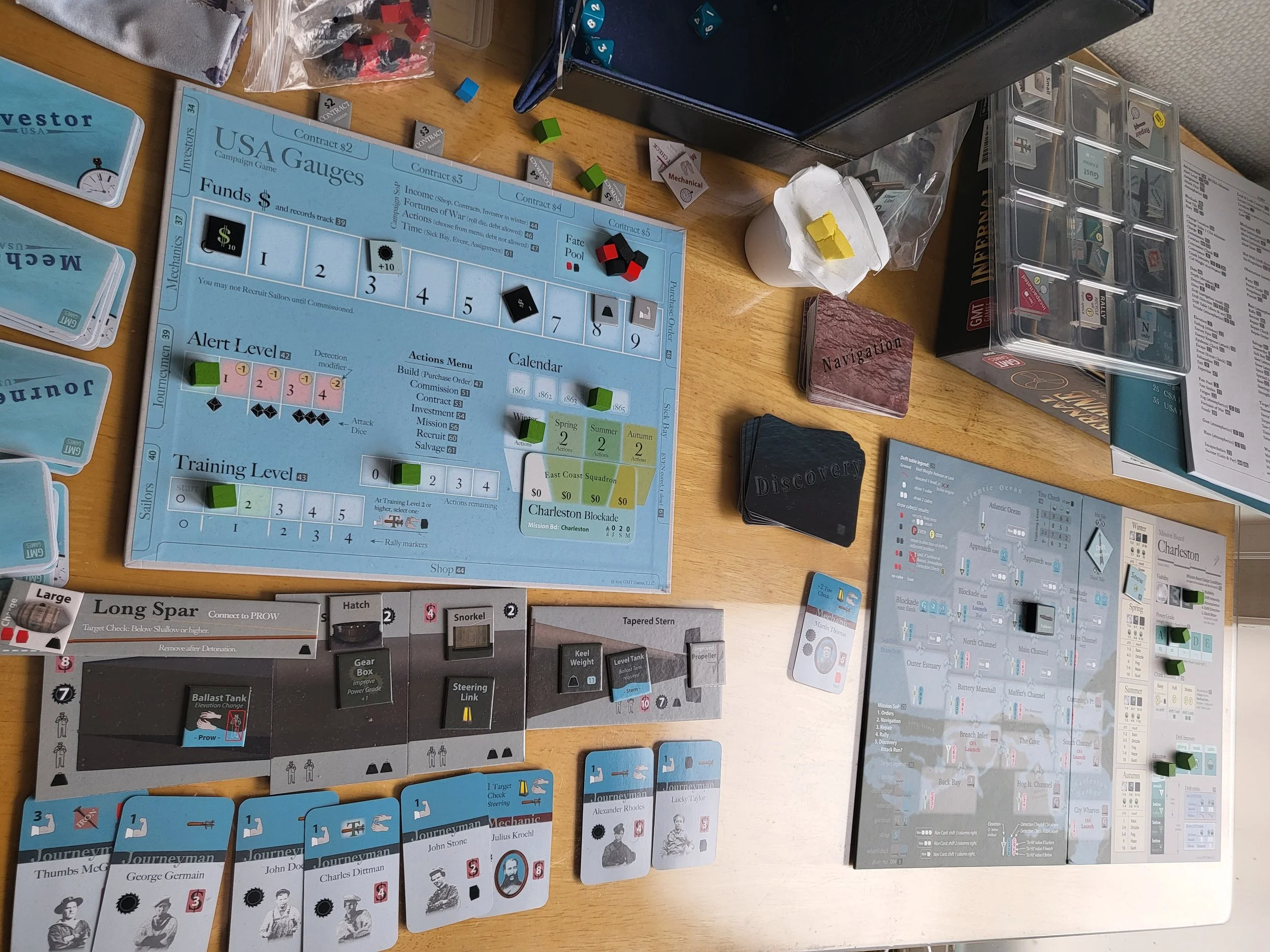
Once I finished my games of Guerilla Generation I could finally expand onto my full table, here I have the mission board and campaign set up at the same time.
Infernal Machine packs a lot of game into its heavy box, including an impressive level of asymmetry. There are separate campaign books for the CSA and USA sides, with unique events and random tables to roll on. On top of that, though, there is a lot of baked in asymmetry to the mechanics of the game, including systems that you will only use if you are playing one of the sides.
As the CSA, you are a businessman trying to manage funds while also putting people in an underwater death trap to set off explosions near enemy ships. You can acquire a letter of marque that will let you actually engage in combat missions, but you are separate from the CSA’s limited naval operations. You will need to think about how to make money throughout the game and you will need to contend with the ever-fluctuating Confederate economy. Events will cause changes to the current value of currency, and you will likely end up paying much, much more for your fish boat parts than the listed cost. You also have to contend with the ever-shrinking borders of the Confederacy, and you could find yourself forced to switch sides mid-campaign if your home port is captured before you can relocate.
Meanwhile, as the USA you start the game running a business but if you ever want to do anything more than a training mission you have to convince the US Navy to let you join. Once you’re in the navy, you can no longer buy new parts for your boat. Instead, you must requisition parts, putting in a request, rolling on a table, and then waiting for your parts to arrive. If you get to greedy, your request could be rejected and with a particularly bad result you could even be recalled to Washington so the Navy can keep a closer eye on you.
My favorite difference, though, is in how your bases operate. The rules are the same, but the way they are expressed in the game is very different. For the CSA you will launch missions out of your base, using the respective mission board. In Richmond? Use the Richmond board! For the USA, though, you aren’t going to be launching any fish boat missions out of Washington, DC or Boston, except those for training your crew and increasing your overall shop competence. Instead, if you have a working boat you will be assigned to a combat zone, usually a blockade outside of an enemy port. When in a blockade location, your options for what you can do are very limited. Basically, you need to launch a mission there and hopefully not sink. If things keep going well, then you can keep doing missions, but if they go badly, back to base to hopefully repair (or recover) your boat – if you have time to do so before the war ends.
I was impressed with the amount of history the designers managed to squeeze into the box, especially given how narrow the focus of what you’re doing is. The random tables you roll on at the start of each turn and the event that triggers at the end are both great ways of working in the occurrences of the wider war into your shop’s operations. What struck me the most, though, was the inclusion of quotes from various participants along the margins of campaign booklets. This is not a unique feature to Infernal Machine, but the choices here are particularly insightful. Quotes are included that make clear the centrality of slavery to the ACW, which might seem like an obvious choice, but I have noticed a distinct lack of willingness to engage with slavery in ACW games. It would have been very easy to ignore it in a game about submarines, but the choice by White and Ostermeyer to include it does a lot to anchor what you are doing within the context of the war and to remind you what is being fought over. The cyclopedia also includes an annotated bibliography, which is something that I also note is lacking from a lot of ACW games and I’m very happy to see it here.
In the end, I really enjoyed my time spent with Infernal Machine, but my misgivings about the campaign experience somewhat reduces my enthusiasm to keep pulling it off the shelf to play again and again. It was an incredibly interesting experience, and a game I would encourage fans of solitaire historical games to try, because I’ve never played anything quite like it. My time with Infernal Machine has also made me more interested in exploring other designs by Jerry White – I can see what all the hype has been about. The onboarding process was long, but incredibly smooth, and the choices in the design are really interesting. I am also very interested in seeing what both of these designers might do in the future. For example, I’d love a game about designing and building ACW ironclads, just saying.
(Hey, if you like what I do here, maybe consider making a donation on Ko-Fi or supporting me on Patreon so I can keep doing it.)