
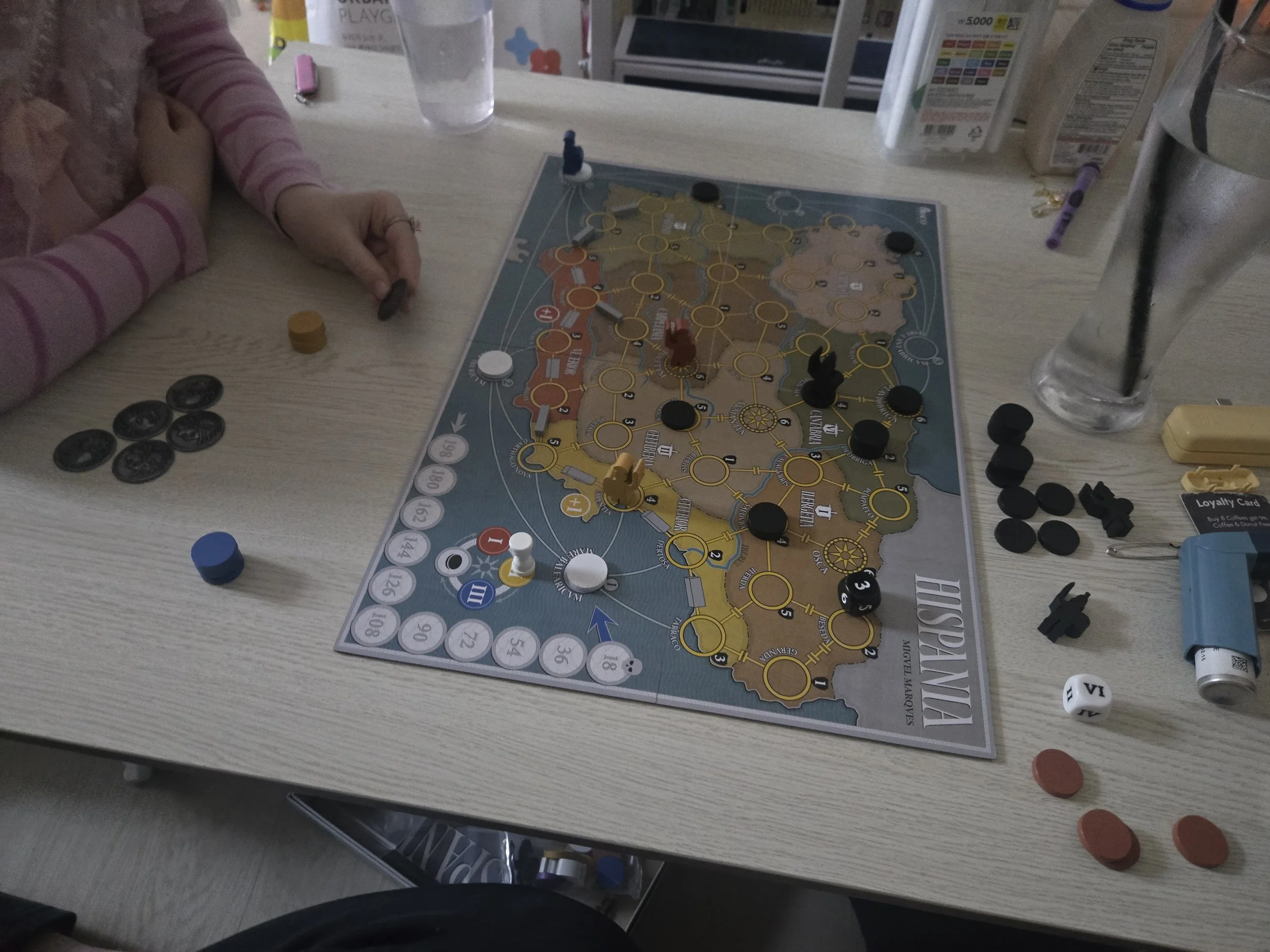
I can’t really play Pandemic anymore after, well, you know, the whole pandemic situation. It all feels a little too real these days, and my regular cooperative gaming companion feels even more strongly about this than I do. However, I do still like coop games and the Pandemic system hits a nice middle ground between complexity and casual fun, so I would love to replace it with something. Luckily for me, there are quite a few games now that are inspired by Pandemic but with themes that doesn’t hit quite so intensely post-2020. Even better, some of these have historical themes to appeal to big ol’ history nerds like me.
Hispania is a follow up to designer Miguel Marqués’ Tetrarchia, and uses many of the same ideas. That game has four players controlling the four Tetrarchs during a weird era in Roman history when there were basically four emperors at the same time. Collectively you are trying to keep the empire alive against the incursion of barbarians along its borders. This is late Roman Empire stuff when the collapse of the Western Roman Empire hasn’t quite happened yet, but it’s going to be soon. Some time ago I played this game on a stream on the Homo Ludens YouTube channel and really enjoyed it. It packed a lot of cooperative fun into a small box. Given my positive feelings towards Tetrarchia, I was naturally curious about it’s sequel, especially since several people whose taste I usually trust told me that they prefer it.
Hispania keeps the player within Roman history but moves centuries earlier to the late Republic (and, arguably, straying into the reign of Augustus). The players represent three Roman generals who are tasked with the conquest of Hispania (modern day Spain and Portugal). It adds a few new mechanics to the system, of course, but some of the most significant changes are knock on effects from the transition to being a game about conquest rather than one of survival against invaders.
The production is really nice, with lots of lovely wooden components. It also comes with totally unnecessary but still very enjoyable metal coins that you use to track your actions on a given turn.
As I mentioned already, both Hispania and Tetrarchia clearly owe a lot to Matt Leecock’s legendary Pandemic. In all these games you are moving pawns around a map and trying to keep the number of enemy pieces on the board under control. You win if you can ensure create a level of stability that prevents future threats to your survival.
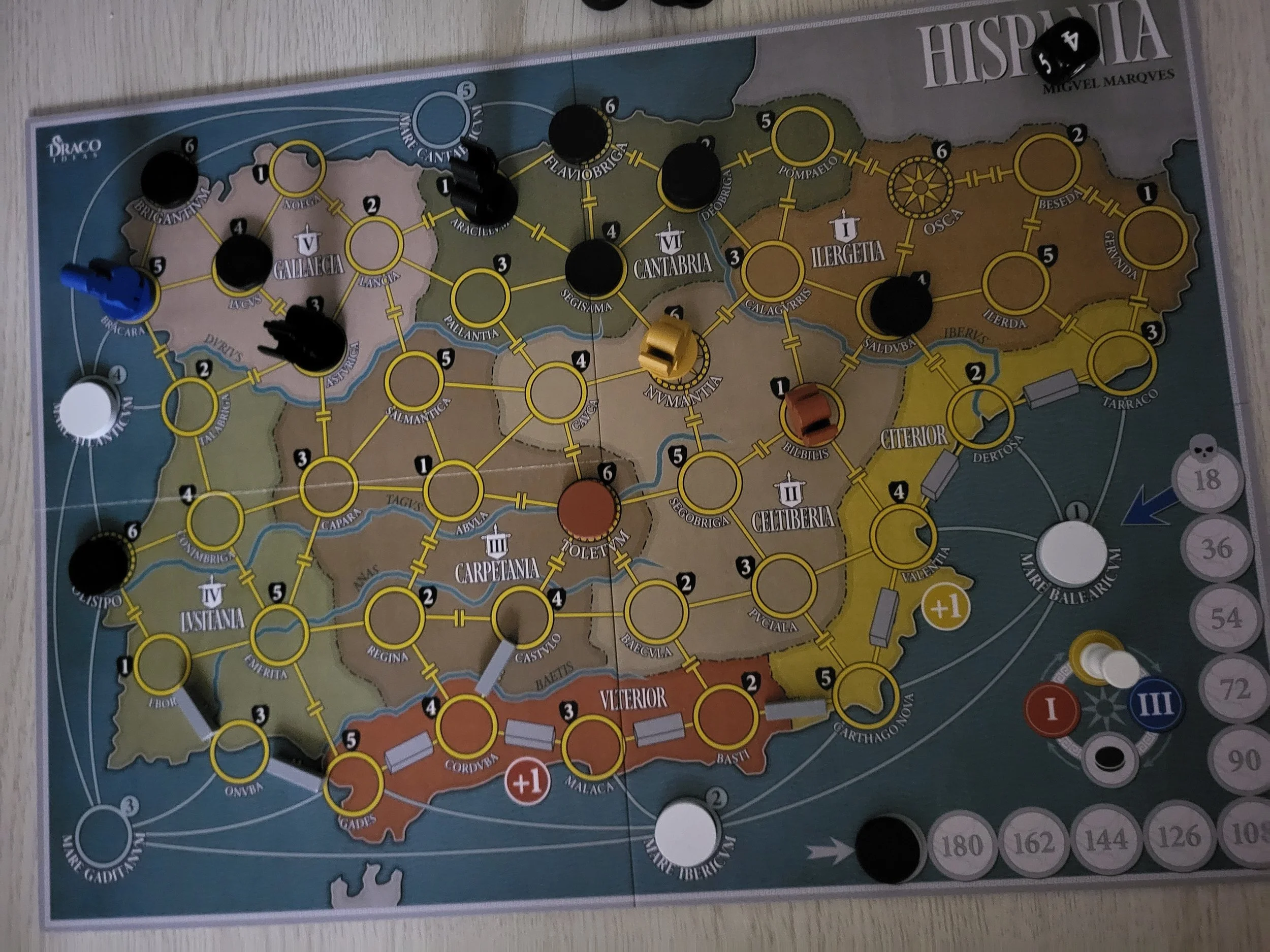
However, Tetrarchia and Hispania do a lot to mix up this classic formula. For one thing, there are no cards in these games. That means there’s no collecting cards to try and find a cure (or equivalent). Instead, victory is done by placing one of the player’s disks on key locations in the region – in Hispania you are trying to establish Roman rule in the capitals of each region of Iberia/Hispania. Similarly, there are no cards for tracking outbreaks, instead the arrival of barbarian rebels (the equivalent of Pandemic’s diseases) is determined randomly by a clever dice rolling system. You roll two dice together, one tells you the region and the other tells you which space in that region to place the rebel disk. There are also enemy generals that can pop up and march around the map, spreading unrest and engaging in battles with the players. Removing barbarian pieces also isn’t necessarily automatic, instead it is done by the roll of dice (with modifiers that can, if you’re doing well or expend enough resources, automatically ensure success).
The switch to dice rolling for outbreaks and removing enemy pieces is the biggest change from the classic Pandemic system. In Pandemic, a big part of the game is in learning where the outbreaks are happening each game as each epidemic returns the already revealed cards to the top of the deck. You must remember which locations are now back on the deck, and a lot of the strategy is in how players manage those locations. In Hispania, however, the arrival is always random because dice have no memory. This doesn’t mean that there is no strategy – you can place disks representing garrisons to block off certain locations for unrest and other elements can possibly limit where outbreaks can take place – but it does make it a lot more chaotic. While I appreciate Pandemic’s deck memory as a strategy, I do think it also contributes to that game’s quarterbacking problem, as the player who understands that element the best will often tell the other players what to do. In Hispania, because it’s so much more random, it is a little harder for one player to “know” what to do (but there’s no stopping some bossy players, of course).
The combat system is another interesting wrinkle, and probably where most of the game’s complexity exists. At a basic level, it’s a roll off on a d6, highest wins. However, you get bonuses to the roll based on how many disks you have in your space or connected to it and you can spend more of your precious actions in that turn to add +1 to the roll for each one. The other piece gets a bonus based on how many discs there are in that location or connected to it – so part of the game is identifying weaker areas and breaking up links of rebel pieces so you can isolate and destroy them. If another player’s piece is adjacent to the enemy you are attacking, you double your result (which is great for you), but enemy generals can do the same thing to you (which is decidedly not great for you).
In general, combat isn’t too difficult to work out, and because the game is so simple in other ways it doesn’t feel burdensome, but it adds more randomness and uncertainty to the game than you have in classic Pandemic. I prefer this because it helps keep each game exciting and makes it more about managing your risk rather than remembering what cards have come up. I’m a lot better at understanding the odds of certain results on dice than I am at remembering what the 6th card that came up after the last epidemic was, so this also plays more to my personal strengths. I also prefer it when historical games include a healthy dose of randomness. People living through these events couldn’t know if their plans would work or not, and I think randomness helps to better capture the uncertainty of their situation.
Ideally, you’d be dropping your disks everywhere, putting down Roman garrisons to stop uprisings and boosting your attacks. However, you only have a limited pool, and if you want to pick them back up from the map you must slowly move your piece back to that location and spend an action picking the disc back up. This can be painful, as the action economy is quite tight and unless you’re on Roman roads your general moves pretty slowly. You also need to be able to place a disk on the key capital cities to actually win the game, so if you place them all too early you won’t be able to win the game. Managing your and your allies discs hits me in just the right spot, its incredibly frustrating in the right way.
However, if it proves too difficult (or too easy), Hispania includes many ways to tweak its difficulty. Play with fewer or more of: actions on each turn, discs, enemy generals, roads, boats, etc. There are hundreds of variations, and while I probably wouldn’t explore each and every one of them, I really appreciate this modular approach to the difficulty. You can identify what aspects of the game are most fun when they’re harder and dial in on that while leaving other things simpler if you prefer. It also comes with scenarios meant to represent various campaigns in the history of the Roman conquest of Iberia, which gives further material to explore if that’s your cup of tea. For me, I’m pretty happy just tweaking the difficulty in the default scenario, but I appreciate that this option is there. There are also several small expansion modules, but dice on the table I haven’t really explored them.
Most of what I mentioned so far is shared between both Tetrarchia and Hispania, but the latter does include some significant additions. Chief among them, to me at least, are the presence of roads and the home provinces for Rome.
Several Roman road pieces are placed during set up, the number based on the chosen difficulty, to expand on the existing road network within the Roman provinces (more on those later). These roads let the Roman players move from one end to the other with a single action – rather than having to spend for each space moved. This helps to facilitate the Roman players’ movement between key locations, and clever placement of them at the start of the game can make a big difference in the game. That said, it isn’t a huge change to the game – it’s not as big a change as, say, Pandemic: Iberia’s addition of railroads to the classic game of Pandemic.
Where Tetrarchia is a game of trying to keep the Roman Empire alive, in Hispania the players are expanding Roman control into new territories. There are parts of the map that are already Roman, though, thanks to victory in the Second Punic War. These areas are generally immune to unrest (although enemy generals can walk in and mess them up if you’re doing very badly). They also give a bonus to attacks to each of two player pieces (helpfully colour coded) if they can trace a connection of their garrisons back to their friendly province. This makes it easier to fight near your home province and harder as you travel deeper into Iberia, which makes sense and helps give the game some of its historic character. One of the players instead starts on a boat and does not have a home province to get that helpful bonus, which makes sense in the game’s representation of history but is kind of a bummer if you’re the player who doesn’t have a home province.
While I admire what Hispania brings to the core system of Tetrarchia, I might prefer the latter and I think this comes down mostly to the topic. The Roman Empire wasn’t exactly a force for good, but we often overlook that because so much of modern western culture wants to draw on the legacy of Rome for their own founding myths. The founders of my birth country, the USA, were obsessed with ancient Rome and Greece and their obsession was passed down to me, as I often learned about ancient Rome through the lens of what slave owners living over two hundred years before my birth thought about it.
This gives me complicated feelings about Rome and their imperial ambitions. While I can’t say that Tetrarchia is devoid of these challenges (maybe it is better if Rome does fall?), there is still a significant difference for me between a declining Roman Empire trying to hold on to control for a little longer and a story of conquest of other cultures by a Roman Republic/Empire during an era of its greatest expansion. The games themselves also aren’t all that different, so I don’t feel like I’m missing out all that much if I play the older game with the topic I find a bit more appealing.
While Hispania may not be my preferred flavour, on the whole these are an excellent pair of cooperative historical games that try to take their historical topic seriously while also being approachable and fun (something we don’t have nearly enough of, if you ask me). Fans of historical games and/or fans of cooperative games should try one of Hispania or Tetrarchia. They are small boxes and relatively affordable (for board games), and if you like the Pandemic-style system these are an excellent twist on them. I don’t think you need both, I certainly don’t, but one of them absolutely has a spot on my shelf.
(Hey, if you like what I do here, maybe consider making a donation on Ko-Fi or supporting me on Patreon so I can keep doing it.)