
I’m not sure if it is possible to accurately recreate the Battle of Chancellorsville in a board wargame. All historical wargames must struggle with the fact that we know what happened, and the historical actors did not. This greater knowledge on the part of the players makes certain historical outcomes harder to replicate. Specifically to Chancellorsville, it is very hard to recreate Jackson’s famous (and overrated) flanking march and attack because that relied on Hooker and the Army of the Potomac not knowing that would happen (although they did suspect he was flanking them and Howard ignored orders to turn his flank, but you get the idea).
Chancellorsville of course has this problem, but it also has more challenges for any aspiring designers. Board wargames, especially battle games, are often designed to be played by two players but of course historically a large battle has dozens of officers and thousands of men. This could create conflicting plans, especially when communication broke down, in addition to the different goals that individual officers might have – Hooker might want him to attack but Sedgewick doesn’t want to risk the lives of his men if he can avoid it. In many cases this can be passed over in the interest of making an interesting game, but in the case of Chancellorsville breakdowns in communication and limited information (double blind play being another thing games struggle to make fun) are an important part of how the battle unfolded.
A game on Chancellorsville can generally do some of these, and they often prioritize trying to replicate Jackson’s flank march, but doing all of them in one game that is also still playable and fun seems to be too much to ask. I don’t know if it can be done.
However, Chancellorsville is an interesting battle (see my previous change of opinion when discussing Sears’ book on the battle) and I’m always interested in seeing how designers tackle the challenges of making a game of the mess that was Chancellorsville.
Sergio Schiavi’s Give Us Victories has been on my radar for a long time. It’s a gorgeous looking grand tactical game, which I think is a great scale for Chancellorsville, and it is designed by an Italian designer. It’s not strictly that Schiavi is Italian that’s gets me so excited, but rather that he’s not American. I was excited to see how someone separated from the mythology of Chancellorsville would approach the battle. It took me far too long to finally get to it, but having played Give Us Victories I’m pleased to report that while not perfect it is one of the most interesting Civil War games I’ve played in a long time.
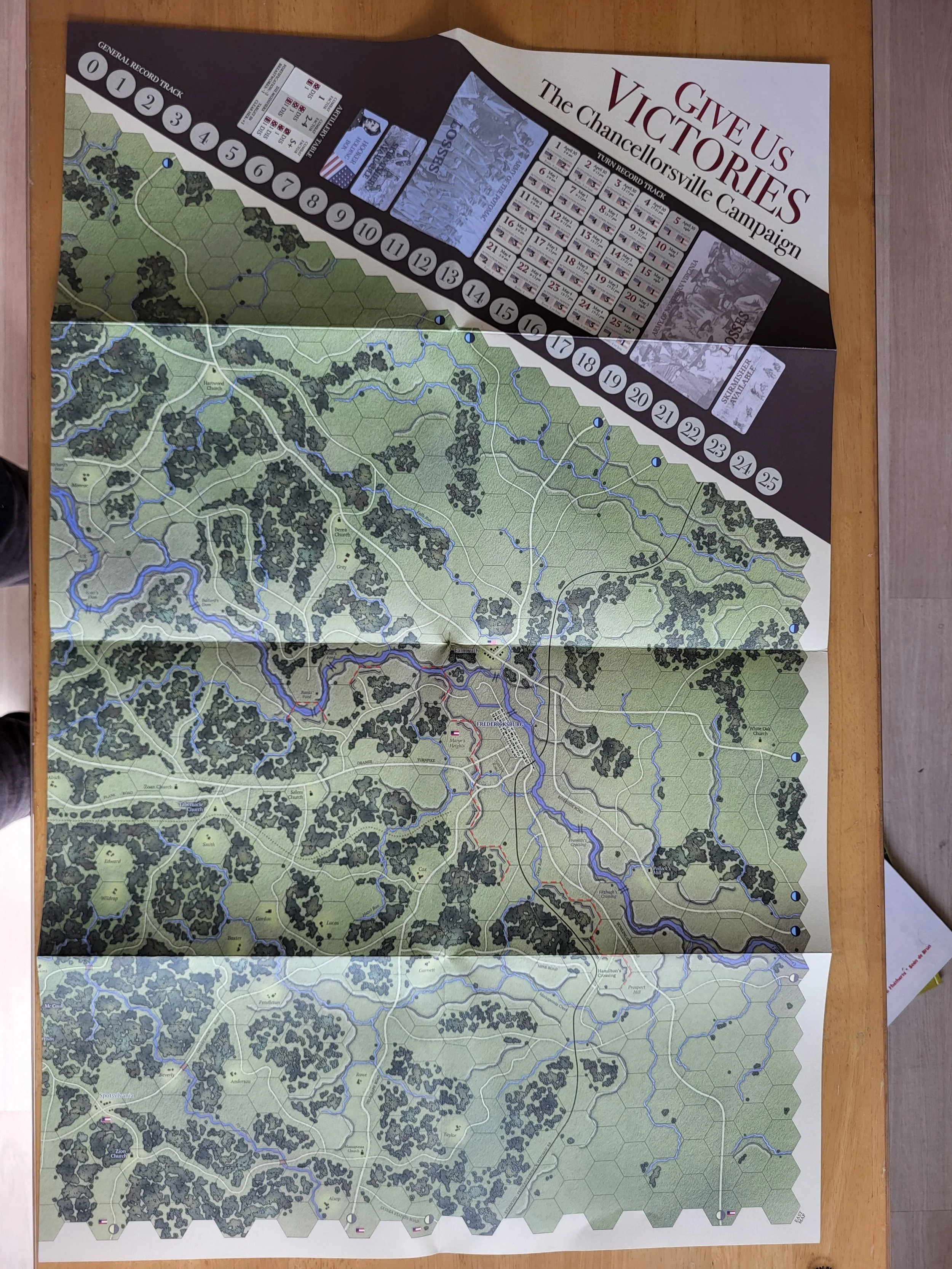
One half of the grand tactical map for Give Us Victories and I think it’s gorgeous
Dissimula Edizioni kindly provided me with a free review copy of Give Us Victories, and I have taken an embarrassingly long time to review it.
Give Us Victories is actually several games in one package, and we’ll talk about the other games, but the main attraction here is the grand tactical hex and counter game. This is at the division scale and uses an interesting variant on chit pull to activate units at the Corps level (usually).
The system is very simple, with a little over a dozen pages of rules total. You move your units across a gorgeous hex map, also made by Schiavi, which is covered in woods. The terrain and movement rules are very simple, if you’ve played any hex and counter game this will be instantly familiar and, if not, you’ll pick it up pretty quickly. In many ways, Give Us Victories is a classic hex and counter system, but it adds a lot of little twists and turns to those mechanics, and some of those changes are inspired, if you ask me. So, let’s dig into these variations and discuss what I love about Give Us Victories and the one area I think could be improved.
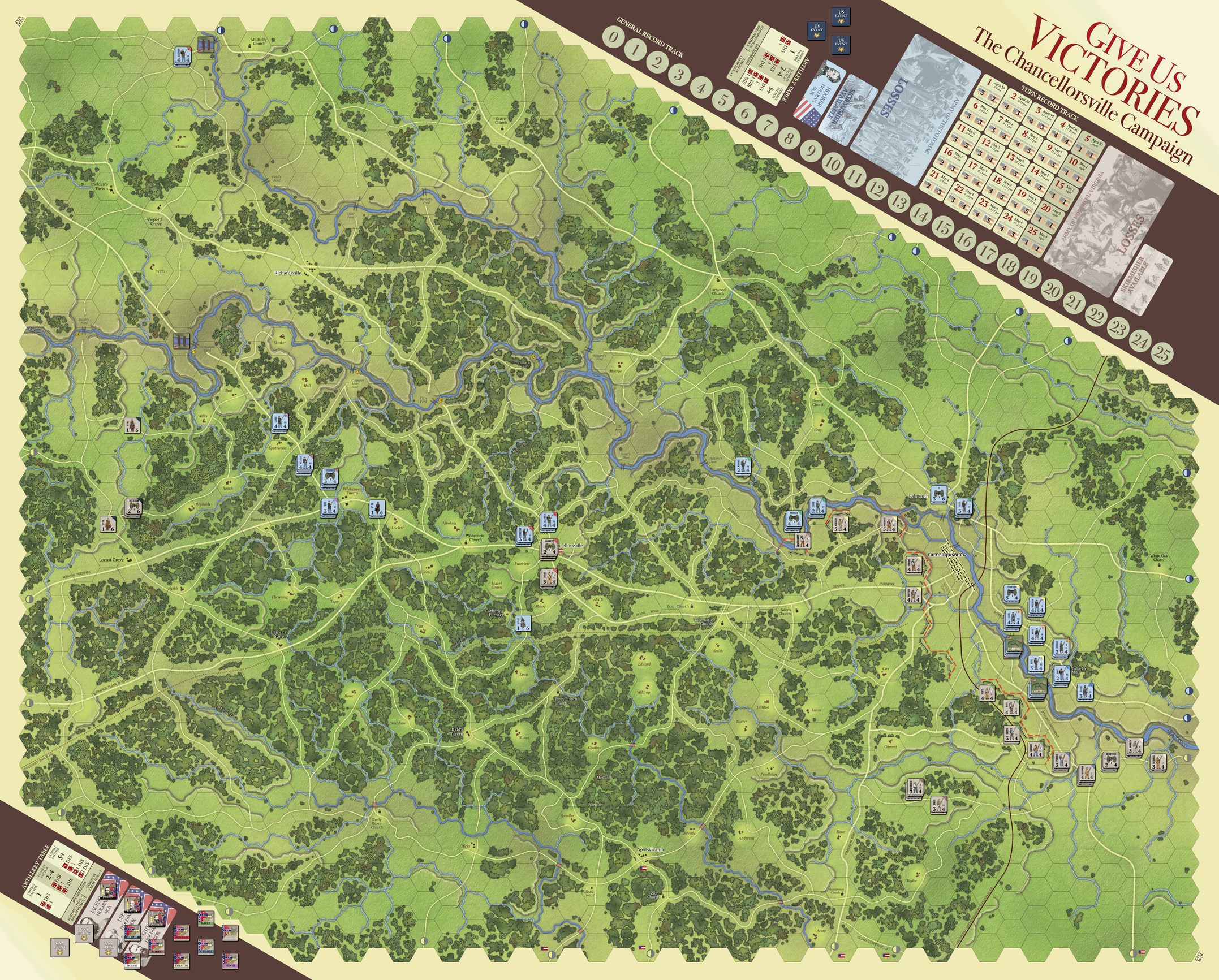
Our initial movements at the opening of the battle. We ended up being too aggressive (well, my opponent did mostly) and started fighting right away. Since casualties are also VPs, this led to an early ending for the battle.
I am generally a fan of chit pull systems – I like the chaos they introduce into games, and they often make for an interesting solitaire experience – and Give Us Victories may be my favorite chit pull system to date. The wrinkle here is incredibly simple: you don’t put all the chits in the cup. Each turn each side has a number of activation points and for each point they can put one of their chits, which activates a corps (usually a handful of counters on the map), into the cup. You also get one free Independent activation chit that will let you activate a few additional units. The number of available points increases over the course of the day, meaning you have fewer in the morning and the most in the late afternoon before being reduced back down to one each for the night turn. This gives each day of the battle a natural ramping up feeling as the troops wake up and prepare for another potentially bloody day of fighting.
This on its own wouldn’t be enough to make Give Us Victories as exciting as it is, but it has further twists to offer. First of all, when you pull a chit you don’t just activate that corps. Instead you have to put the chit on the map, and each leader has a range in hexes listed on it. You can only activate units from that corps that are within the leader’s command range, which can be blocked by enemy units. This is such a clever and simple system to encourage you to keep units from one corps together. You are also allowed one detachment marker that will let you add one unit from another corps to a given activation, which can add some flexibility, but you can only do this once a turn and a unit can only activate once, so you only have that one get out of mistakes free card.
But maybe you want to coordinate a grand assault, what then? That’s where your commanding generals come in. Instead of putting corps activation counters in the cup, you can instead secretly assign them to a general (Hooker or Lee or Jackson, for example) and put that general in the cup. When they come out all of the officers assigned to them will activate as one single corps, which will allow them to move and fight together. This lets you do big sweeping moves, but at the cost of flexibility because you’ll only get to activate them at that one time. If they come out of the cup first, you may have no capacity to respond to your opponent’s activations because you lumped them all into this one go. You can also only use these generals once every other turn, which is where the Confederacy having multiple generals gives them greater flexibility.
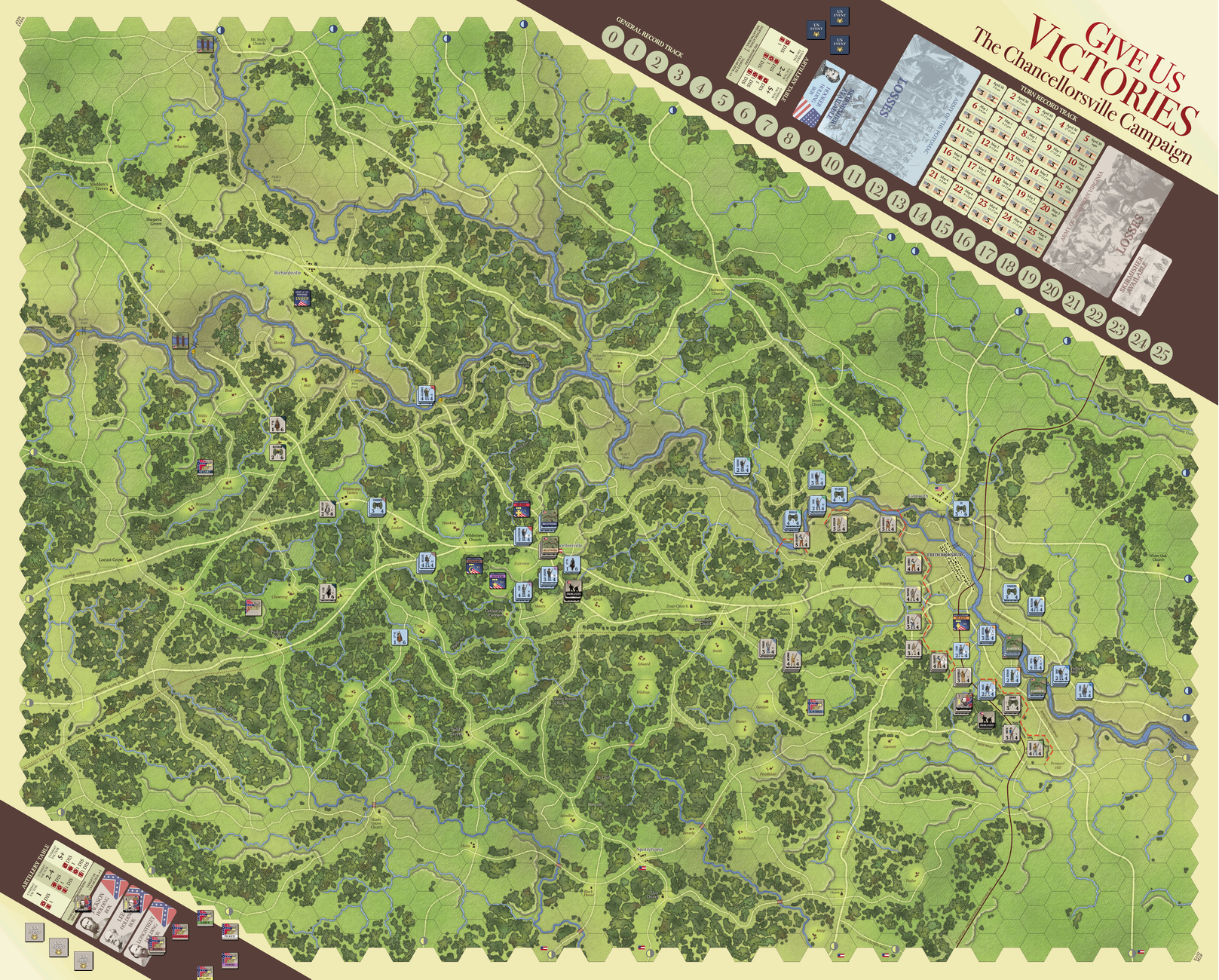
Reached the end of the first day, and things are tense around Chancellorsville itself. You can see the lingering placement of the Leaders here.
What this system does is take chit pull and turn it into interesting decisions. You make your plan at the start of the turn when you pick your chits, and then during the turn you have to decide what to do with them as they come out in a random order. It also smoothly integrates a command-and-control system that makes you carefully think about how you distribute your forces. It makes an interesting game out of something that is often just an administrative task in other games, and I love it. I don’t think every game should adopt this system, but I absolutely think more designers should take note of it. It’s great.
What to do with cavalry in American Civil War battles is one of the trickier questions in this design space. Cavalry were used at times to attack infantry formations, maybe most (in)famously by ol’ Kilpatrick (known as Kilcavalry to his men) at Gettysburg, but it basically never worked. Cavalry would also fight against other cavalry, like at East Cavalry Field at Gettysburg, but again with very little impact on the wider battle. There are some important actions done by cavalry, like Buford at (say it with me) Gettysburg exchanging fire with the Confederates and kind of starting the battle. The main role of cavalry was outside of battles, in the operational phase of the campaign, but they are present in battles so designers need to figure out what to do with them. I bring this up because I think Give Us Victories handles cavalry the best of any ACW battle game I’ve played yet.
The key to this is that Give Us Victories includes fairly basic supply rules. At the end of each day of the battle, you have to check your units’ supply by tracing back to the main roads and on to supply sources – including across the rivers for the Union. Cavalry represent one of the best ways to block off supply lines by placing their Zones of Control, and are incredibly annoying to get rid of because they can easily withdraw from approaching units and just be jerks in general. They exist as an irritating, harrying force, rarely worth using to attack directly (their strength is very low) unless that unit is already weakened and isolated, but they can drag units out of formation to try and clear supply lines.
The inclusion of a basic supply system also solves a lot of problems I have with ACW games, and the sometimes-ahistorical outcomes you get in unit position (or the special rules that are required to keep these results from happening). Now, some people might not like supply rules in a battle scale, but I would argue that supply in Give Us Victories doesn’t represent literal supplies coming to troops but rather a sense of security that the troops feel. Falling out of supply does not cause a reduction in combat strength or step losses, instead it causes units to become disorganized or demoralized, and prevents them from recovering from those statuses. So it makes more sense as soldiers who feel insecure without an anchor connecting back to friendly lines, and it really makes you think about your troops’ positions. These guys aren’t paratroopers, trained to be surrounded by enemy units on all sides, and you need to think about that when you maintain your lines because if you get cut off you will lose your ability to launch attacks. It all ties in so wonderfully with the positioning and flanking attack challenges that are a big part of Chancellorsville.
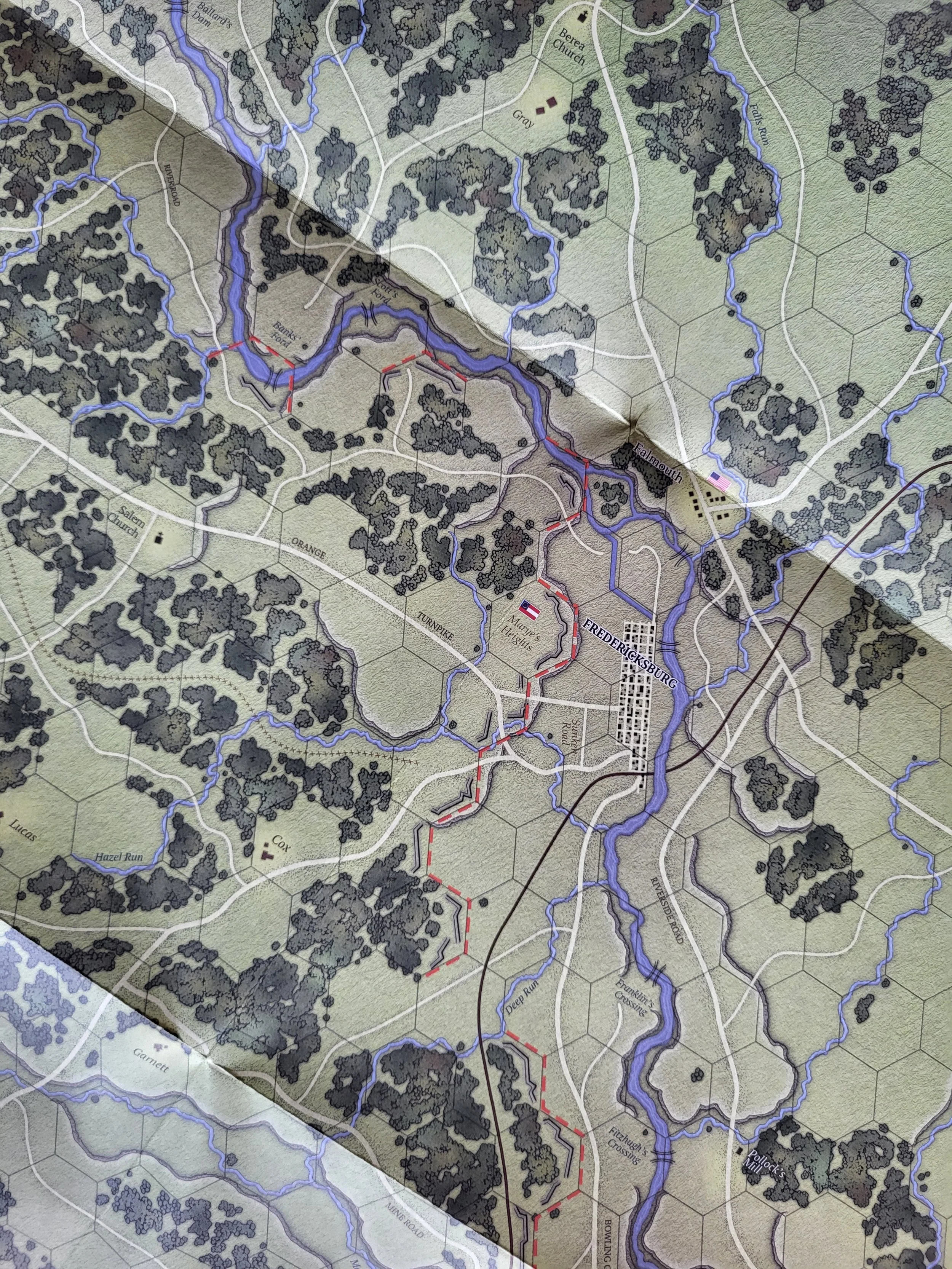
The positioning and movement side of the game is also enhanced by Sergio Schiavi’s gorgeous map. I’m a big fan of his maps in general, he did a great one for El Gran Capitan, an Italian Wars game that has so far defeated me with its complexity but that I swear I will play one day! The map is beautiful and includes lots of interesting little roads for units to move along. I love its slightly skewed layout, where Schiavi doesn’t feel the need to fit hexes into the whole map but instead we get a slash of land diagonally across the two sheets. It’s beautiful and a joy to play on. ACW games are maybe the most competitive space for gorgeous maps in the wargaming hobby, but in this competitive field I think Give Us Victories is among the best.
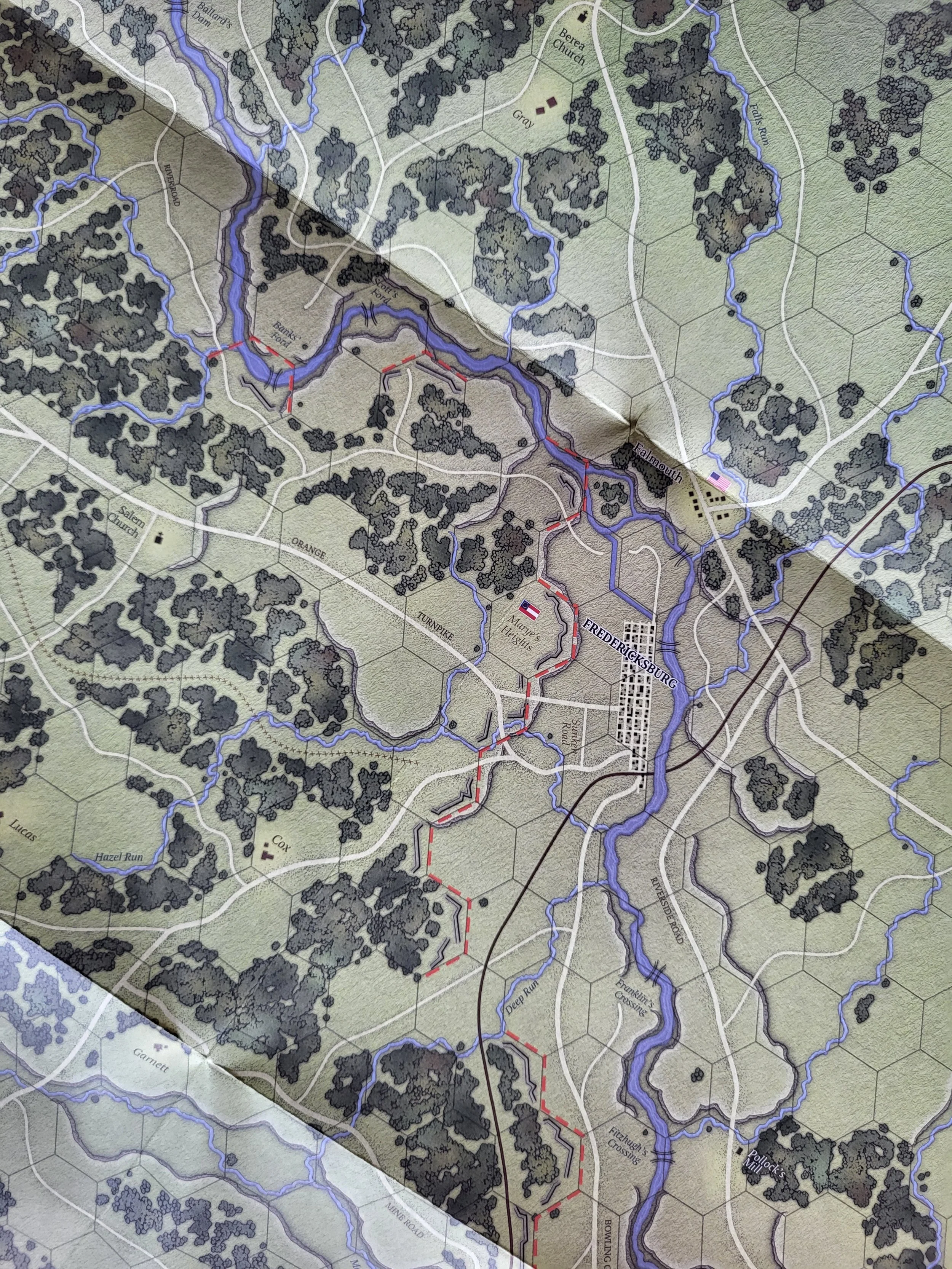
A zoom in on Fredericksburg. This is a part of the USA I know very well and I think it is lovingly portrayed here. A great map that is easy to read and play on as well.
I am not without complaints about Give Us Victories, though, and my main issue has to do with its combat. I don’t hate the outcomes of combat, which are largely step losses which arrive at a reasonable pace, but I think it’s a little too fiddly. The system is basically a dice pool where you are trying to roll 5s and 6s on d6s. Dice are determined by force ratio, so in a 3/1 combat one side rolls three and the other one, plus one for both sides in all combats to yield a total of 4d6 vs 2d6 (assuming no other special modifiers). Dice can be given a bonus modifier (+1 or +2, for example) if there are units with veteran status, shown on the counters, present in the fight but you must declare which dice will receive the bonuses before you roll them. Now, I love d6-pool combat – I’m a huge fan of the Columbia block system for example – but I think Give Us Victories doesn’t take the best advantage of this kind of combat. One of the biggest perks of dice pool combat is that it’s easy to resolve. You sacrifice some granularity and simulation in exchange for something that is easy and quick to resolve (and, in my opinion, lots of fun).
However, I think Give Us Victories is a little too fiddly to capitalize on this gained simplicity. I like the idea of adding modifiers to the dice before you roll them, but it means you can’t just pick up a fistful of dice and roll them all at once. At the same time, combat ratios are annoying to calculate, and the modifiers that grant extra dice are another thing you have to track track. It’s not overwhelming, this isn’t a complicated game, but it had me wishing it just used a simple combat results table (CRT).
I don’t love the use of combat ratios at the best of time, and I think in this case it actually undermines the game in an important way. It makes a fight between two huge forces basically identical in terms of loss of life to a small skirmish between cavalry. It’s not broken combat, and there are combat systems I have liked less over the course of my exploration of Civil War games, but it feels like it needed a few more passes through development. If Give Us Victories has a second printing (and I think it should!) I would love to see the combat go through another round of development because I think it could be a lot cleaner, easier to resolve, and more fun.
Combat has some amazing features in it, though, and best among them I think is how Give Us Victories handles entrenchment. Many an ACW game I’ve played has rules for beginning digging trenches, then waiting for them to be completed, and then you get this combat modifier once it’s done. These are fine, but they’re not very interesting. Give Us Victories lets you engage in quantum entrenchment and declare at the start of combat if your units are entrenched or not. So why not always be entrenched? Well, if you move out of trenches while adjacent to enemy units, all of your units become disorganized (or demoralized if already disorganized). So, entrenching can lock your units in place in a game that is about maneuvering, and you can only freely move away again when the night turn comes.
Being entrenched also gives the defender a choice in combat, something that is missing in a lot of wargames. The defender chooses either to automatically inflict a step loss on the enemy or reduce their attack dice pool by one d6. I love the idea of this – more games need to give defenders something to do during combat – but I do think it could have used some refinement because I think picking step loss is almost always better than reducing the enemy attack by one die, especially in big combats. That is just an issue of numbers, though, and I think having a choice between increasing the chance of inflicting damage on the enemy vs. possibly saving yourself from being damaged is excellent.
I don’t want to make it seem like this game is complicated, though. Give Us Victories is an excellent mid-weight game, simpler than something like Blind Swords but a little heavier than Worthington’s Civil War Brigade Battles series. This is a really sweet spot for me, especially for a game trying to do a full battle of the size of Chancellorsville. While not exactly a short game, you could definitely play Give Us Victories in a long afternoon. As I was playing on Vassal it took maybe 90 minutes to resolve a day of the battle. For five days of fighting, that would be about six hours, but we were also playing in chunks and online which is much slower. I think you could play this in about four to five hours without stressing yourself, and that’s a nice space for a big game like this.
I would be remiss if I did not mention the other games that come packaged with Give Us Victories. So far I have talked about the main attraction – the grand tactical battle game – but it also includes a more operational/strategic take on the battle as well as paper figures and rules to play a man-to-man miniatures skirmish game. At time of writing, I have only dabbled with these rules, but I love how it includes extra games with different perspectives on the battle. You can zoom out to the operational or all the way down to a skirmish between units in the woods.
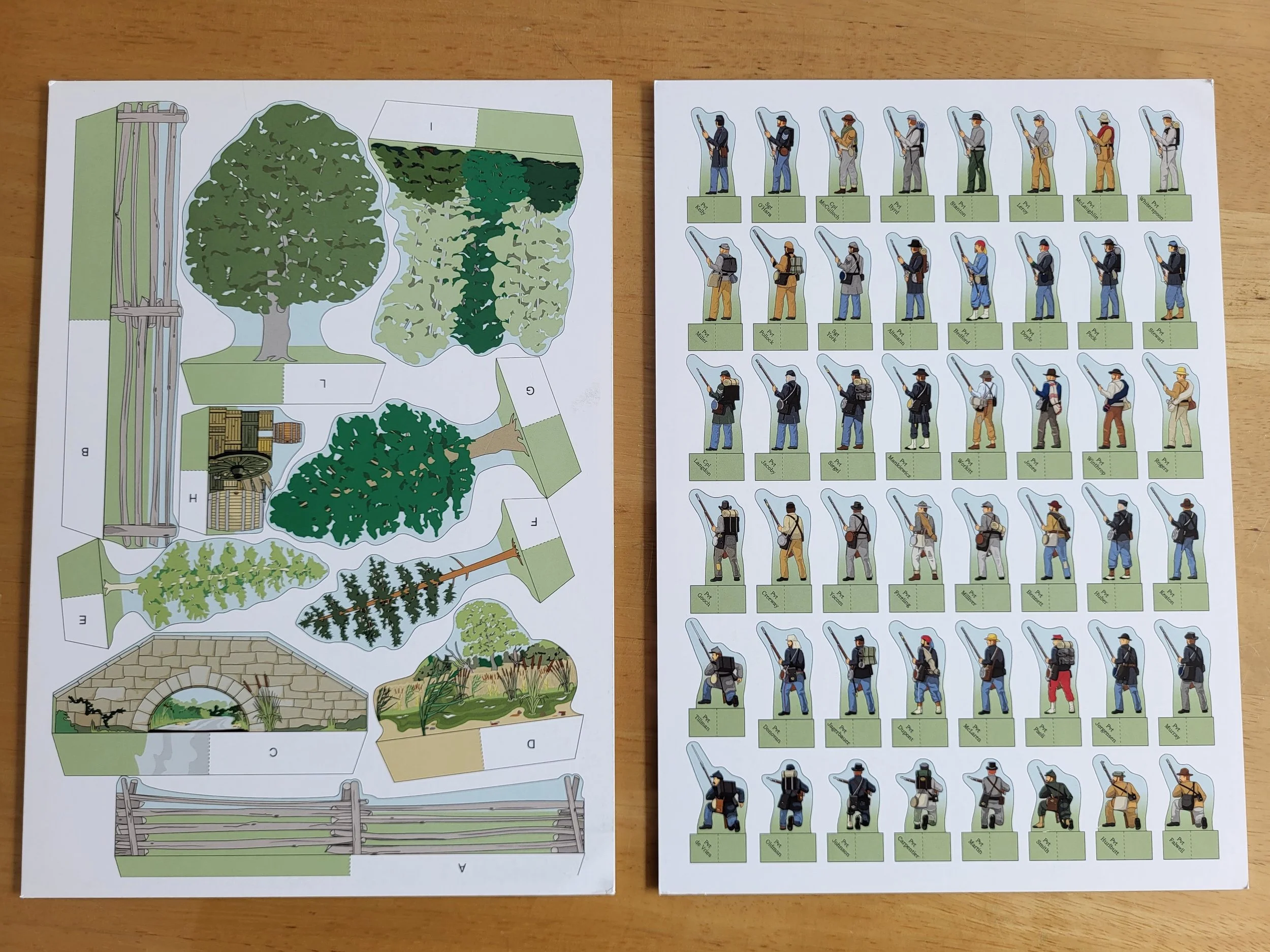
Look at these little guys! I love this! At some point I’m going to cut them out and play this game with my daughter.
It also includes a very sophisticated looking bot to control Hooker and the Army of the Potomac for solitaire play. Hex and counter solo bots are pretty rare, especially in battles where the enemy has to move and attack (as opposed to, say, defending the beaches at Normandy against the Allied landings). Again, I wish I could say I’ve explored this more but my little gaming table cannot hold both maps and I’m generally reluctant to play solo on Vassal (my solo gaming is a break from screens, not a further indulgence). It’s an impressive package, though, and I won’t turn my nose up at these bonuses!
Give Us Victories has reinvigorated my love of bespoke games – those designed for just one battle or campaign. I’m a big fan of systems, I love to see how a system’s rules are adapted to a new historical event and I enjoy the benefit of having learned most of the rules already when I pick up a new game, but sometimes what you really need is someone to have tried to tackle a historical topic on its own, without thinking about how their rules could be expanded to cover other, similar events. Give Us Victories is a game about Chancellorsville, not a game about ACW battles that happens to cover Chancellorsville, and I think it’s better for it.
If it’s not clear yet, I really enjoyed Give Us Victories. This is a great game that a lot of people have overlooked because it’s from a small European publisher. It’s an excellent entry into the already overflowing canon of ACW games, and one that stands out amidst such a packed crowd. While I can see similarities between Give Us Victories and other ACW games I have played, I can confidently say I’ve never played anything quite like it and I would be delighted to play it some more. Definitely one of my highlights of the past year.
(Hey, if you like what I do here, maybe consider making a donation on Ko-Fi or supporting me on Patreon so I can keep doing it.)