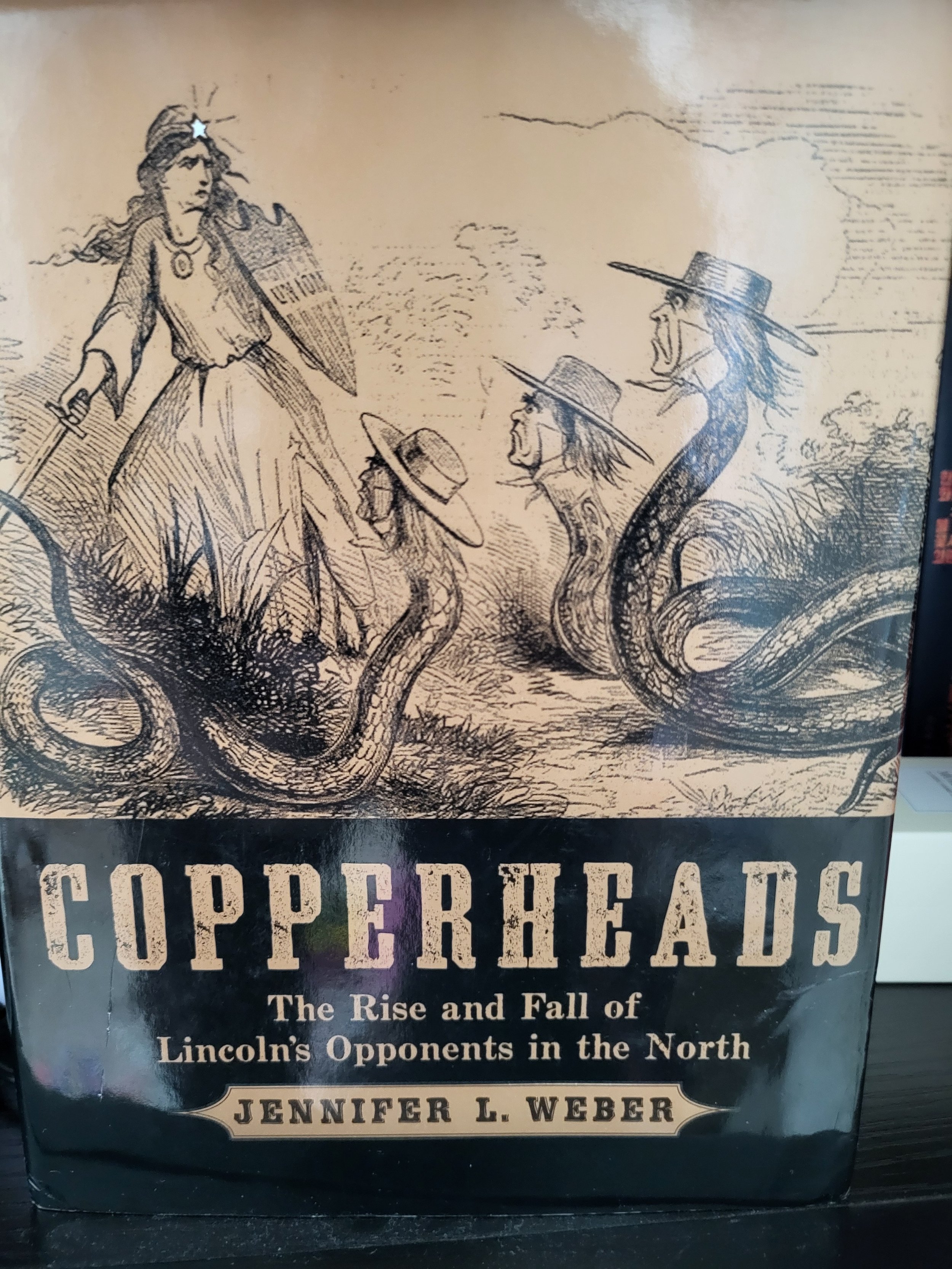
Understandably, most histories of the American Civil War focus on the conflict between the United States and the self-proclaimed Confederacy, and the military engagements that came out of that. While a good history will spend some time on the internal conflicts both sides suffered, and the important role that a willingness to pursue the war from the Northern States played in determining the war’s outcome, the full depth of that political conflict is often neglected. This isn’t for any nefarious purpose, though. Ultimately, the peace party within the north, known at the time as “copperheads” after the venomous snake, was unsuccessful and so most historians have judged their influence to have been no more than a novelty and with so much else to cover they summarize the copperhead issue in a few pages and move on.
Jennifer L. Weber disagrees with this approach, or at least suggests that there is more to the copperheads than most historians have thought. In her book on the copperhead movement, she compellingly argues that they wielded a far greater influence than they are often credited with. In particular, she points to the Democratic Party Convention of 1864, where the party’s political platform was successfully hijacked by the copperhead movement even as a non-copperhead (McClellan) was nominated as the party’s candidate for president.
With this end point in mind, she traces the power and influence of the copperhead movement from 1861 through the war’s conclusion. Pointing out how while they never achieved a majority status, they still had significant political power and it is impossible to understand the elections held during the war without some knowledge of the peace movement, as they called themselves.
Weber is a good writer, and Copperheads is an engaging read. While probably not so interesting that it will attract readers with no interest in the Civil War as a subject, for those who have only studied the war’s military side I think it offers a much greater understanding of the key political factors that underpinned much of the war effort. It is structured mostly chronologically and covers many key moments in the political history of the war, so there is no need to already be an expert on American Civil War history before you read it. That said, I probably wouldn’t recommend Copperheads as someone’s first history of the topic (I think that spot still goes to James McPherson’s Battle Cry of Freedom), but it certainly could make for an interesting second book.
I don’t have a lot more to say than that. It does what it says on the tin, this is a book about the copperheads and their fight both with Lincoln and with other members of the northern half of the Democratic Party, and it nails it. I really enjoyed it and found it very informative, highly recommended.
(Hey, if you like what I do here, maybe consider making a donation on Ko-Fi or supporting me on Patreon so I can keep doing it.)