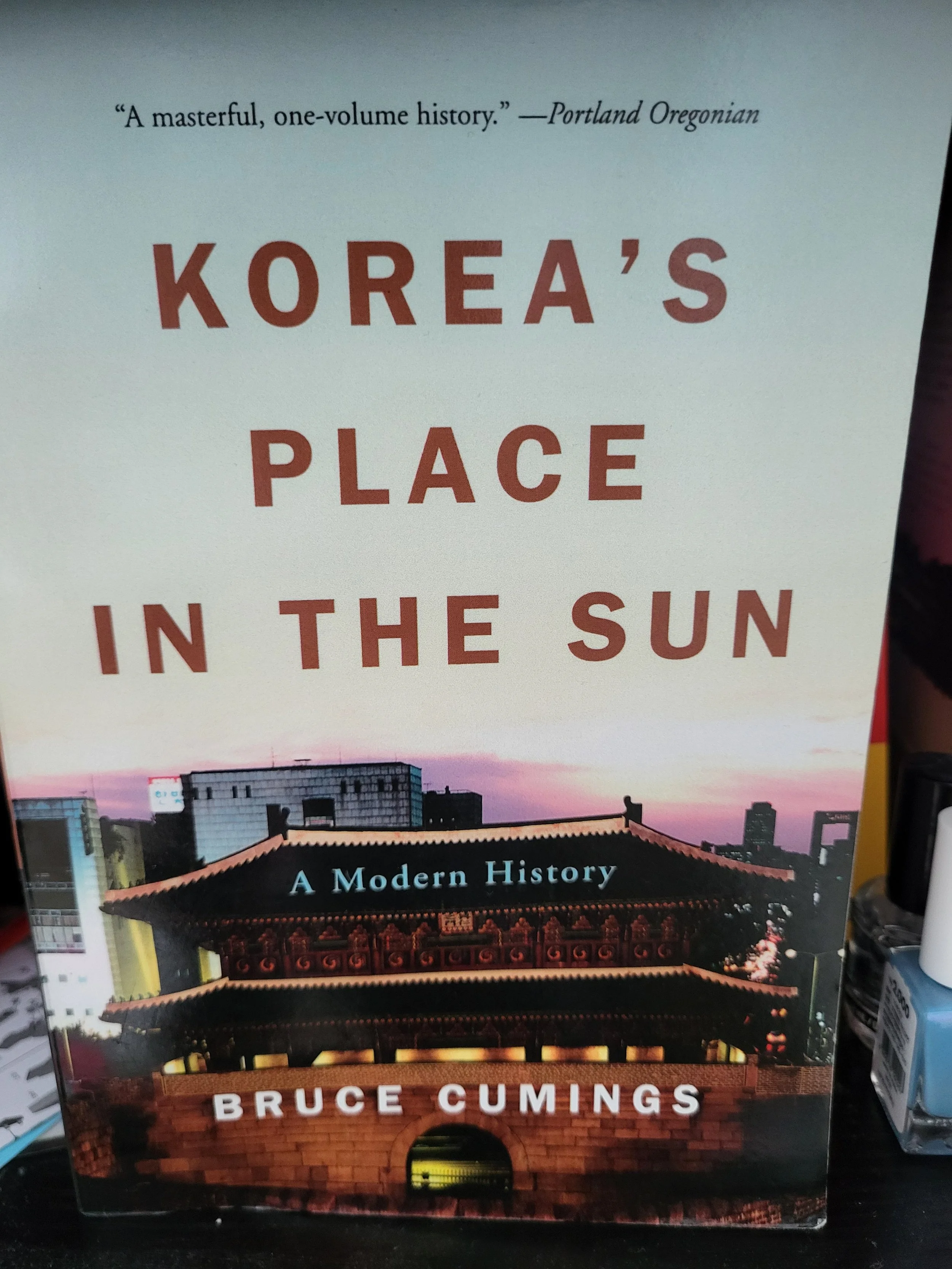
I was really impressed with Bruce Cumings’ history of the Korean War, and I was looking for a good general history of Korea, so it didn’t take much of a recommendation to push me towards grabbing a copy of Korea’s Place in the Sun. This is a history of modern Korea, primarily focused on 1850-2000, but it includes a decent overview of Korea’s earlier history in its opening chapter. This is because Cumings wants to emphasize how long Korea has existed as a single nation, because it is essential to understanding the impact of first Japanese colonization and then the division between north and south on the Korean psyche and modern history. Overall, I was really impressed with Korea’s Place in the Sun, it is an engaging if dense history of a fascinating country that does its best to take some very complex topics and make them easier to understand.
I imagine to some Cumings is a bit of a radical in his historical takes. This does not surprise me – his history of the Korean War devoted more time to war crimes and abuses than it did to heroic last stands and small unit American tactics. That choice is part of why I liked that book so much, and I really appreciated his willingness to question established narratives and remind us of the dark side of history. As someone who is generally inclined towards skepticism, and being generally a bit annoying when constructing historical narratives, I enjoy it when other historians pick away at established ideas.
The opening chapter explaining the early history of Korea is one of the best summaries I have read of early Korean history. I think it manages to do more in less than Eugene Park’s book, which tried to be a history of all of Korea but never quite dug in as deep as I wanted. I feel like I have a much better understanding of the Three Kingdoms and Joseon eras, especially the way they laid the framework for modern Korea. I find it particularly fascinating how the Baekche and Silla divisions were recreated in the 20th century under the dictators, who were all from the part of Korea that had once been Silla, and the tension that created with the more leftist south-west, former Baekche. As a fan of historical memory as a subject, I couldn’t help but be intrigued by this parallel.
The section covering the 1800s was well structured, but a little harder for me to follow. Cumings digs deep into the Neo-Confucianist philosophy that defined Joseon politics and how it attempted to reform itself over centuries, but was ultimately unable to adapt to the world that Korea faced in the late 1800s. This is all important stuff, but Neo-Confucianist philosophy is pretty dense and I sometimes struggled to keep track of who was who in this complex web of kings, philosophers, bureaucrats, and other political actors. The big picture was easier to follow, but please don’t ask me to explain any of it!
The middle of the book is almost an economic history, where the Japanese colonization’s industrializing elements are examined, followed by the “Miracle on the Han” narrative of South Korea’s dictatorships. I’m usually not wild about economic history, but Cumings kept it interesting and never got too lost in the money. The human side is always remembered, and even as he tells this economic narrative he never stops criticizing overly simplistic examinations of the period (both in discussing Japanese collaboration and economics, and then in how the “Miracle on the Han” was achieved at great cost to the people and in violation of expected economic rules).
The final sections of the book first cover South Korea thematically, it’s economy and then the fight for democracy in two back-to-back chapters, and then North Korea as more of a singular narrative. Throughout this, Cumings does a great job at dragging up earlier points he made and reminding readers how the modern history was connected to the old. In particular, he points to how North Korean politics share a lot with late-Joseon scholar dynastic politics, but mixed in with an identity formed in resistance to the Japanese and a hatred of collaborators. Meanwhile, South Korea never fully shed the Japanese occupation and collaborators continued to exist in important roles in the state, and this tension played a major role in the peninsular conflict.
Throughout, Cumings also shows his personal connection to Korea. He has visited both North and South Koreans, the latter multiple times, and includes personal anecdotes at times to illustrate points. While I wouldn’t say every single one of these is amazing, they do help in places to ground the narrative to the personal and remind the reader that the author speaks Korean, has spent time in the country, and has connected with its scholars and people. Having a historian be able to read (and ideally speak) the language of the country they are studying sometimes feels like a minimum standard, but when it comes to histories of countries with difficult languages for English speakers to learn it is not always as common as we’d like.
Overall, I was really impressed with Korea’s Place in the Sun and would heartily recommend it to anyone who wants to learn more about Korea. Cumings frequently notes that it is a country that many Americans know about, but that only a tiny fraction can say they actually know. This is illustrated most clearly in his final chapter on the Korean diaspora, and I think it speaks to this books goal as a possible means to help people know Korea a little better.
(Hey, if you like what I do here, maybe consider making a donation on Ko-Fi or supporting me on Patreon so I can keep doing it.)