
I have a messy relationship with GMT’s Counter Insurgency (COIN) series. I have enjoyed my plays of COIN games, but I also rarely want to immediately jump back in and play a given game again. This is fine for my day-to-day life, where if I play two of these games in a year that’s a lot, but it is a challenge if I’m hoping to write a review of one. COIN games are fiercely asymmetric, so to get a fully rounded experience you should at least sample the various flavors of its factions. However, I often find more enjoyment in seeing how each entry adjusts the system’s core features to create a new experience than I do in revisiting the ones I have played before (with a few exceptions).
That said, I am on the lookout for COIN games that I can revisit more often because I do enjoy the core system. People Power came to my attention because it promised to be a faster playing COIN game. The British Way had reinvigorated my enthusiasm for the series in 2024 in part by delivering a COIN game in about 60 minutes (and in part thanks to designer Stephen Rangazas’ excellent research). However, that is only a two-player game and I was interested in seeing a similar shorter play time but with the classic multiplayer asymmetric dynamic that helped COIN make a big splash when it first appeared. I was also optimistic that the shorter play time would make it easier for me to play People Power at a normal board game meet up – the pitch for “hey, want to try this weird game about politics and insurgency?” is much easier if it’s a two-hour game versus an eight hour one.
GMT Games very kindly provided me with a review copy of People Power.
People Power is a three-player game – yes there are bots to simulate other players, but for me COIN is either a full player count or solo only experience. COIN has traditionally been a four-player game, but with All Bridges Burning, Vijayanagara (technically ICS, but come on), and People Power we are seeing it expand into the three-player space. This was my first experience with this player count, and three players is always an interesting space in game design (particularly with regard to kingmaking). I found that while it was definitely a three player game that People Power mimics some dynamics I’m familiar with from other traditional COIN games. While my personal favorite COING games, like A Distant Plain or Pendragon, have a sort of 2v2 dysfunctional teams format, but where one player can win, People Power reminded me more of the all vs. government format of early games like Andean Abyss. That’s not to say that People Power’s three player dynamics bring nothing new, but rather that I think the three player experience slots into existing COIN dynamics pretty well.
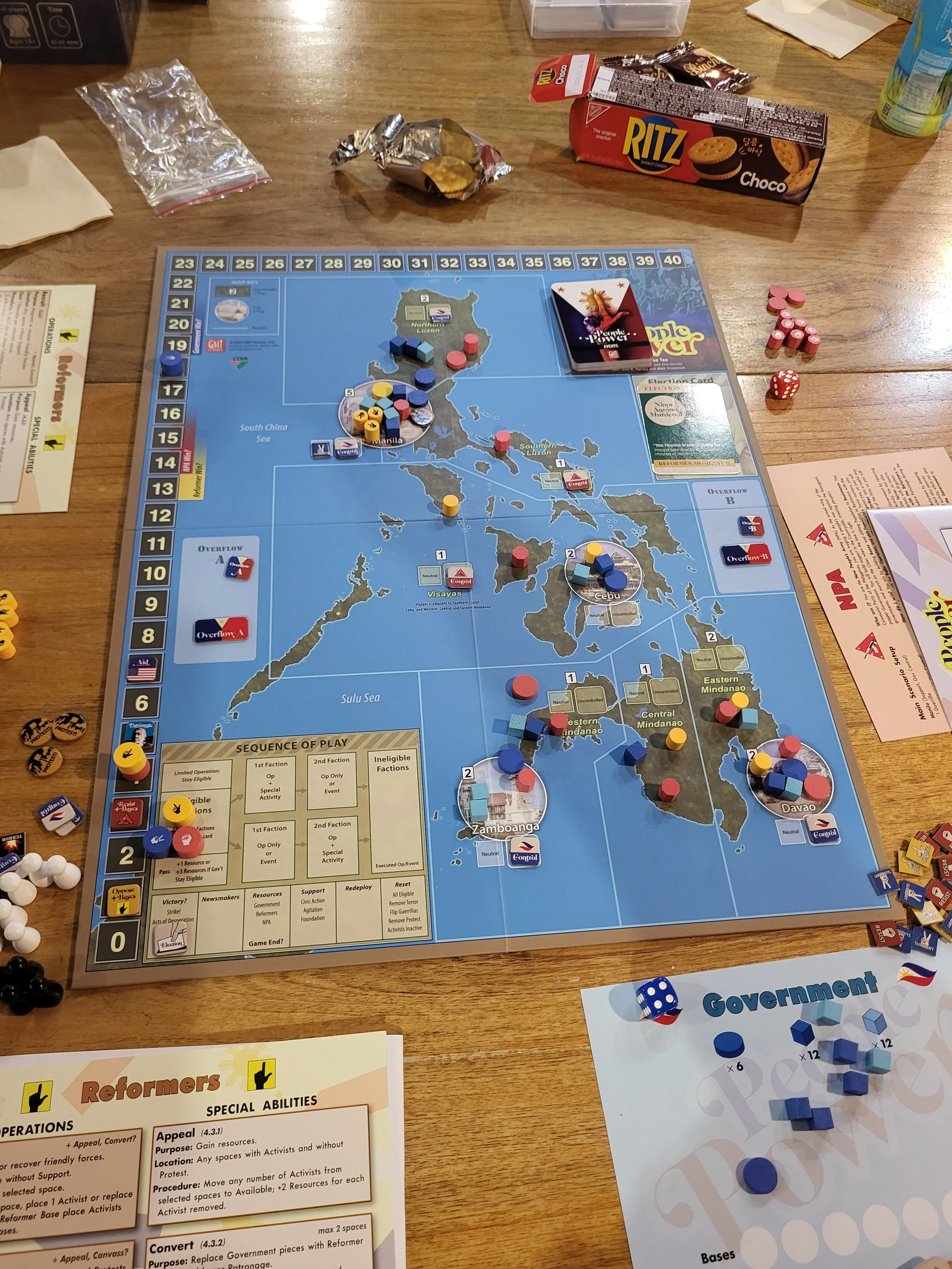
The initial set up for the shorter scenario, where we only play two election rounds. I’m the government player and, fair warning, I’m a terrible COIN government player.
In People Power one player is the Marcos regime in The Philippines while the other two players represent the peaceful reform movement and the more violent, and broadly communist aligned, armed resistance to the dictatorship. At the start this is a 2v1 game, where both resistance players must bring the Marcos regime – which starts almost at their victory threshold – to heel. If the two resistance players squabble at the start, the game will probably be a short one. Once it seems like Marcos has been quashed, they can bicker over who should be on top in the new era, but that can then create an opening for the government to claw its way back into power.
People Power comes with two scenarios, one is played to two elections (the victory check rounds), the other to three. For my first game we played the two-election game, and it had a pretty clear pattern. In the first half, it’s Marcos vs. the other two players. Then in the second, it’s a total free for all to claim victory before the end comes. This is a fun dynamic, and because each phase is approximately ten cards – the election is shuffled into the bottom 4 cards of each set of ten events – the game moves along at a good clip.
People Power makes several changes to the core COIN system to make it work better as a three player game. While no doubt some of these changes first appeared in the other three player games, this is my first time encountering them, so I’m going to discuss them here as if they are brand new. Overall, I liked these changes but some of them did have me missing the more traditional form of COIN.
One of the biggest differences is the addition of a “Limited Action, Stay Eligible” action space. For those not familiar with COIN, in these games when you take an action it usually forces you to skip your next turn. So, in a four-player game, you have two players taking actions on any given turn, often in alternating turns. Because People Power is for three, it has the option for a third player to always take an action on the turn, but their action is limited – meaning it can only affect one space on the board. I have no real problem with this change specifically, I think letting people play the game more is generally good (especially with this game being targeted as a potential good entry point into the system, see more on that below). However, it has a knock-on effect that I have mixed feelings about.
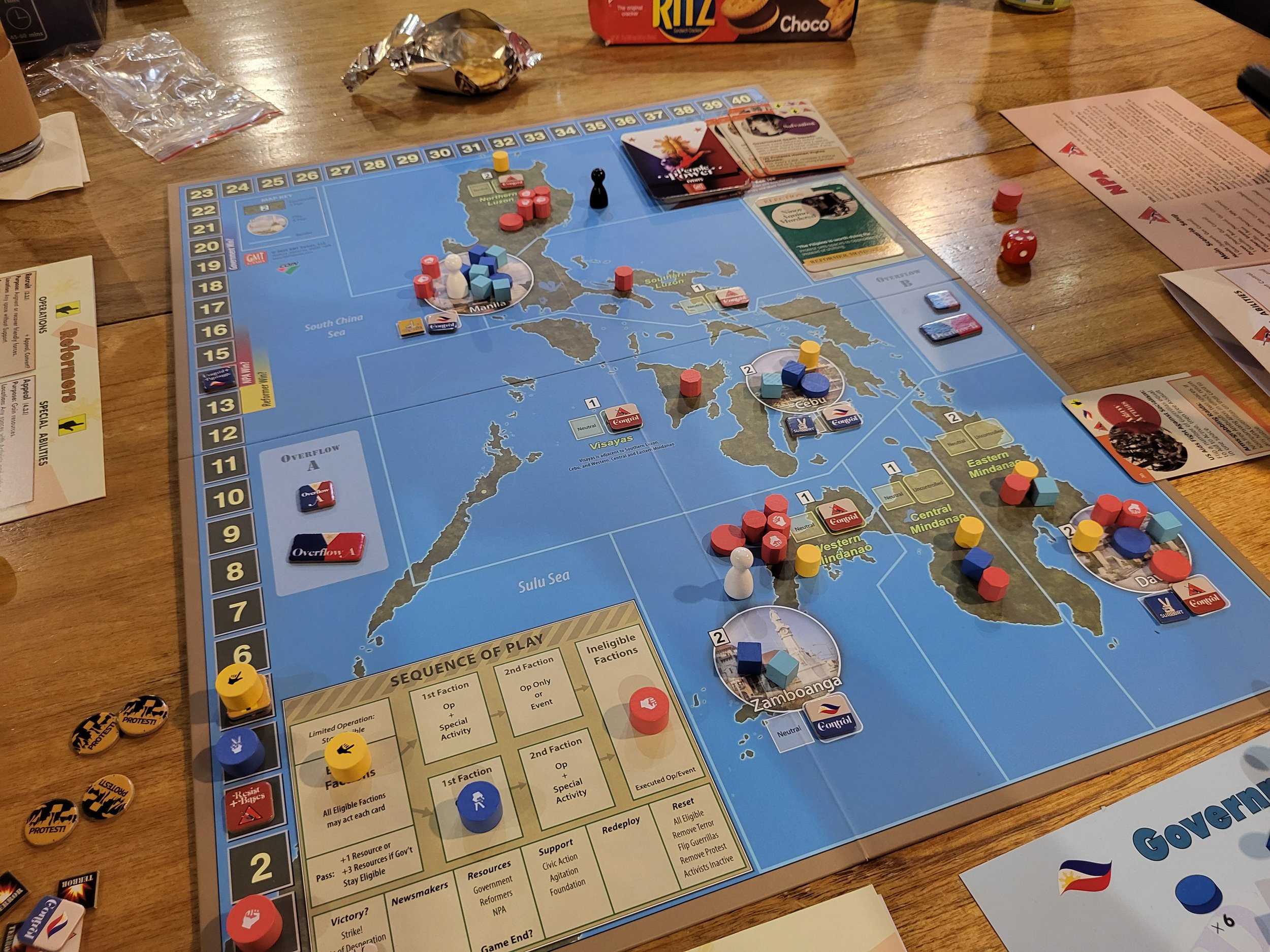
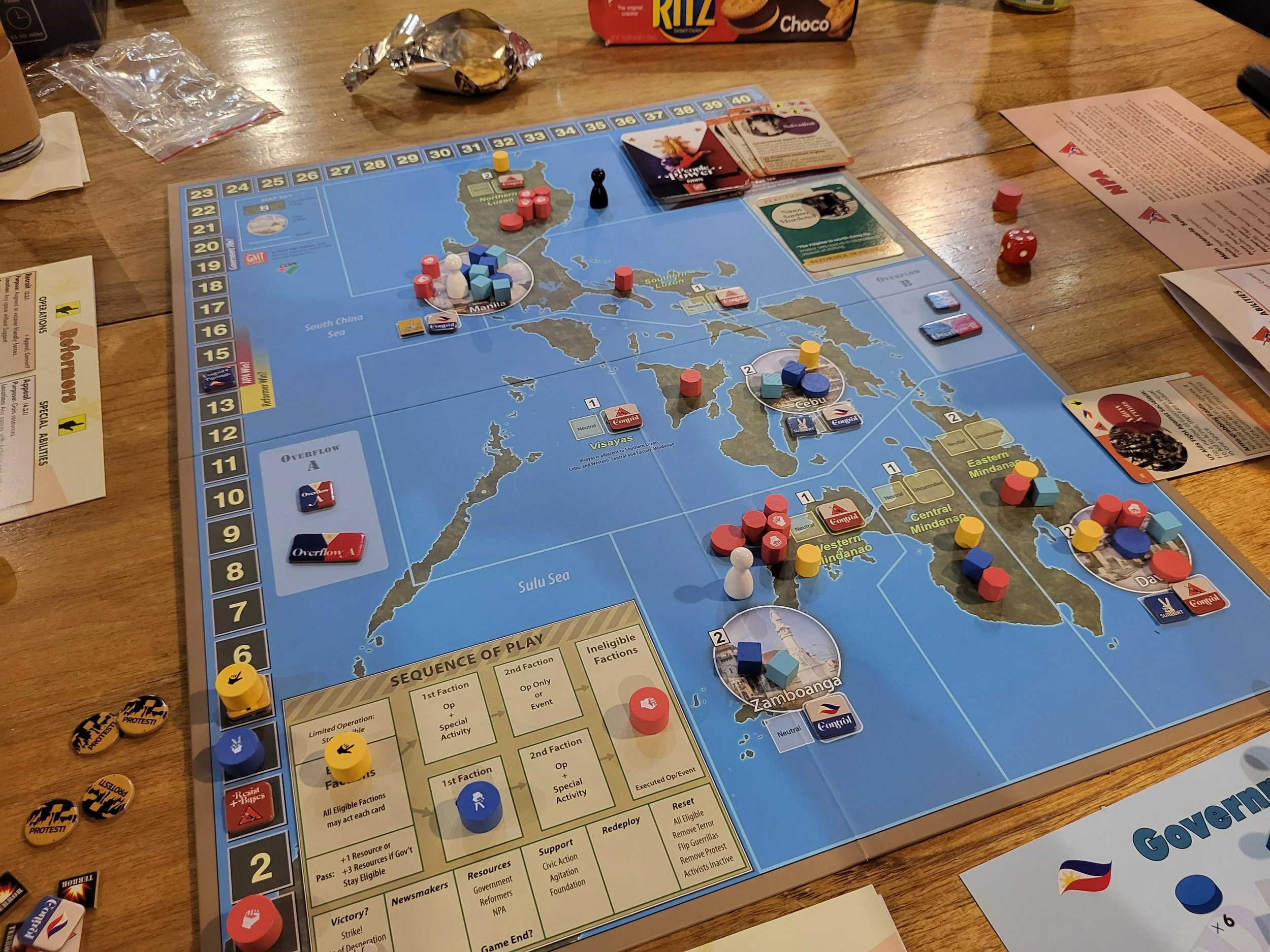
I managed to clear out Manila but things are looking bad in the countryside. My control was slipping very badly. It would get worse before it got better.
In traditional COIN is that you see the event card from the deck for this turn and for the next turn at the same time. This lets you plan a bit around what is coming down the pipeline and can encourage some players to pass this turn because they want to act on the next one. I really like this dynamic in COIN, but it is missing from People Power. This isn’t surprising. Because there are so many ways to stay eligible, the ability to know the next card would mess with the dynamic of play. The British Way and A Gest of Robin Hood also limit your knowledge to the current card for similar reasons. However, in a three-player game I find I miss the advance knowledge more than in a two-player game.
COIN has at times suffered from a player being stuck with worse actions because the initiatives on the cards being drawn are consistently punishing them. When you can see into the future by one turn it makes it easier to know whether you should take this mediocre event or operation, or if you should pass and do something better next turn. However, without knowing the future, a player can get stuck in a cycle of Limited Operations because they are waiting for an initiative card for their faction. In the two-player games, initiative is something that is separate from the cards, so if you are taking the limited you know you’re getting initiative next turn rather than hoping for a good draw. It would probably have added a bit of complexity, but I think I would have preferred initiative to be more divorced from the deck in People Power, but maybe that would have imbalanced the game in irreparable ways.
People Power is capable of some wild swings in fortune. As the Marcos player, I was down and almost out going into the first election, but in the second phase I managed to claw my way back to forcing the game to a tiebreaker over only a dozen cards. For fans of COIN’s more deliberate pacing, where progress is incremental and develops over the course of several hours of careful play, this might be incredibly frustrating. However, as someone who has more admiration than enthusiasm for traditional COIN pacing, I found this very enjoyable.
I think this radical swingy-ness is necessary given People Power’s shorter playtime – you have to let people stage massive come backs in the span of only a few cards because there isn’t time for them to build back more slowly. It also helps People Power as a new-player experience, because players will make mistakes and if the game is too punishing they may be dispirited and not want to come back to the game or the series. As a big fan of chaos in general, and in games especially, I really liked how much things could swing in People Power. I’m also very forgiving of chaos in a shorter game like this than I would be in, say, an eight-hour all-day experience.
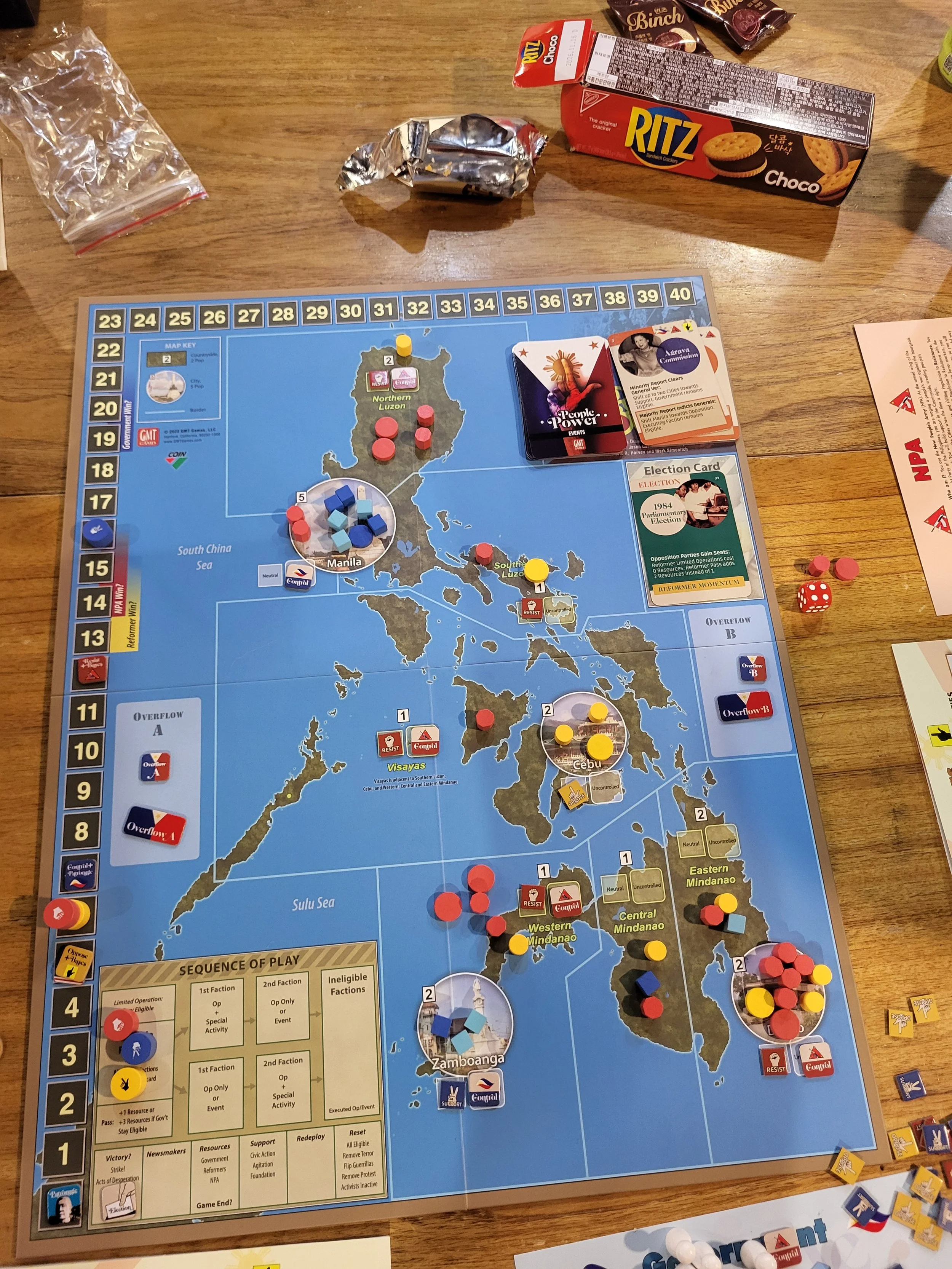
The first election round. See how far I have fallen, and we only barely managed to stop the communists from winning. This painted a big target on the back of that player, which was good for me.
I really enjoy the asymmetric victory conditions, a staple of the COIN series, in People Power. The Marcos government cares about control of the population and how much money they can steal from the state via patronage. Meanwhile, the two insurgent factions care about establishing bases on the map and getting the population to support their respective factions. These feed into the actions well, as the two insurgents will fight over population alignment while the Marcos regime only really wants population support to either limit what the other players can do or so they can cash it in to increase patronage. Meanwhile, the Marcos player is obsessed with controlling areas, while neither resistance player really cares about that unless it’s to stop Marcos.
The victory conditions tie in with the available actions, as the government needs to control the target area to take most of its actions while an area with support for the government can limit what actions other players can take (similarly, the presence of terror markers can influence or enable actions). All of this swirls together to create an evocative experience – you can really feel the different priorities and tactics of these powers through the gameplay. It doesn’t have to tell you what they represent, it shows you via the game.
Now, I got People Power in part to introduce COIN to new players (and, also, to hopefully play it a little more), so how did it perform? This was the first time I played COIN with non-wargamers since my first game of Andean Abyss many years ago. I think this is illustrative comparison, so I will be focusing on the benefits of People Power versus Andean Abyss (or, arguably, Cuba Libre, which I haven’t played but I understand is very similar) as an introductory game.
As an opening note, People Power has a little introduction to each faction, their relationship to the other factions, and what they’re trying to achieve written on the back of the player boards. While I’m generally not a fan of the cardstock player boards in COIN – I prefer all the pieces and spaces be on the board – this extra detail makes me like the player mats in this game a little bit more.
The greatest strength of People Power is its shorter play time and the immediate chaos of the available actions. It’s much easier to get people to try a game that will only take a few hours, and even a short game of Andean Abyss is a lengthy undertaking. However, one downside of the shorter playtime I found was that some players ended up repeating a lot of the same actions over and over, and maybe not exploring their full array of possibilities in the shorter timeframe. This can make the game feel more limited and you miss out on some of the depth – it’s not that People Power doesn’t have it, but rather that I found it slightly more susceptible to a “insurgent player just recruits most of the game” situation.
People Power’s asymmetry is a huge part of the appeal of the game, but it does make the teach a little harder. In Andean Abyss there is one huge layer of asymmetry, the government versus the insurgents, but there is significant overlap in the actions available to insurgent players so when I taught that I took the role of the government player and then I could teach almost the same game to the other three players. So, in some ways People Power sits in an awkward spot where it is a good length for new players, but it adds more nuance to make it more interesting for series veterans which in turn makes it a little less good for new players. That said, I would still recommend People Power as a good entry point into COIN. I would not say it is superior to all other options, but it is another one in the existing canon of good COIN games for new players.
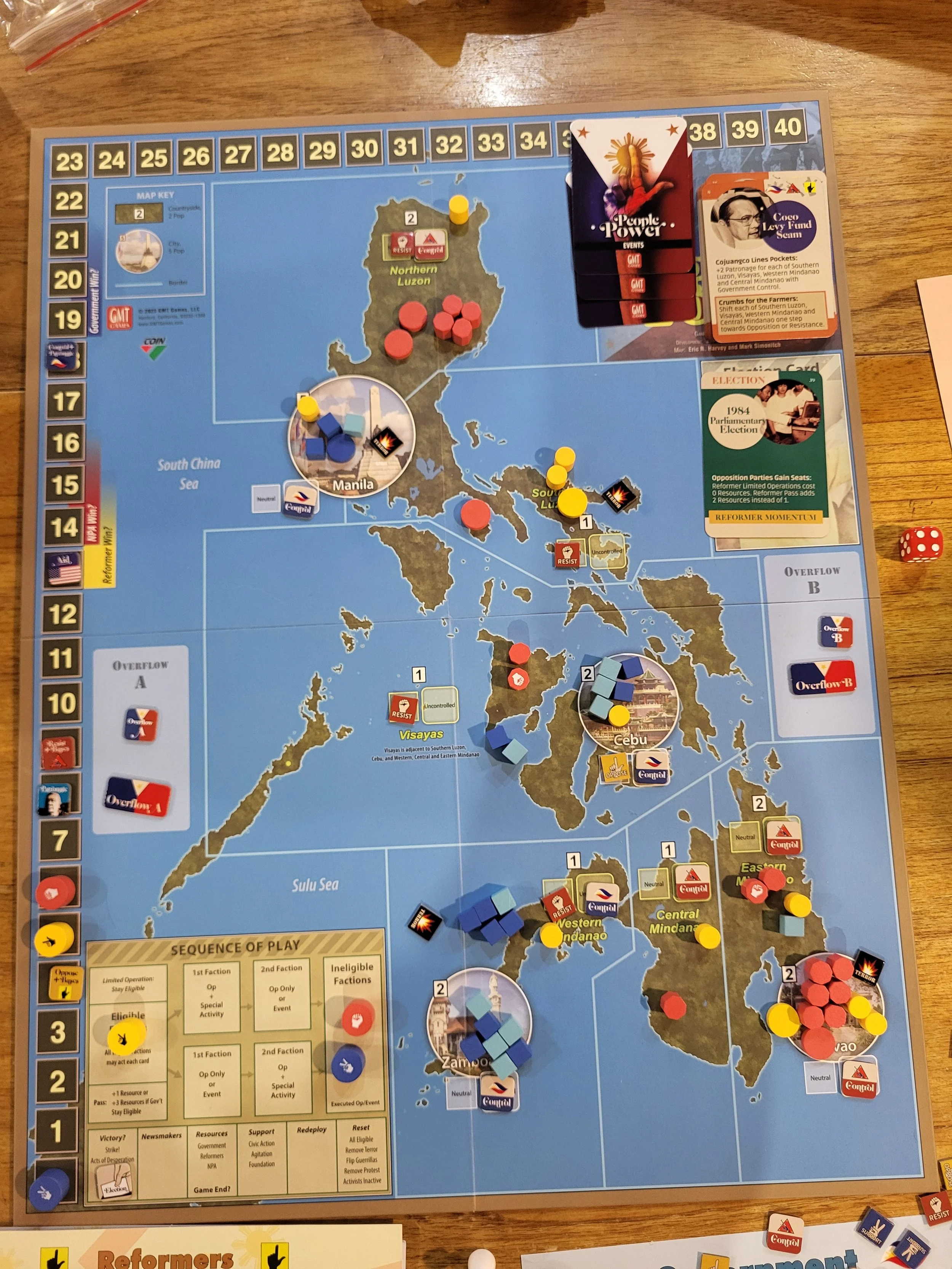
Very near the end, I am beginning to claw my way back, but ultimately I will not succeed and lose on the tiebreaker.
I would be remiss if I did not take a moment to comment on Donal Hegarty’s graphic design for this game. I love the aesthetics of People Power. The map is only okay, but in a series where I have very mixed feelings about the maps, I think it stands perfectly well against its siblings. However, the card design is beautiful. While I’ve enjoyed many a card in a GMT game, I find the traditional GMT layout (boxed picture on mostly beige card with text) to be bland. The cards in People Power are gorgeous, and it helps to elevate the overall graphical package into something that is a delight to play and much easier to put in front of people who are used to the more polished graphical presentations of modern hobby board games.
While I have lots of positive things to say about People Power, at the end of the day I’m also not sure that I want to play it many more times. During my game, I often found myself wishing I was playing Gandhi (which also has non-violent factions that feel similar) instead, which has similar government, non-violent, and violent opposition factions and felt thematically the most similar to People Power, but which offered a little bit more in its experience. And I don’t even own Gandhi anymore, I moved that on because for COIN I often find myself either wanting a new experience or to revisit one of my established favorites (which, for my sins, includes Pendragon).
So, while I like People Power and I can see it being someone’s favorite COIN – and I really, really like that it plays in a short enough time that you could actually fit multiple games in to a single day – I don’t think I enjoy it enough for it to be a staple in my game collection. It sits in that awkward space between “I would happily play this again” and “I am prepared to take it down from the shelf to try and convince other people to play it with me.” Because I live in a tiny apartment, I tend to be quite ruthless about what I keep, and I’m not sure People Power will make the cut. However, I recommend anyone interested in COIN try it, because it delivers a satisfying COIN experience in only a few hours, and that’s nothing to sniff at.
(Hey, if you like what I do here, maybe consider making a donation on Ko-Fi or supporting me on Patreon so I can keep doing it.)