
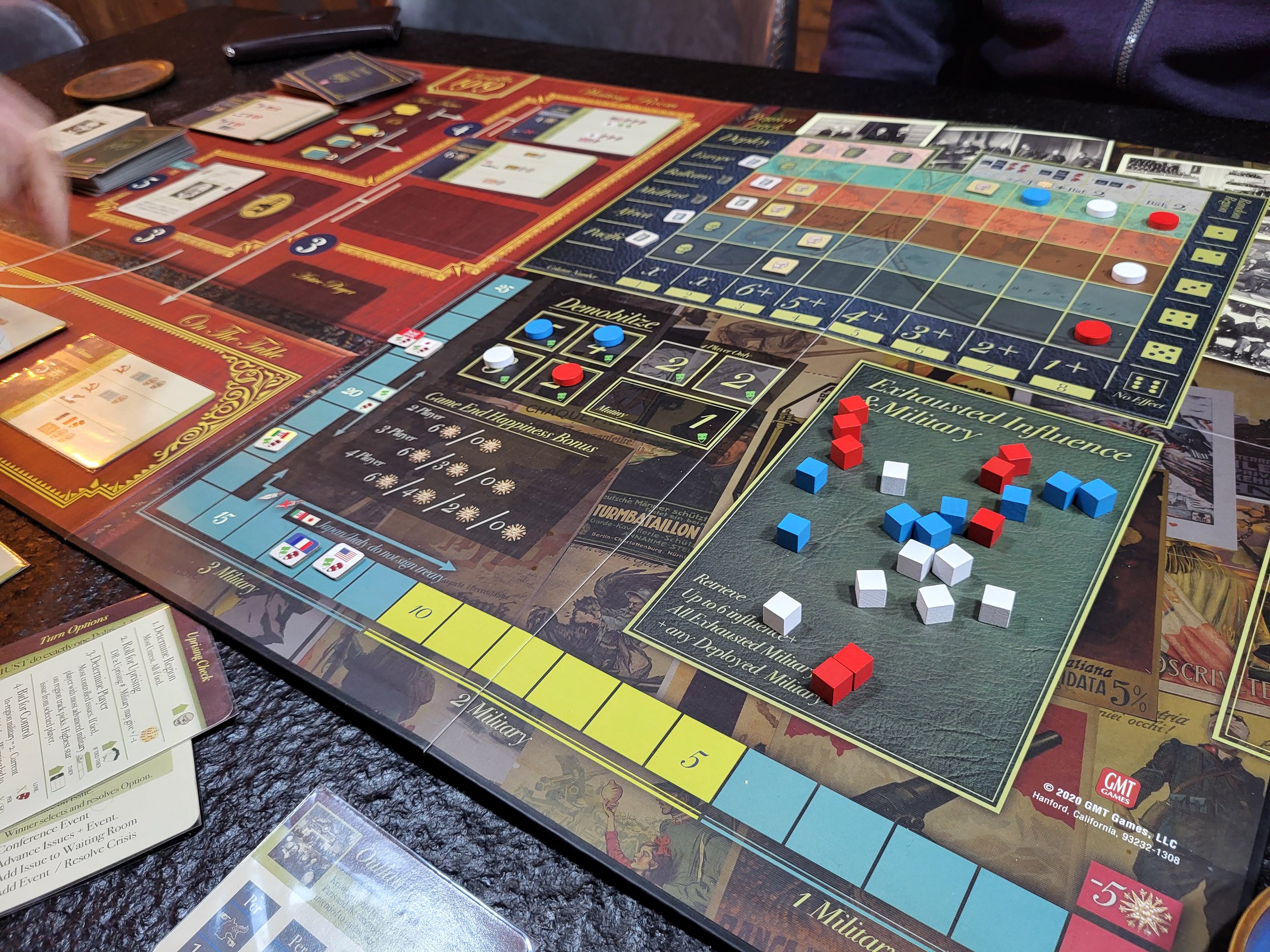
If you need someone for a high-pressure negotiation, you probably shouldn’t send me. I’m not a good negotiator. I don’t give in easily, I won’t give up something for nothing, but I’m not good at making deals. I struggle to know exactly what something is worth to me vs. what it could be worth to someone else – usually I can spot the former but calculating the latter into the overall decision eludes me. For this reason, I don’t play that many negotiation games, especially not pure negotiation games. However, a game with sufficient stature and/or on an interesting topic will drag me to the table to flop around like a fish at a mermaid war council. In 2024, I played Cole Wehrle’s John Company because of this (and ultimately didn’t enjoy it, few games are less for me than John Company), and more recently I played Mark Herman and Geoff Engelstein’s Versailles 1919.
There are lots of games about war, but not very many about ending wars. Most wargames are happy to say one side got more victory points or achieved a victory condition defined in the rules, and that’s the ending. But ending a war is far more complicated than that – it is never so black and white, and even when a victor is clear what that victory means must be defined in the war’s aftermath. For that reason, I’m interested in games about peace treaties and ending wars – it’s a space I think the hobby has neglected historically and it’s a rich area for historical game design.
GMT Games kindly provided me with a review copy of Versailles 1919.
Versailles 1919 is about the signing of the Versailles Treaty that ended World War I, and in it players take on one of the four main Allied powers: France, Britain, the USA, and Italy. The losing Axis side is not represented in the game, instead the focus is on the former allies jockeying for position in the war’s aftermath and trying to create a post-war world that favors their interests. You want to steer the issues in your direction so that when the treaty is finally signed by all parties, you come out top of the pile. To achieve this, the game abstracts out the idea of influence and debate into a very simple, sort of Euro-game inspired, system that I think works really well. Versailles 1919 manages to evoke the idea of squabbling politicians dividing up the world between them, and it’s an incredibly clever design, but ultimately, I don’t think that I loved it. Let’s try and unpack that.
The mechanisms representing debate in Versailles 1919 is simple but clever in the best way that boardgames can be. At its core, Versailles is an area control game, but the areas are ever changing. Each turn you will have three issues open for debate, and several more that are have been tabled and are waiting for their turn to come up for discussion. On your turn you can place influence cubes on two issues, reclaim cubes that you have already used from the pool of exhausted influence, or resolve an issue that is currently up for debate. You can also take military actions, adding military to one of the region tracks (and possibly reclaiming some cubes at the cost of happiness), moving an existing military disk to a new region, reclaiming spent military, or sending your troops home, permanently removing the piece from the game but gaining some happiness (which is no small benefit, happiness is hard to come by). That’s not a lot of actions, but Versailles makes the most of them in clever ways.
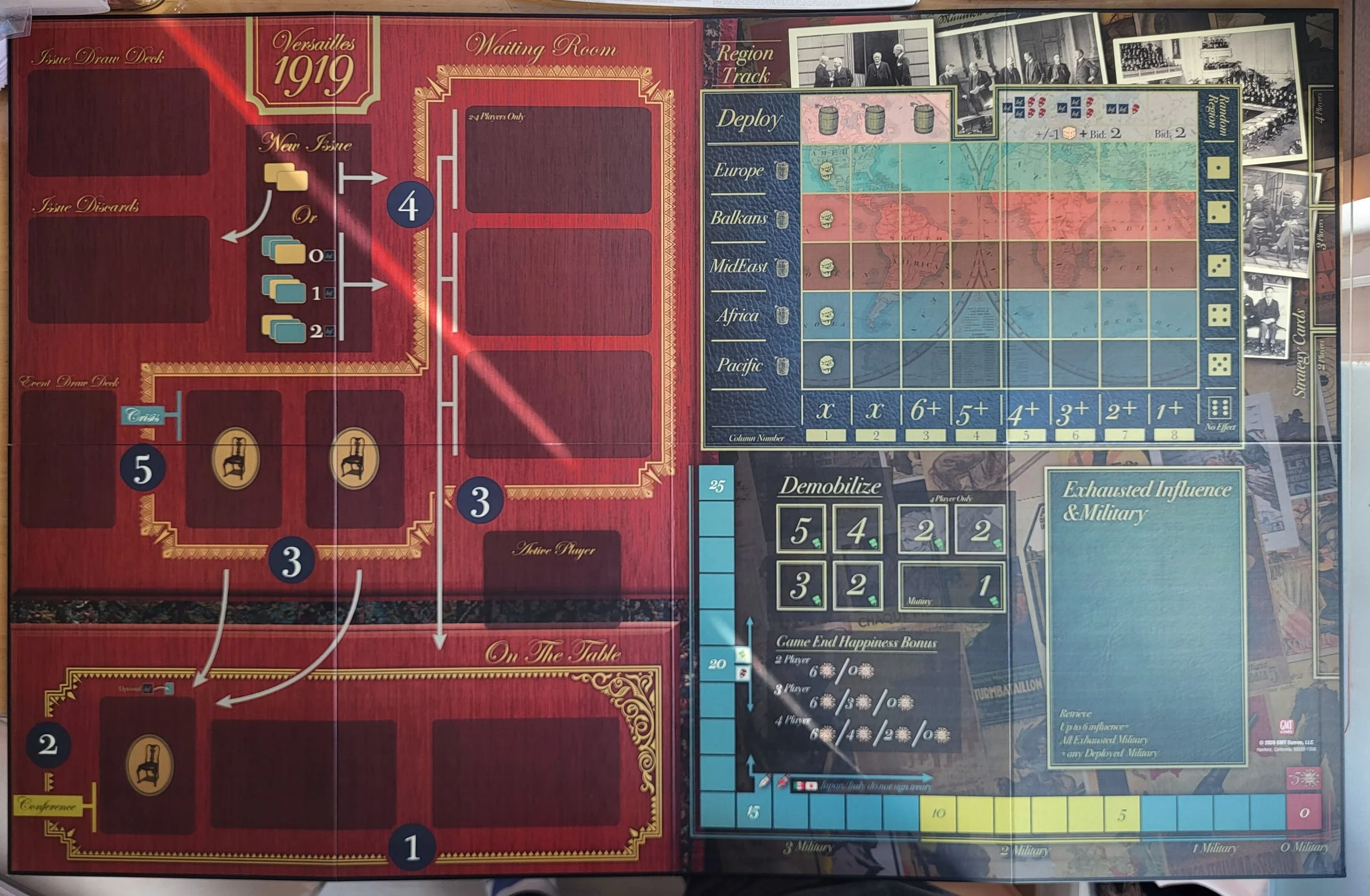
The game board does a great job at helping you track all of the key information and is very easy to parse, all while evoking the vibe of a stuffy room somewhere outside Paris.
The best wrinkles are reserved for placing influence, the core action that much of the game hinges on. You must place influence on two issues, but you can only place influence on an issue if you would have more influence on it than any other single player. This takes away a lot of control from you and changes the math for all the players around how much influence is the right amount to invest in a fight. Your pool of influence is limited, and you don’t want to go all in on a few issues early and then forced to spend actions recovering your influence as your opponents settle issues on the cheap. The requirement to be in a majority and to place on two issues can potentially lock you out of being able to place influence at all, but more often it puts you in a situation where you just can’t justify spending that much influence. This then nudges you towards the game’s other key action: resolving an issue.
When a player decides to resolve an issue they pick one of the three available on the table to resolve, and whoever has the most influence on it wins the issue and gets to decide which option is agreed – with ramifications for the global world order, but also some stuff about victory points, I guess. You don’t have to resolve an issue that you are winning, and in fact if you resolve one you are losing you can get back all your influence cubes as opposed to only half should someone else resolve it. This brings in the game’s negotiation element, where you can promise to resolve an issue for someone else (sparing them the action and possibly a future fight with another player), in exchange for some sort of promise or immediate benefit. These promises are rarely binding, though, so you have to consider how much you trust your opponents to keep their word in future turns.
Resolving an issue also triggers two event resolutions – one that was already tabled and will resolve its secondary effect, while a new one is drawn from the top of the deck to resolve its arriving effect. You then decide which event moves down to be resolved after the next issue is settled and choose one issue to come to the table and a new issue (either from the discard or top of the deck) to bring to the waiting room. This gives the person resolving the issue some control over the flow of the game, which can be quite powerful, especially if there are issues you either really want to resolve or want to see buried for as long as possible (or maybe forever).
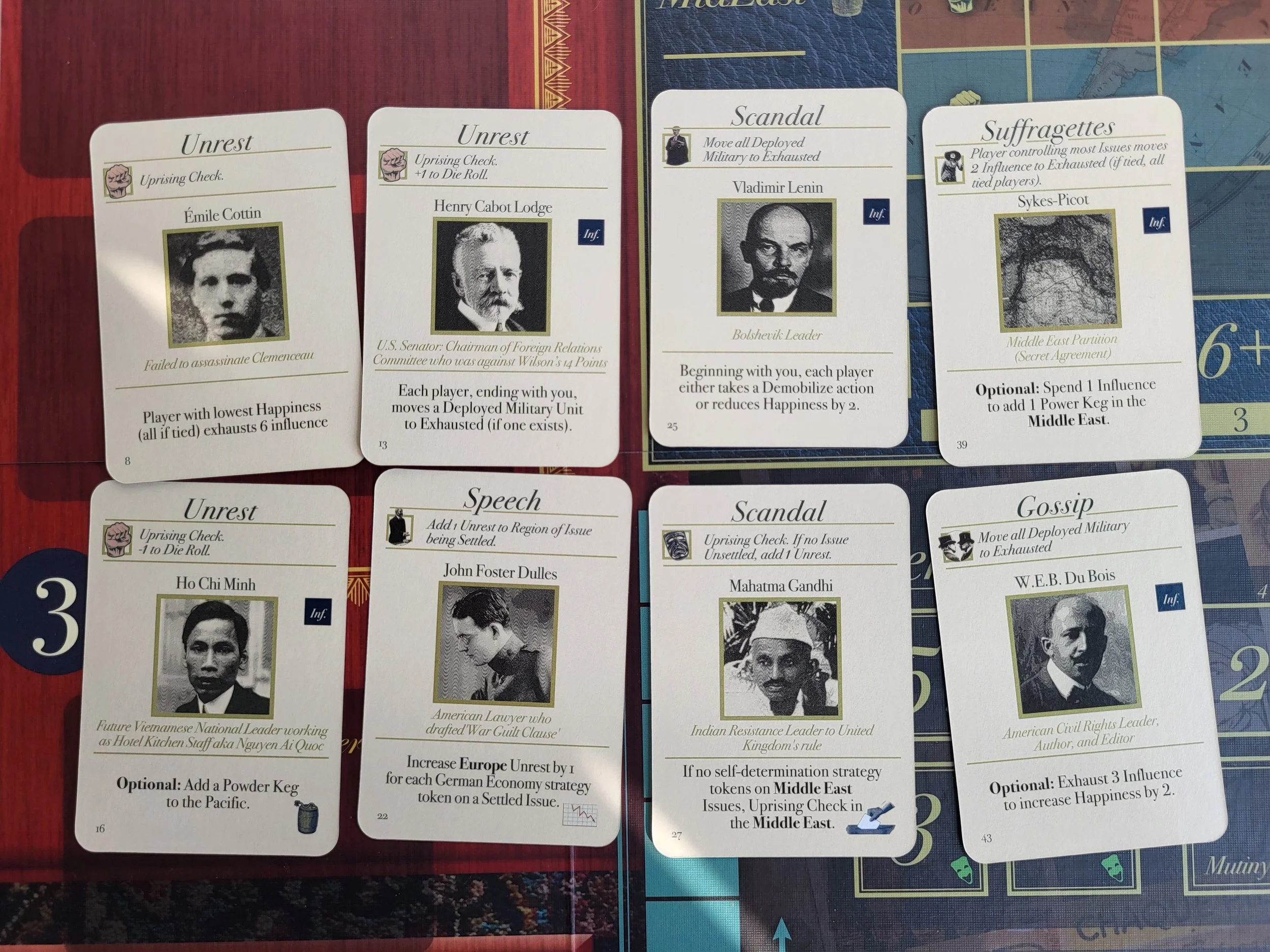
The events are sometimes events but just as often they are people, often the kind of people who did not get to participate in the actual negotiations. On the top of the card is the effect when they are drawn and on the bottom is what happens when you resolve them.
Issues once resolved do not always stay that way. Various issue resolutions and events can increase unrest in parts of the world, tracked on the board but possibly limited by the position of troop discs. You will periodically check unrest in a given region which is done by rolling a d6 and checking the result against the column marking the current region’s unrest. If a revolt happens, then players check who has the most issues resolved in that area and one of them will come back up for discussion again. This discussion is done immediately via an auction, and an auction where having troops in the region counts for far more than anything else.
The unrest and revolts help to keep players on their toes and represent a possible way to drag back a leading player by making them give up one of their issues. It also captures a lot of theme in some very light mechanics. The fact that a revolt causes everyone to reevaluate what they agreed for the region is great, and the presence of troops on the ground giving far more sway to the subsequent discussion gives the whole auction round a vibe of gunboat diplomacy (or a near cousin to it) in comparison to the staid discussion and wrangling of influence that defines the other phases of the game.
Versailles as a whole does a lot to evoke its theme. You do feel like you are debating what to do with the world while sitting in a fancy room somewhere, often hundreds or thousands of miles away from the places that you are deciding the fate of. In my game, one of the players was intimately familiar with the events and could provide a description of what we were debating at the slightest prompting, which definitely helped evoke the theme. I could certainly see someone ignoring the theme should they just skip the names and only look at the points and rewards, and their experience would be worse for it in my opinion. This is also true of many games – if you are prepared to ignore what the game is about, you often can, so that is not any great failing of Versailles.
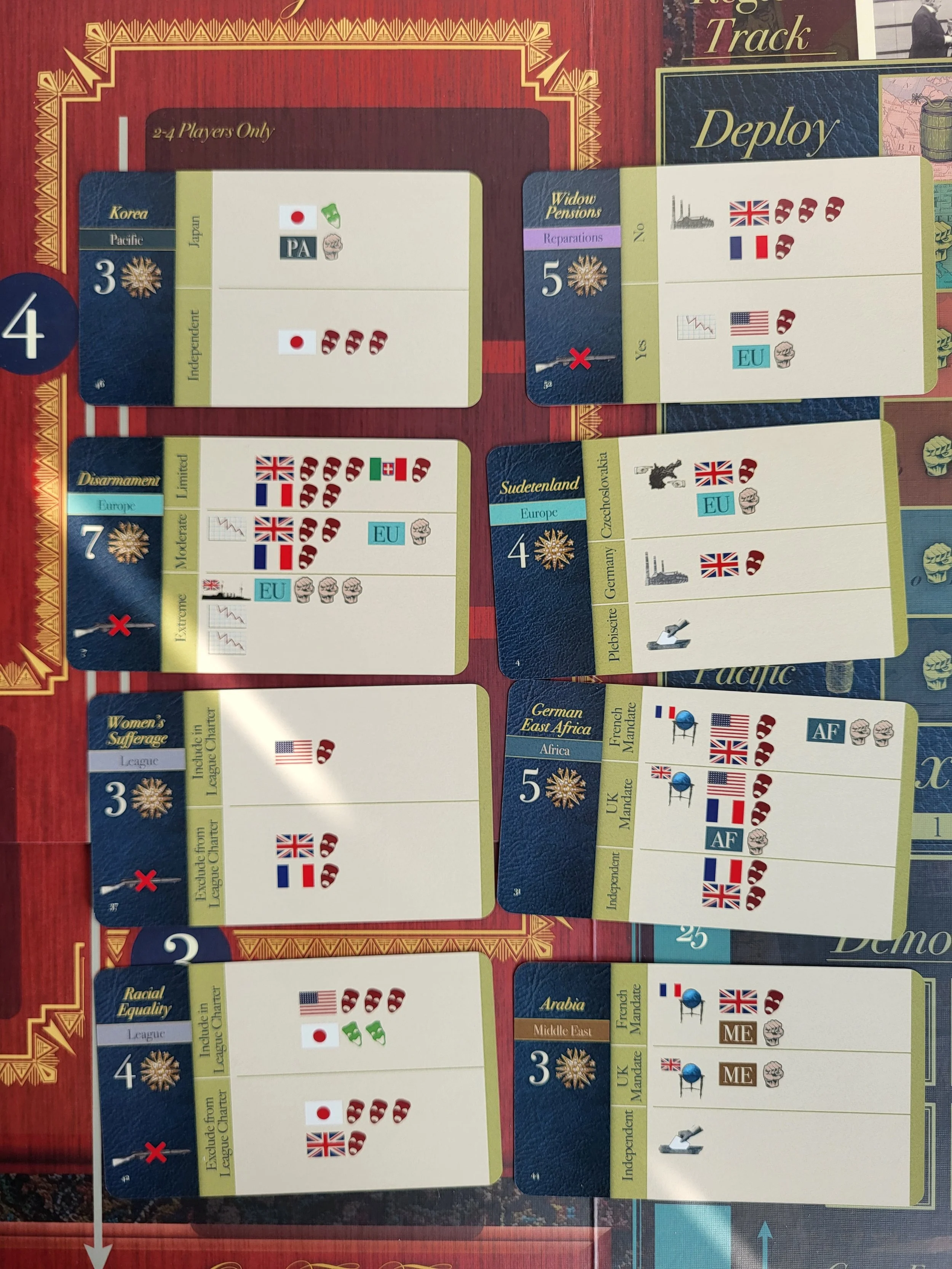
A selection of the issues that you will be fighting over throughout the game. On the left is the specific historical event, the type of event (usually its region) and how many victory points it is worth. On the right are the various ways it can be settled, with a short description of what you are choosing and then the symbols of what it means in game terms if you pick that resolution.
If I have any critique of how Versailles handles its theme it is in that the factions all feel very similar. While there is some asymmetry baked into the decks, and Italy is tracked for whether they will sign the treaty or not (along with non-player Japan), but for the most part it does not matter if you are the USA, France, or the United Kingdom. While it makes the game easier to play, since asymmetry is always harder to teach, I do feel like it pushes the game towards a more generic tone. I feel like I am negotiating the Treaty of Versailles, but I don’t feel like I am any specific historical person doing it, instead I am just me.
While I’m airing my critiques, Versailles is an incredibly dry game. You move cubes, maybe discuss some schemes, and then either claim a minor triumph or resign yourself to a mild defeat. There are no thrilling moments where everything comes down to one move or one throw of the dice. This is the kind of game you could play in a room with a big “Quiet Please” sign hanging above you. To some degree this helps reinforce the theme – this is a game of bureaucrats and western leaders deciding the world order, not exactly an adrenaline-heavy activity. However, it is also something to bear in mind should you want to play it – I like the occasional dry game, and Versailles isn’t quite so long as to overstay its welcome, but this is pushing up against my personal limit.
At the risk of engaging in some backseat game design (I apologize, this is reckless of me), I really wish Versailles had some kind of hidden end game scoring. After the first uprising is resolved in the game, players take a scoring bonus card from an available pool, which is how some player asymmetry is introduced, but independently of history so the USA can find themselves wanting to support British expansion. I like this idea, especially in how it gives you an opening phase of the game to explore some options and then pick your target after you’ve played a little. However, I don’t love that this is public information, and that’s because as a mostly luckless game with lots of open information it is very possible to play Versailles like a calculator.
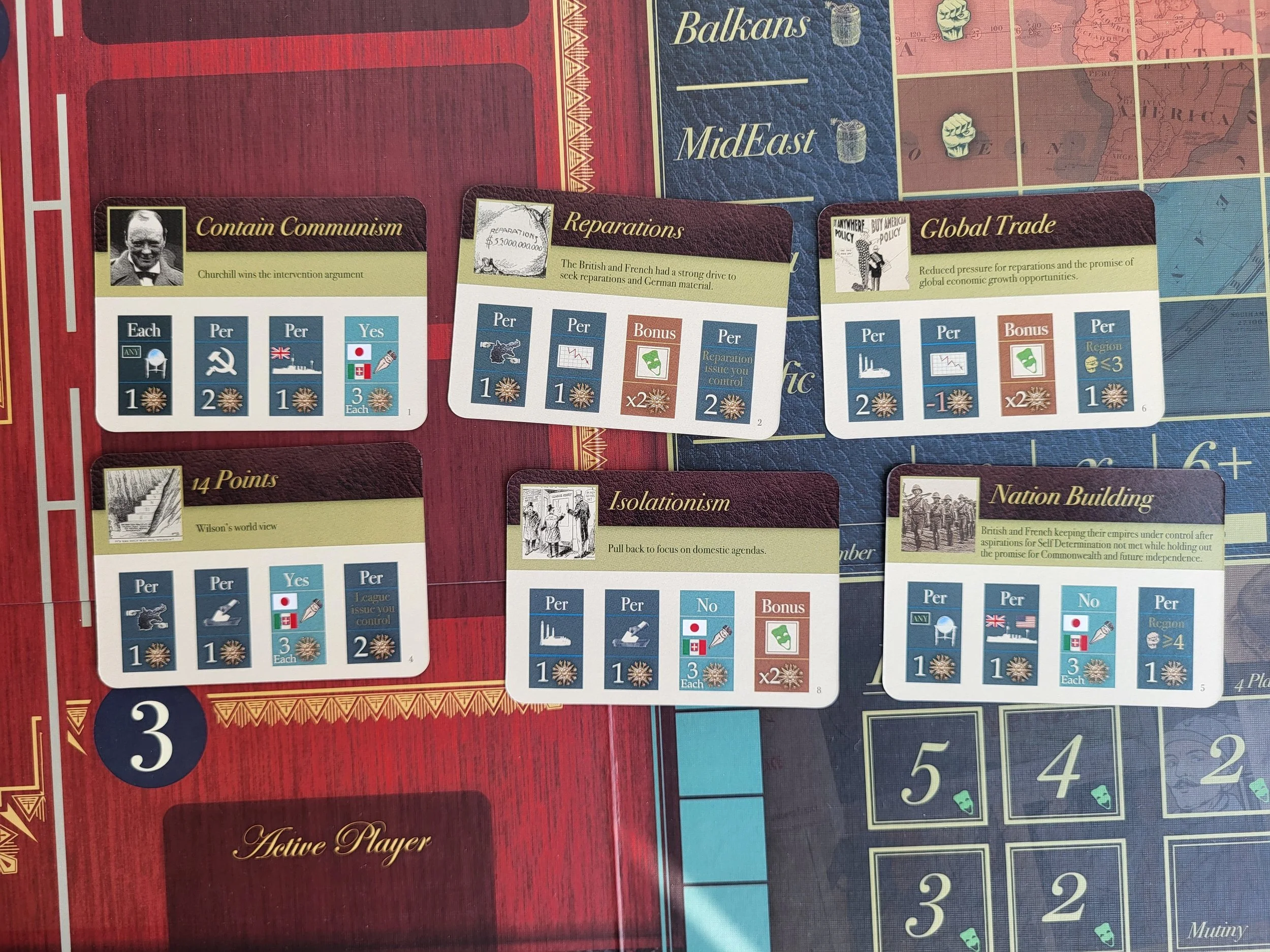
A selection of the end game scoring bonus cards - as you can see many of them are linked to a historical figure (14 Points is Wilson and the USA while Contain Communism has a picture of Churchill on it) but they can be selected by any player.
My game mostly avoided this situation, and I think the better experience is probably to roleplay and play with your gut rather than with math, but it is open to pure mathematical calculation. Some of the best negotiations in Versailles are around convincing someone to resolve a certain outcome on an issue they are winning, because you want it to benefit you somehow. While it maybe makes the game a little more open and fairer if you know what everyone’s interests are, I think it would be a bit more fun and less math-y if you had to guess what end game scoring interests each player has. This is of course a preference, and there are games that do hidden end game scoring badly, but I think I would have preferred a version of Versailles with it even at the cost of losing the interesting selection phase.
This open information also creates one of my personal problems with negotiation games, which is that if players don’t know the relative value of what they are negotiating over it is hard to have a fair negotiation. Here my problem is less how much is this worth to a player, and more how much is it worth within the scope of the game - for example, is an issue worth 10 points a lot? Or is it relatively little in the scope of what is in the deck.
I think Versailles is clearer in this than some other games I have played, since at a minimum each issue has a victory point total printed on it and most gamers have an intuitive knowledge of how to handle VPs. If you are playing with players of similar skill and experience, then this generally isn’t an issue either, as everyone is equally informed or ignorant, but it can create a disparity in game experience with differing levels of expertise (and I will fully admit that my backseat design idea above probably only makes it worse).
This can be balanced by other players advising a newer player, but that’s a tricky space to play in. Now, this is a personal taste thing, and plenty of people love negotiation games, so I can’t claim that this is some fault of the game. Versailles would also be a worse game if you played it without negotiation (a thing that is possible, but sounds incredibly dull), but there is a risk of the game going all weird because someone has memorized the value of each card in the deck and decided what they will or will not give up for each printed VP or bonus. Again, playing with your gut is probably a better experience, and is largely what my group did, but this is maybe something to think about with regard to your regular gaming group and their behaviors before you decide to put Versailles in front of them. There are absolutely people I would never play this with. I’m also a terrible negotiator, which certainly doesn’t help.
At the end of the day, I am really impressed with Versailles, and I enjoyed my game of it. However, it was a little too dry for me and it can’t quite overcome my natural ambivalence to negotiation, born at least in part from my own incompetence. It’s the kind of game I’d happily join someone in playing, but I don’t think I’ll be trying to convince other people to play it. So, it probably doesn’t belong on my shelf, but I’d be happy to see it on someone else’s. I am also very curious to try some of the other games in the series to see if any of them grab me. I am particularly interested in Congress of Vienna…
(Hey, if you like what I do here, maybe consider making a donation on Ko-Fi or supporting me on Patreon so I can keep doing it.)