
I would not consider myself someone who is likely to join the GMT Games’ COIN system fan club. I have never had a bad time playing a COIN game, and I have enjoyed most of my time with the system, but there are just so many of them and I struggle to be excited to try another one. As I explored the system more, I very quickly found COIN fatigue setting in. There was one notable deviation from that, though, in the form of Stephen Rangazas’ The British Way, a game that had to overcome my initial reluctance to play as the British Empire and convince me it was an interesting take on COIN and the history it covered. Sadly, I only managed to play the Malaya game a couple of times before packing the box into storage for my move to South Korea in 2024, and so it remains shamefully un-reviewed at present.
While I plan on eventually revisiting that box and giving it its due, in the meantime a new Rangazas’ package has arrived on my doorstop. The Guerilla Generation is another multi-pack volume with four separate small COIN games in it. While each game is generally more complex than those in The British Way, these are still smaller COIN experiences than you’ll find in basically any main-series entry. Instead of focusing on a single counter-insurgent power like The British Way, The Guerilla Generation dwells on four different kinds of insurgency, specifically in Latin America in the second half of the twentieth century.
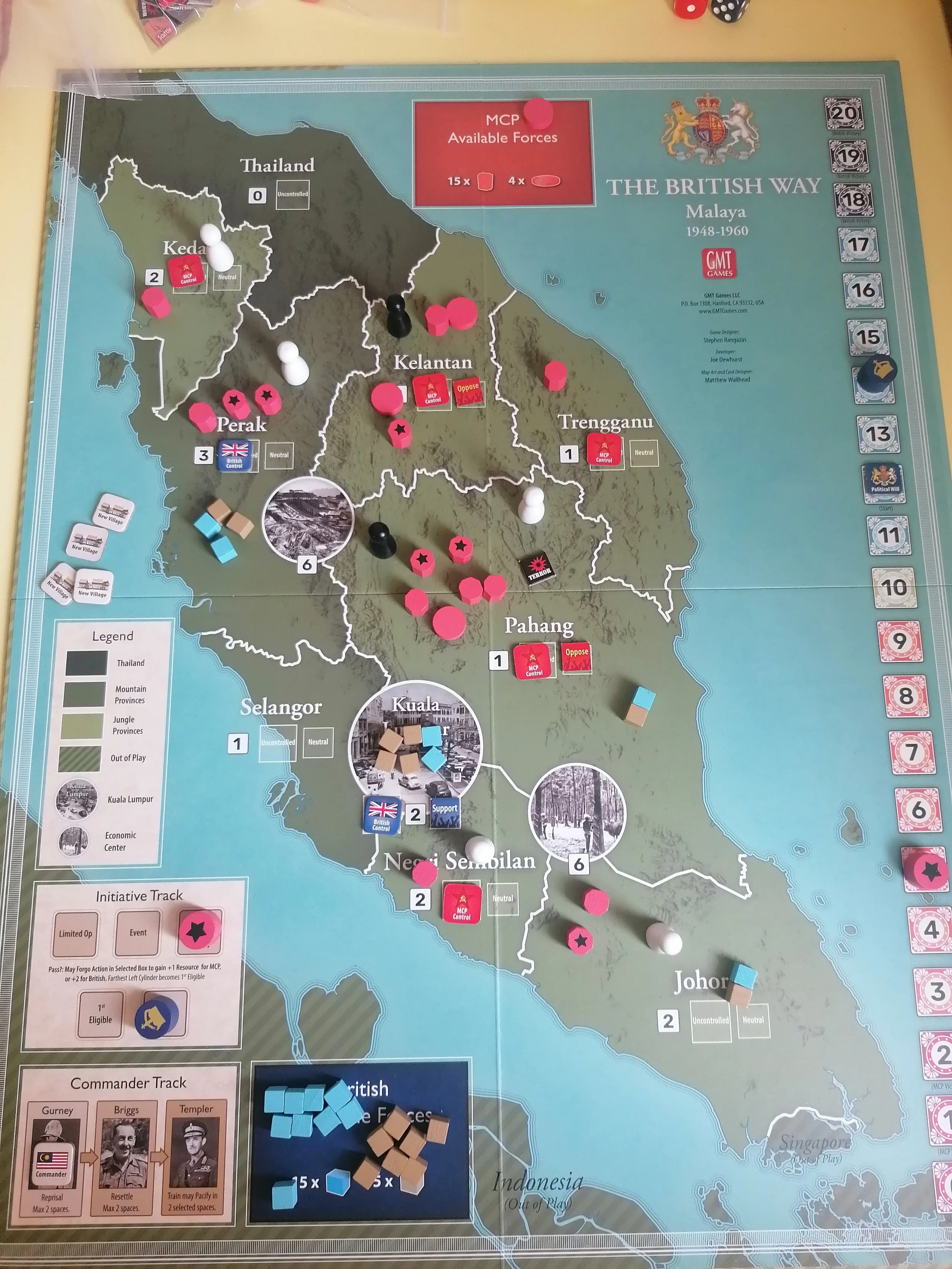
Proof of my playing Malaya, which is a great game. I should really play more of The British Way!
GMT Games kindly provided me with a complimentary review copy of The Guerrilla Generation.
I will share my thoughts on each volume in turn, but first I want to dwell on the total package. While it would be a stretch to say that these multipacks have revived my enthusiasm for COIN as a whole, they have captured my attention and are probably my favorite way to play the system.
Part of this is purely logistical – the shorter two player games are just so much easier to table and complete than an eight-hour game of A Distant Plain. The length of traditional COIN has always been a double-edged sword for me. While I appreciate how the games develop via a grand arc of play, I also don’t really feel that they earn that playtime (at least in my experience). I am not equally engaged for every moment of the game across those many hours, it can feel like the early phases are a procedure one must pass through to reach the more exciting late game. These tighter two-player COIN games give me the arc that I want in a timespan that suits me better.
I also have a lot of respect for Stephen Rangazas’ desire to explore a core thesis through multiple games in these multipacks. The Guerilla Generation wants to introduce players to different styles of insurgency, so each game plays quite differently but together they paint a wider picture of the possibilities of insurgency and counterinsurgency. To do this he makes great use of the minor tweaks and fine tuning that often give COIN games their signature differences. COIN as a series shares the same core mechanisms across each entry, and it is in the details and the margins that much of the differences between volumes exist. As we will explore later when discussing the individual games, Stephen is very good at using this to make interesting and different experiences.
Lastly, The Guerilla Generation comes with a huge bibliography of recommended readings and detailed descriptions of what every event card represents in the game. This is the product of a truly vast amount of research, and I think that Stephen’s work is really pushing the boundaries of historical wargames as educational and argumentative tools. Many historical games claim to be an introduction to or simulation of a historical period, but I am often skeptical of how much they actually teach the player about history. Maybe after playing a Gettysburg game you understand a bit more about how the terrain and army structures impacted how the battle developed, but have you learned anything about the historiography, cultural memory, importance, or wider causes and implications of the battle?
The multi-pack approach invites comparison and contextualization. Seeing the different mechanisms changed slightly between volumes, and playing them close together, encourages the player to think not just about terrain and units, but to consider what it is the system itself is trying to say about these conflicts. Why does the side (government or insurgent) that creates terror change between games? What do the different conditions required for government reprisals against their own populations tell us about those governments and their situations? I think The Guerilla Generation is fulfilling the promise of historical games far better than maybe any game I have ever played before. Except maybe Warriors of God, which we all know is the most accurate game ever made.
Before moving on to the individual games, I want to make a note about how I played The Guerilla Generation. My friend Timothy and I live on different continents, but rather than playing digitally we decided to each set up our own copies of The Guerilla Generation and play asynchronously by sending photos and action descriptions to each other via Discord. This is my favorite way to play these games. It allows us time to meditate on our moves and the game state between actions but without forcing the other player to sit and watch. We can also play across vast physical distances but still enjoy the tactile experience of the game pieces. We decided to play the games in chronological order, starting with Uruguay, so that is how I will write about them. I don’t know if this is the best order to play them in, but it worked for us, so it’s probably not the worst. In most cases, we tried to play each game at least two times and when we moved on to a new game we usually swapped sides so that we could experience both the government and insurgent roles (and also so that no one player had to be committing all the atrocities).
Uruguay
What stands out the most to me about Uruguay is its scale. While most COIN games are strategic, taking in an entire country or maybe even region in their scope, Uruguay is focused on one city and, vaguely, some of its neighboring rural areas. This zoomed in scale helps Uruguay feel more intimate and real. One aspect of COIN I struggle with is how removed I feel from the consequences of my actions – the game exists in the jockeying between the players representing different factions while the actual suffering on the ground can be ignored. By focusing on a fight over a single city, I found it much easier to think of the pieces as actual people. As the government, I was rounding up and arresting my own people in a desperate attempt to maintain control of the streets of my capital city. The game felt like it took place among the people of Uruguay instead of in the boardrooms of global powers.
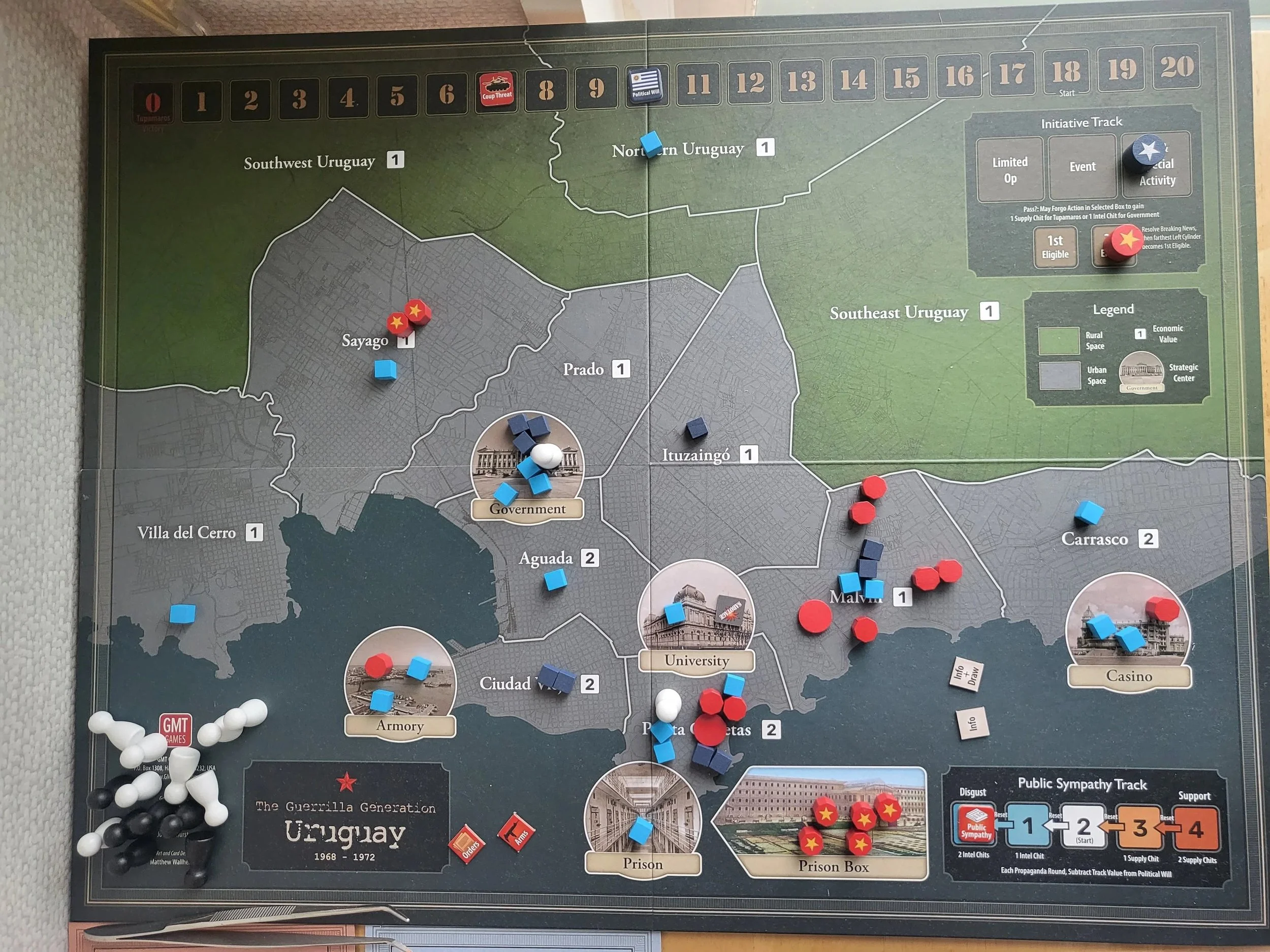
While Uruguay may be my favorite single game in the box, I think its map is probably the ugliest. It’s functional, but the regions are very bland.
The Tupamaro insurgents were less violent than those depicted in other COIN games, and their urban insurgency was marked more by sabotage and control of the streets than outright terrorist violence. Instead of bases they have safe houses, and much of the game is a cat and mouse of insurgents striking and then trying to get back into hiding before they can be arrested by the government. Arrested pieces are placed in a separate prison box (inspired by a similar mechanic in Fred Serval’s A Gest of Robin Hood), where they can be broken out via raids on the prison space or when half of them are released during the propaganda round.
As the government player, a lot of the game is in trying to reduce the number of Tupamaro pieces on the board. Each propaganda is an area control game, and losing degrades public will which can lead to an eventual government defeat. As the Tupamaro player, you must carefully weigh the benefits of exposing a piece that will almost certainly be arrested versus what you gain from their action.
Should matters turn decisively against the government player, they can opt to call in the military. The soldiers are slightly better at arresting Tupamaros (they need a ratio of 2:1 instead of the police’s 3:1), but their greatest strength is just bringing more pieces to bear in controlling the city. Filling areas with soldiers makes them naturally harder for the Tupamaro’s to take over. However, military intervention also introduces a significant coup threat. If political will falls low enough, while the Tupamaros may be defeated the government will also collapse into a military dictatorship (which was the historical outcome). This is represented as a moral victory for the Tupamaros; many of whom were in real life eventually released from prison and played a major role in Uruguay’s post-dictatorship democracy.
Every game in The Guerilla Generation makes several changes to the COIN formula, and Uruguay is obviously no exception. Perhaps most noticeable was the lack of any resources for the players. Actions are limited to a number of spaces, and both sides have a separate resource system of chits they can collect to boost their actions. This creates a very different action economy in Uruguay where you never have to think about passing to increase your resources, but you may want to build up a pool of resource chits so you can have a really big turn later in this round.
Overall, I really liked this, and I think it helped Uruguay feel a bit more approachable as I eased back into playing COIN. Managing one’s resource pool is often a major headache in COIN, and it was nice to not have to think about it. One possible downside to this, though, was that I felt like we rarely chose to play the events in Uruguay. Taking the event is a common trap that new COIN players fall into, and eventually you learn that taking actions is almost always better. However, events are also almost always free, so if you are trying to save resources the event might be a good option. Sub-optimal but free isn’t a bad exchange. However since we were never broke in Uruguay, we never felt like we needed that release valve for the pressure facing our purses.
I would be more disappointed by this if it weren’t for Breaking News, one of Uruguay’s other additions to the system. Breaking News is a special kind of event printed at the bottom of every card that will trigger unless one of the players uses a special action to censor it. These events mostly favor the Tupamaros, and the choice of whether to allow Breaking News to trigger or not weighed heavily on me as the government player. They also helped to inject a better sense of the history into the game and sometimes offered subtle commentary on the history (such as Breaking News about condemning violence having no game effect). While not something for every COIN game, this was a huge part of my enjoyment of Uruguay.
Uruguay is a fascinating and incredibly tight little game. Even after two plays, my opponent and I were discussing all the things we could have done differently and the different shape the game could have taken. It was a strong opener for my experience of what The Guerilla Generation could offer and I was hugely impressed.
El Salvador
Where Uruguay felt like a struggle for control over a single city, El Salvador is very clearly a civil war. This is a far more kinetic conflict than you usually see in COIN, with significant violence on both sides. That violence also helps The Guerrilla Generation cement its focus on violence and atrocity. All wars are horrifying, but many of the ones in this box are particularly egregious examples.
El Salvador is much closer to the classic COIN formula than Uruguay was. We have support and opposition tracking for the population in each area, control of spaces being important, civic actions and sabotage, you know, the kind of things that have been kicking around since Andean Abyss. However, it is not content to simply rest on that structure without throwing in its own spice.
The most notable changes are the ways in which El Salvador inverts our expectations of COIN. Here, it is the government player who places terror, which they do whenever they move troops into the highlands (representing the very real war crimes committed by El Salvadorean soldiers in remote rural areas where there was little chance of oversight) or when they engage in reprisals, which lets them remove guerilla cells and erase support for the revolutionaries but at the cost of placing terror and shifting the government’s political position further rightward – denying them access to US support in the form of reform capability cards. Meanwhile, it is the revolutionaries who have the power to govern – either taxing the people for resources or increasing their opposition to the government.
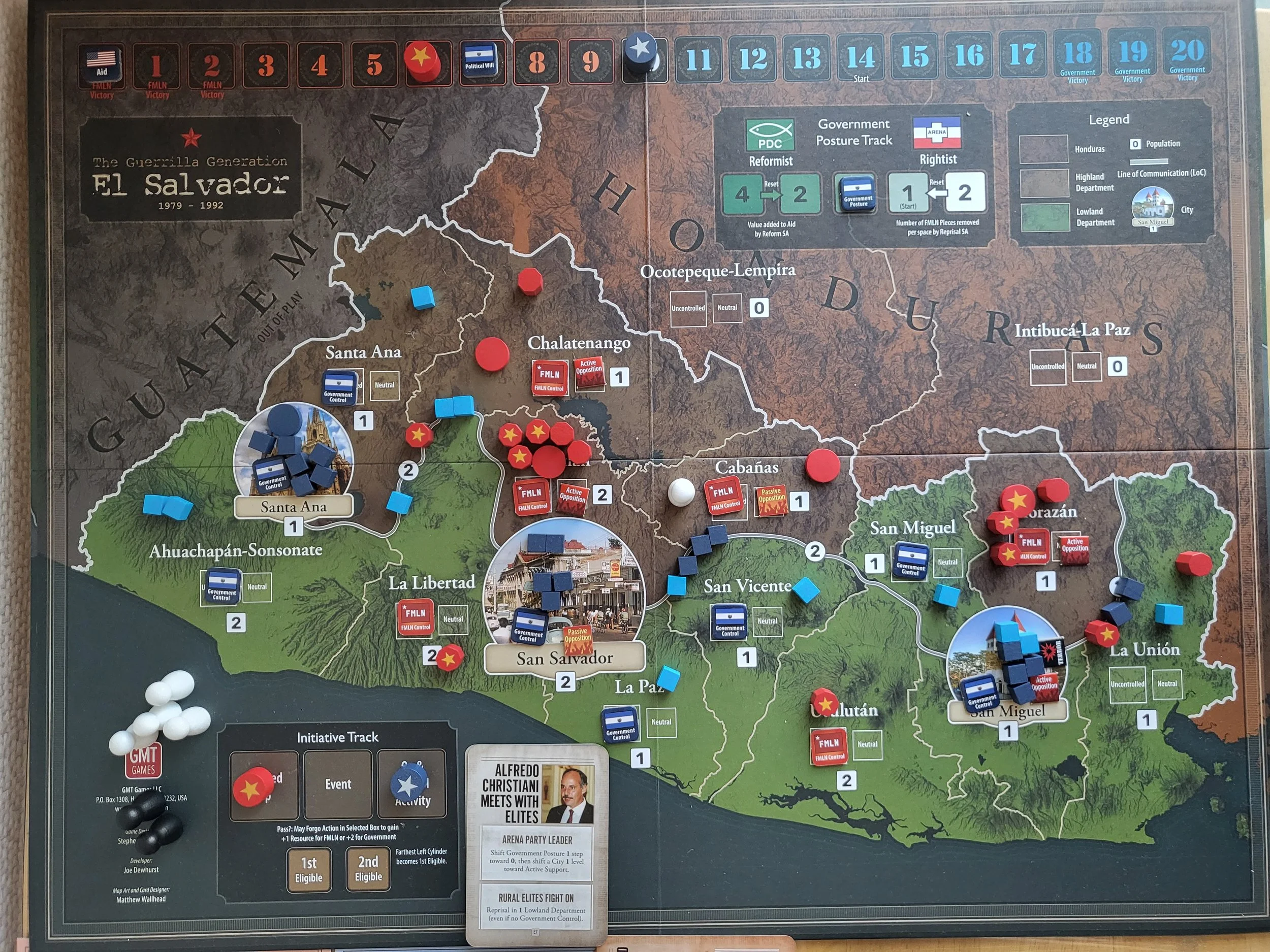
El Salvador is a much prettier map - maybe one of my favorite COIN maps so far? It was a joy to play on, even if it was also at times upsetting.
When they govern, the revolutionaries also have a chance to expose government atrocities. The player draws a card from a slim deck of only half a dozen cards, half of which are marked “atrocity exposed.” These cards have a requirement, usually for there to be terror markers in certain spaces. If that requirement is met they can then can be placed aside for an end of game shift to political will that favors the insurgents. Importantly, this can only happen if the revolutionary base representing their radio station is on the map and in El Salvador (not across the boarder in another country), so the government can try to shut down the broadcasts. They can also simply deny them – one result in the atrocity deck is government denial, and in one of our games another event allowed the government player to shuffle an exposed atrocity back in the event just because the president told Reagan it didn’t happen. As the insurgent player, I was livid, as you can imagine, but it was also a great reminder of Reagan and the US’s complicity in all this.
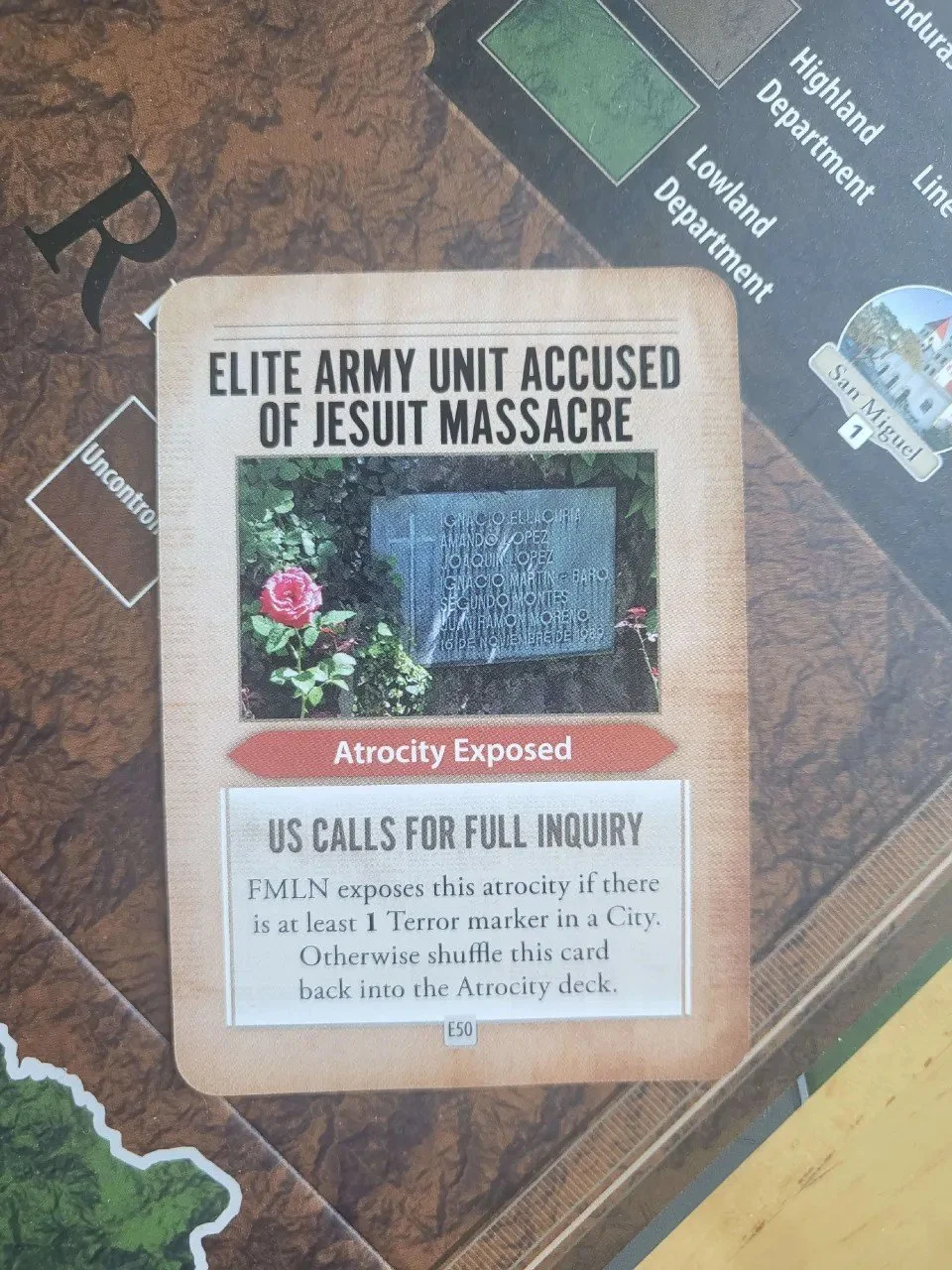
A sample Atrocity card.
The government player must also balance two resources. They have the usual COIN resource system (same as the guerillas) but they also have aid from the USA to manage. While aid systems are not exactly unheard of in COIN, this one stood out to me because there are several very important (and powerful) actions that can only be paid for with aid. The aid is not a bonus set of resources to fall back on, but rather key to the regime sustaining itself. During propaganda rounds aid also only goes up if political will is low enough – the USA won’t support a regime that’s winning, but will be scared into throwing them resources if it looks like they might collapse.
El Salvador presents a very difficult problem for its players, especially the government who must balance their political position between two right-wing extremist policies and maintain control against an insurgency that can hit back at them surprisingly effectively. It also does a good job dialing in on the horror of this conflict. A few times during the game my opponent and I felt genuinely uncomfortable with the events or actions we were taking.
I will admit to knowing basically nothing about El Salvadorean history, and this game really helped me to get some level of understanding of the conflict. It also helped that my opponent periodically sent me short documentaries about these conflicts so I could brush up on the history while we played.
There is a lot that it does not cover, and which couldn’t effectively be covered by a whole country’s strategic level approach, but I think it does its best to introduce many aspects of the conflict to its players. It is also a really engaging game with a lot of options for players to explore over multiple plays. While I moved on to the next game after two plays of El Salvador, I am very interested in returning to it in future (especially via the Resisting Reagan scenario, eventually).
Nicaragua
Nicaragua felt a bit like COIN as it would be played in a mirror world episode of a Star Trek series about huge nerds (okay, that might be all of them, but you get my point). The core itself has not been significantly altered here, and there are relatively few extra systems added on to it. Instead, the most radical change is in the menu of actions, which felt very different from any COIN I had played before, but not so much that I could not recognize the genre of game I was playing. Hence the mirror world, the actors are the same but now some of them have beards and the personalities are all weird.
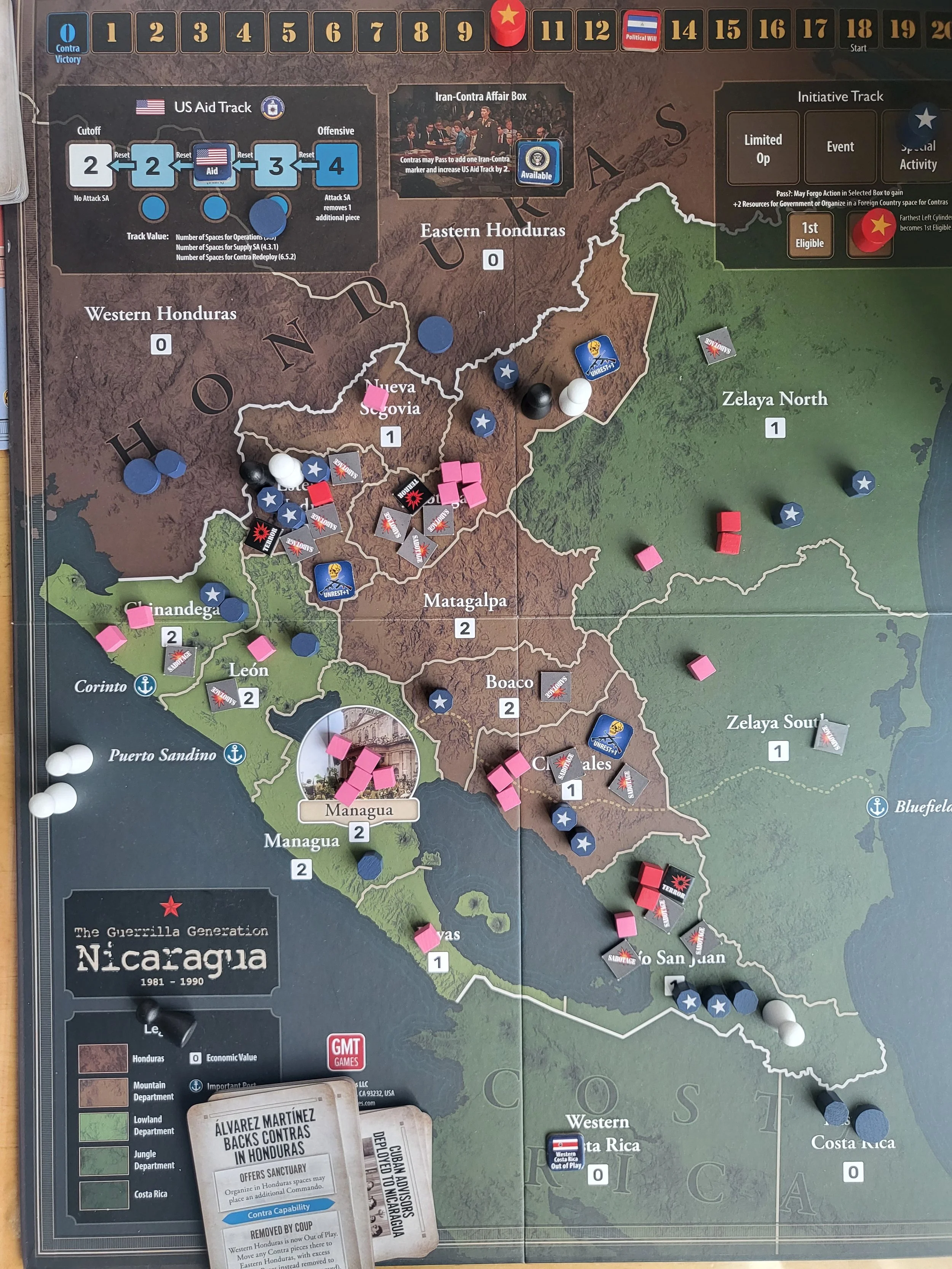
The Contras are leading a cross-border insurgency so they can’t just crop up anywhere they want on the map. Instead, you either deploy new pieces in Honduras and Costa Rica, or you can, through the Supply special action, reinforce an existing continuous line of pieces already in Nicaragua with new commandos. This restriction means that a lot of the game focuses on the almost logistical puzzle of how you get your pieces into the country and make them as annoying as possible for the government player. Like Uruguay, pieces cannot be replaced by other pieces, so if you have all your commandos on the board you must make do with what you’ve got – meaning you might want to keep some in reserve for a key deployment. You also have very few opportunities to hide pieces again once in Nicaragua, making them potentially more vulnerable, and during the propaganda round all but a few spaces will be emptied again, forcing you to restart from almost first principles.
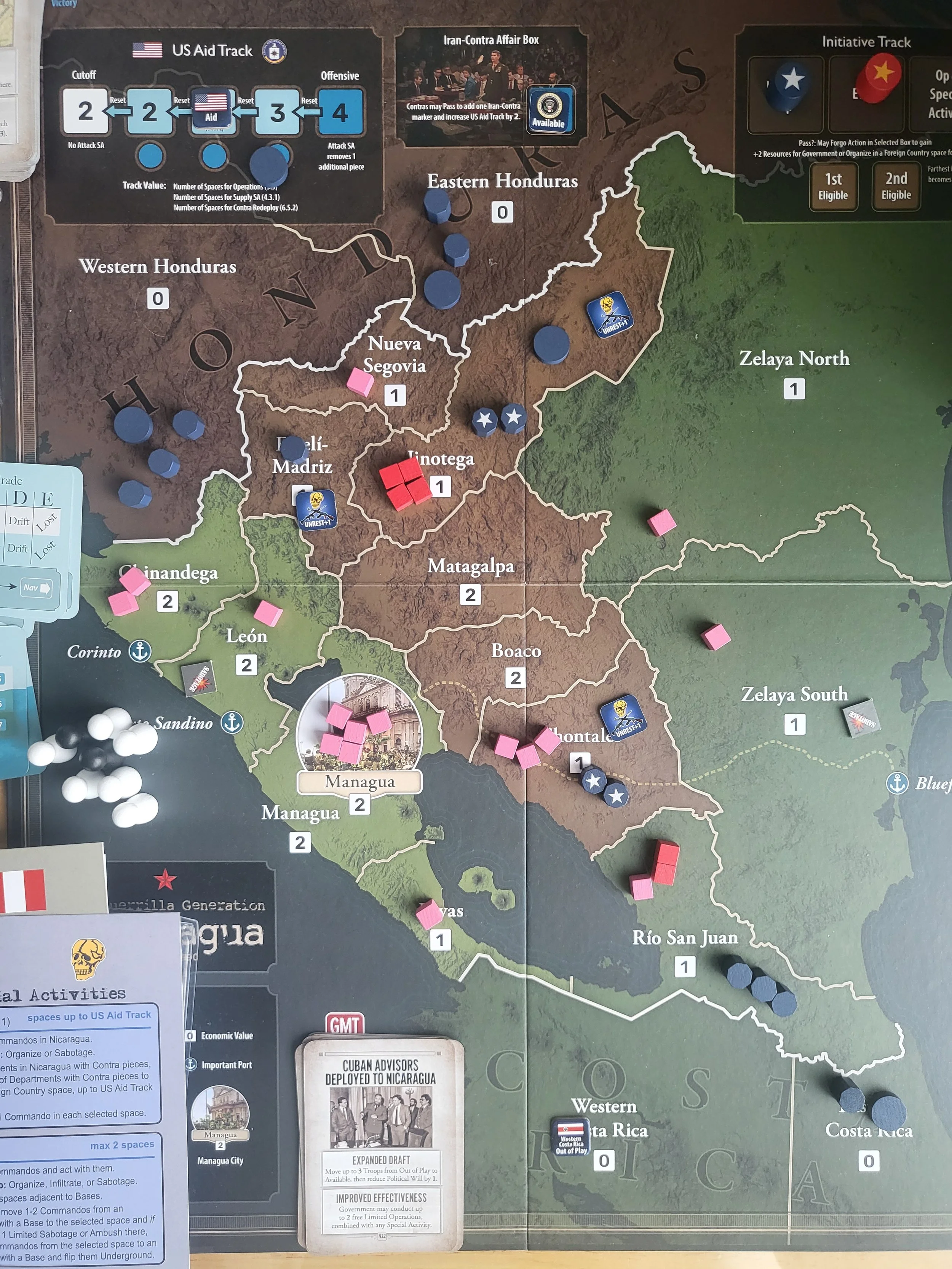
The Contras originate in Honduras and Costa Rica and can push into Nicaragua from both directions, while the government player must try to limit their penetration into the map. This map is also quite attractive, but it can be a little hard to recognize the difference between the Jungle and normal terrain, especially if you’ve covered the terrain key with your play aid like I have here.
The name of the game here is the sort of area control push and pull we saw in Uruguay. If the Contras can establish a majority in a region during propaganda, they can create unrest and decrease political will. They can enhance their position by acts of sabotage, sometimes adding terror markers as well for more effective sabotage actions. These terrors can come back to bite you, though, so you’d best time them as close to the propaganda round as possible.
The most interesting wrinkle here is that unrest markers linger into the next campaign (the technical term for the game played between propaganda cards). Unrest markers are flipped to a +1 side, meaning that if that area is in unrest again next propaganda it will inflict greater damage to political will. What is more interesting, though, is that the Contras win ties in areas with existing unrest but lose ties in places without. In a game where the number of pieces held by both sides is limited, this edge can have incredible consequences, especially as the plus one modifier incentivizes fights over certain areas.
The lingering unrest also helps to avoid the sort of unreality of the structure of COIN. While as a game these sudden and semi-random scoring rounds are really engaging, in many entries it is hard to know exactly what they mean. The reset phase that follows can feel very arbitrary and game-like, lacking any relation to history. Suddenly everyone just forgets about all the terrorism they suffered, as the board is cleared of terror markes, and moves on with their lives until the next bout of terror arrives. The lingering unrest markers remind you of what happened in the last campaign and tell a story of where the worst of the conflict is hitting the people and creating dissatisfaction with the government’s ability to protect them.
Playing as the Contras also gives a decided feeling that one is really fucking this country up. You are littering it with sabotage, terror, and unrest. This is not an insurgency that is seeking to make things better. Rather, it is one seeking to ruin and destroy. You are, to quote Mitchell and Webb, the baddies. This is supported in part by the fact that your funding all comes from the notorious Iran-Contra. The Contras have no resources to spend, but instead their actions are set by their level of external funding. The government, in contrast, must pay for everything. Your backers want you to ruin this country, to topple this government, and you get a real sense it’s not to make the lives of anyone better.
The ultimate goal is for the Contras to bring political will to zero and for the government it is simply to survive. This is a test of endurance – a miserable, grinding, battle of wills from which there is no real winner. You can only try to avoid being the second worst loser – the worst always being the people forced to endure this conflict.
Peru
Peru might be the most classically COIN game in the box. Like El Salvador we have control and support/opposition to keep track of. Insurgents perform terror to erode public support and sway people to their side while the government is sweeping and then assaulting cells with a mix of police and soldiers. There’s a big city to fight over and three different types of region. While El Salvador had a lot of these elements, it also felt more like an open civil war than a classic insurgency, which is where Peru differs.
However, it would not be fair to say this is just classic COIN distilled down to two players. There are extra wrinkles in the game to make it feel different. Chief among these are the rondas, the narrow fight for hearts and minds, and the search for the Shining Path’s leader, Guzman.
The rondas are the biggest change in Peru. These are insurgent style pieces that the government player gains when the Shining Path performs terror in the highlands. These pieces start inactive, with their symbol down, but can be activated either by random roll in the propaganda round (more on that later) or with special operations in designated Emergency Zones. Activating the rondas can remove terror, which is helpful, but even more than that the presence of an active rondas piece makes government assaults in the highland areas far more effective. If the government player wants to root out the Shining Path, they need help from the locals.
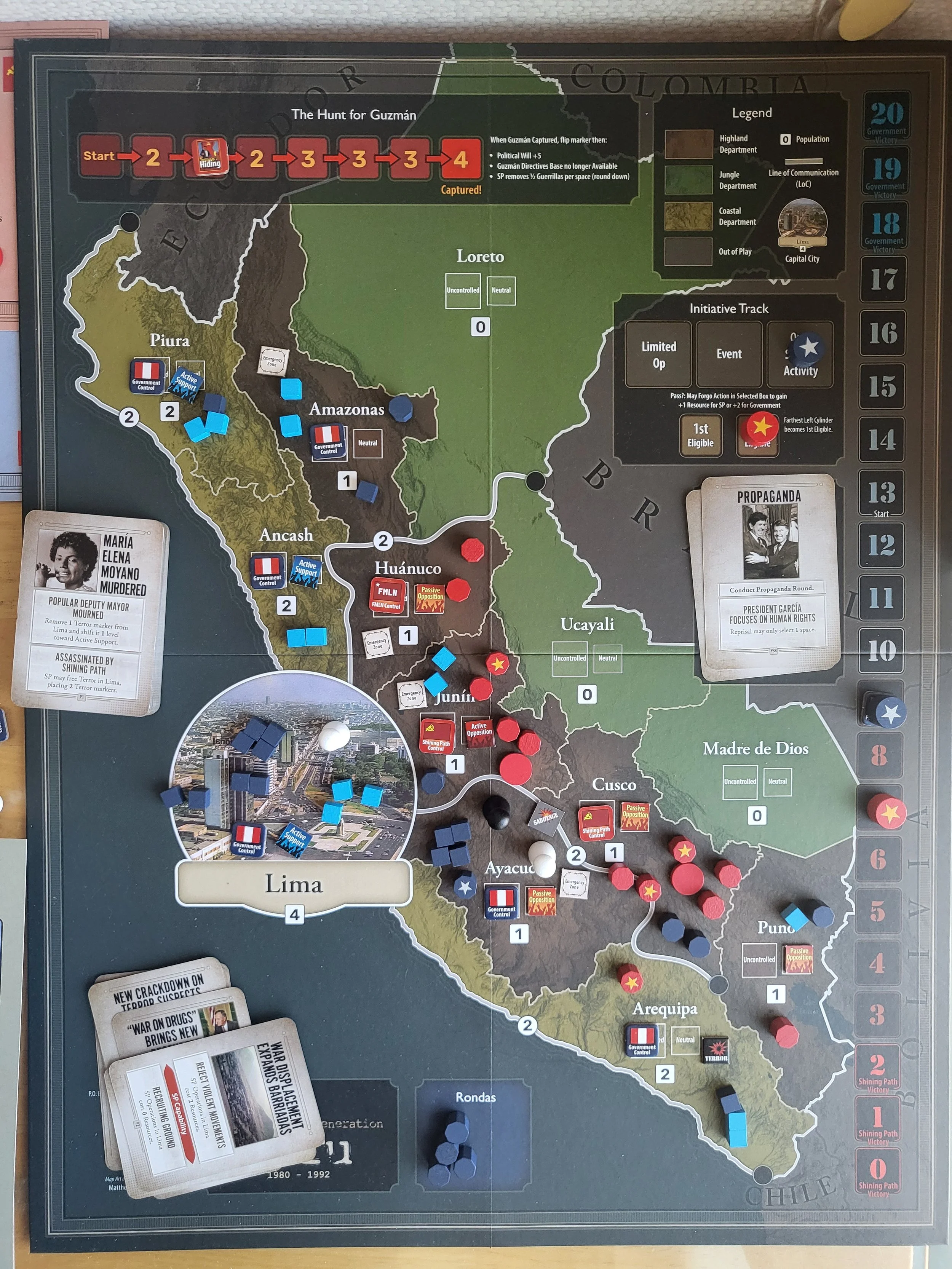
Peru can get a little crowded, but it never felt too overwhelming. There is a lot going on in this map, but once you’re comfortable with COIN it’s pretty easy to parse.
Overall, I really like the rondas. Because they mostly appear as a result of Shining Path terror, they give some extra flavor in showing that while their actions shift political will, they also make disaffected people who can cause problems for the Shining Path later on. The government has to find a way to tap into that disaffection by activating them, though, and their own reprisal actions can actually reduce rondas’ presence in areas, as government violence undermines potential support. Often the effects of terror feel too abstract in COIN, and I think the rondas help to create a more expressive narrative of terror.
Peru also does some interesting things with the differing values of its various spaces. During propaganda, only support/opposition in the central highlands spaces and Lima matters. The coastal regions track support, but mostly to restrict Shining Path actions (the presence of terror there can hurt political will, but whether they support the government or not has not affect during propaganda), and the jungle paces offer no bonus to victory but could be used to enhance Shining Path resources. These differences help to focus the action in Peru and that tells a story about what the priorities of both sides were. It also helps to highlight how the lived experiences of this conflict must have varied significantly depending on where in Peru someone lived.
The hunt for Guzman is interesting in broad sweeps, but not super exciting in the moment to moment. It’s represented by a simple track on the top of the board, and the two sides can roll on it to try and push a marker closer or further from the Guzman captured space. While I really liked the push and pull of the public sympathy system in Uruguay, this similar mechanism doesn’t work nearly as well for me. It’s just not very exciting as an action to take (and adds more random die rolls, more on that later). If the government player reaches the end the track, they gain five political will and remove half of the guerillas in each space on the map, a huge swing for them, and probably one they will need to win the game. So on some level this is a priority for you, and another ball to juggle, but it just isn’t that exciting.
You can also advance the track by finding Guzman’s HQ, one of the Shining Path bases that is secretly marked with a star (same as the People’s Prison in Uruguay). Finding the HQ also stops the Shining Path player from getting two free limited ops during the propaganda round, so it is definitely worth it. This is a more interesting bluffing game, but it doesn’t feel quite as tight as the hunt for the People’s Prison in Uruguay.
One thing that Peru adds is quite a lot more randomness. You have the normal randomness in the form of insurgent attack action – which can be made not random with the ambush special action. On top of that, though, you have the rolls on the hunt track and in each propaganda round you roll a dice for each area that has rondas in it. A roll equal to or lower than the number in the space flips them to active and moves the area one step closer to support, before the areas are scored. This can be quite consequential (if, unlike me, you can actually make the rolls), but you can’t count on it.
This randomness puts me in an awkward place. On the whole, I vastly prefer random elements in my historical games – I think you can’t properly represent history without acknowledging that there are elements beyond people’s control and events could always have turned out differently, which I think is best captured by having some unpredictability in the gears of your game. However, COIN as a system is noteworthy for its relatively limited use of randomness. These games often feel incredibly tight, with deterministic actions making you know what is possible and you build your strategy around that knowledge. Added randomness can throw off these calculations and make the game feel weird – when so much is deterministic, the odd bits of randomness stand out a lot more and can feel kind of awkward. This has me all conflicted – when I’m playing the games I mostly don’t like to have to roll dice. With so few rolls, it can be hard for the curve of probability to be relied upon during a single game – if you only make three rolls in the game, what if they all go against you? On the other hand, I love accounting for randomness in historical games and sometimes the deterministic nature of COIN makes it feel like you are playing with Laws of Human Behavior instead of exploring a model that attempts to make sense of the chaos of history. I don’t have a neat conclusion here, I’m conflicted and Peru reminded me of that, a lot.
Resisting Reagan
Cards on the table, I haven’t played Resisting Reagan yet. This scenario combines Nicaragua and El Salvador into a bigger game that incorporates USA meddling from the Reagan administration and the Central American Peace Movement as key factors in both games. It looks really cool, but I haven’t tackled it yet. When I do, maybe I’ll write a separate post about it. Sorry to you, dear reader, if you were hoping for my thoughts on it!
Final Thoughts
I have suffered COIN fatigue. While I fondly remember the entire day I spent playing A Distant Plain I am not overly interested in spending 6+ hours on one of these games again in the near future. For that reason, the shorter experiences offered in Stephen Rangazas’ multipacks have really appealed to me. The Guerilla Generation is a strong continuation of what The British Way established. Each of these four games is a fascinating take on the COIN system that won’t take you a day to play – in fact you could probably play all four in one day if you set your mind to it. While I don’t like them all equally, I did enjoy each one and I will happily continue to play them in the years to come. That said, Uruguay is the best one, don’t @ me.
I particularly appreciated the variable takes on terror and coercion seen in these games. One thing I have always been at odds with COIN about is how abstract terror felt. Playing the Taliban, I rarely felt the seriousness of what my acts of terrorism actually meant. The Guerilla Generation offers several different ideas of what terror means – you have the classic insurgent terror action, but you can also see it in government reprisals or even when they move soldiers into certain population centers where oversight of their actions wasn’t as strong. The experience is a lot more focused and gives you a lot more to attach your actions to. I emerged from my plays with a much more sobering sense of what had been done in the game. My opponent and I even made an effort to alternate who was playing the probable war criminals, a consideration that rarely came to me in previous games where it was the actions, not their meaning, that determined who I liked to play.
The word “simulation” gets thrown around a lot in historical wargaming, and I am not always all that impressed by how it is used. It seems to me that it can often be used as a method of quashing debate or historical analysis – it justifies the portrayal of some of the darkest times in human history in game form while also limiting debate about how it portrays that history. I generally prefer to think of games as arguments or attempts to explain a historical perspective, but they are only that: one historical perspective. They always have limitations, and the limitations are as much in the designer’s vision of the history as they are in the game’s mechanisms. All of this is to say that sometimes I approach games with a slightly jaded view as to whether they can actually do what we like to claim they can. Does playing a historical game actually grant you greater understanding of the history in question, or is that just how we justify the hobby to ourselves?
I bring this up because if there is one designer who I think is facing this challenge head on, it is Stephen Rangazas. The bibliography in The Guerilla Generation is immense, the historical notes detailed, and the explanations of the history respectably robust while also encouraging you to please go read a book about these topics. The very format of the multi-pack encourages comparison between games, which in turn makes it natural to question the model and the systemic architecture of COIN itself. Why does this action work in this way in one game but differently in another? This question pushes you down an avenue that will hopefully get you to interrogate the very assumptions of the games and its system.
The Guerilla Generation is a masterpiece, you should check it out.
(Hey, if you like what I do here, maybe consider making a donation on Ko-Fi or supporting me on Patreon so I can keep doing it.)