
This one has been a bit of a struggle. Usually, when I’m planning to review a game I get a decent set of thoughts from the first couple of plays, and the subsequent plays are an exploration of what I might have missed alongside a probing of how sincerely I hold my initial thoughts through further games. While I can’t endorse this as the perfect method for generating reviews, it generally yields the results that I want: an exploration of my thoughts and feelings of a game rather than whether the game is “good” or “fun”. I want to dig into the history, what the game says, and how I feel the whole thing hangs together as an experience. However, every so often a game comes along that is a real challenge to get my head around – not in terms of rules but rather just as an experience. Molly House is the latest challenger, and it has sent me for a bit of a mental loop. That means that today’s review is going to be even messier than usual as I try to create some structure and order to my thoughts on this fascinating, and slightly messy, game.
Wherlegig Games kindly provided me with a complimentary review copy of Molly House.
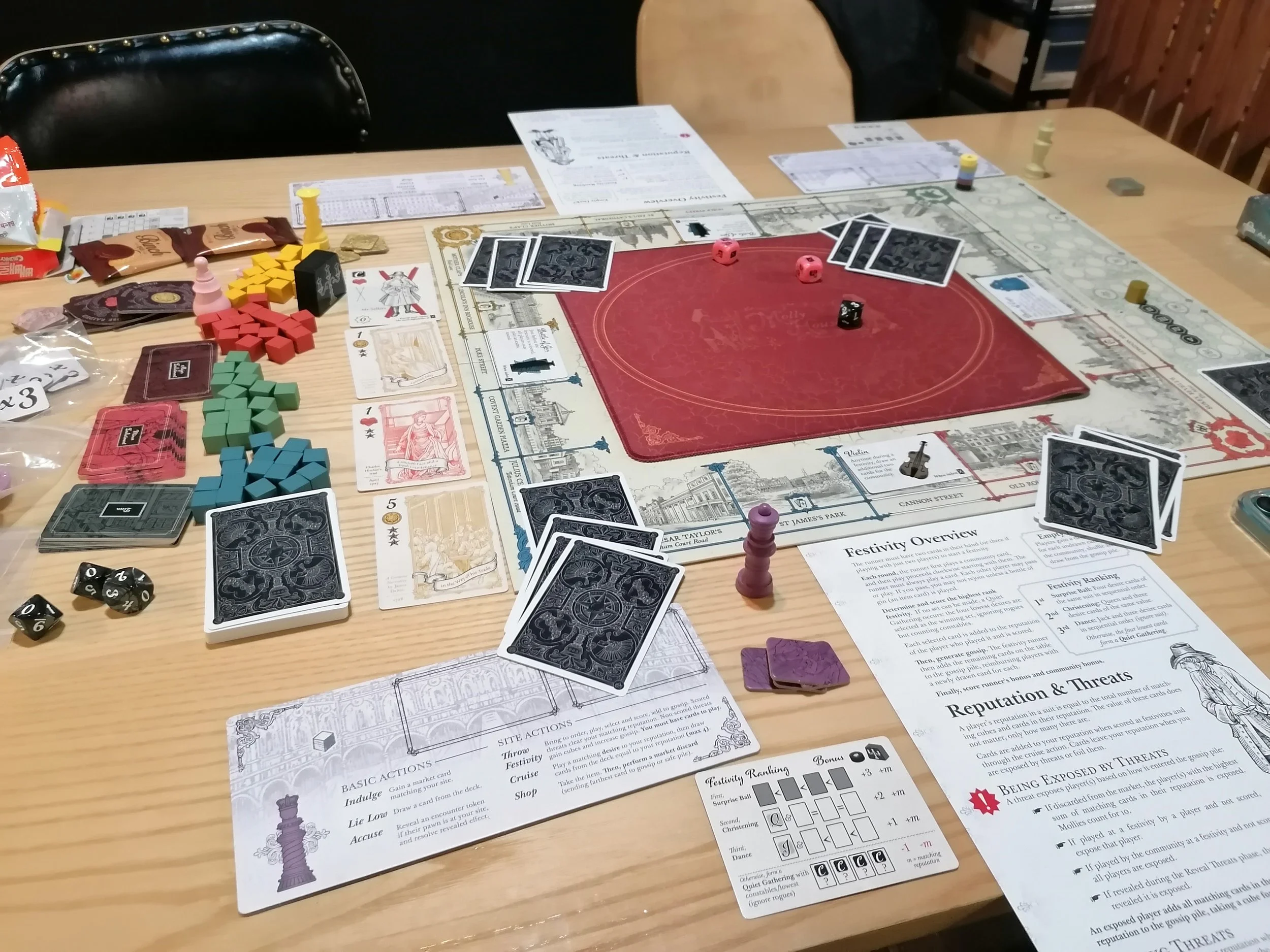
Molly House is a gorgeously rendered game on queer life in eighteenth-century London. Players cooperate to try and live their best lives in a society that actively seeks their suppression, and in the end the (surviving) player who had the most joy wins, but only so long as the community as a whole can survive. Via simple roll and move players will move their pieces around the board to collect cards and items, play cards to their tableaus, and, most importantly, throw parties. At the same time, there is always the lurking fear of infiltrators and other actors of the semi-official Society for the Reformation of Manners seeking their suppression. The titular Molly Houses, where the parties are held, are subject to raids, and players can collect both risk in the form of their greater reputation and indictments for their crimes against contemporary social mores.
I don’t want to say that Molly House is more interesting than good, not because I think that is mean but because it isn’t exactly what I think. However, I’m struggling to find the exact words for how I feel about this game. I have reveled in bringing it to the table and showing people how it plays. It’s a wonderful game to introduce people to. You can show them a historical topic and gaming experience that is probably quite different from anything they’ve encountered before. At the same time, as a game, I don’t know if I find it all that engaging. My joy in playing Molly House comes so much more from the experiences of the people I’m introducing it to, which feels like a criticism of the game, but I am only having this experience because of the game so maybe it’s amazing? Last year, I picked Molly House as number one in my retrospective of new to me games, and it’s because it wormed its way deep into my brain, but I also can’t help but think that once I run out of a willing audience of new players my excitement for it will be greatly diminished.
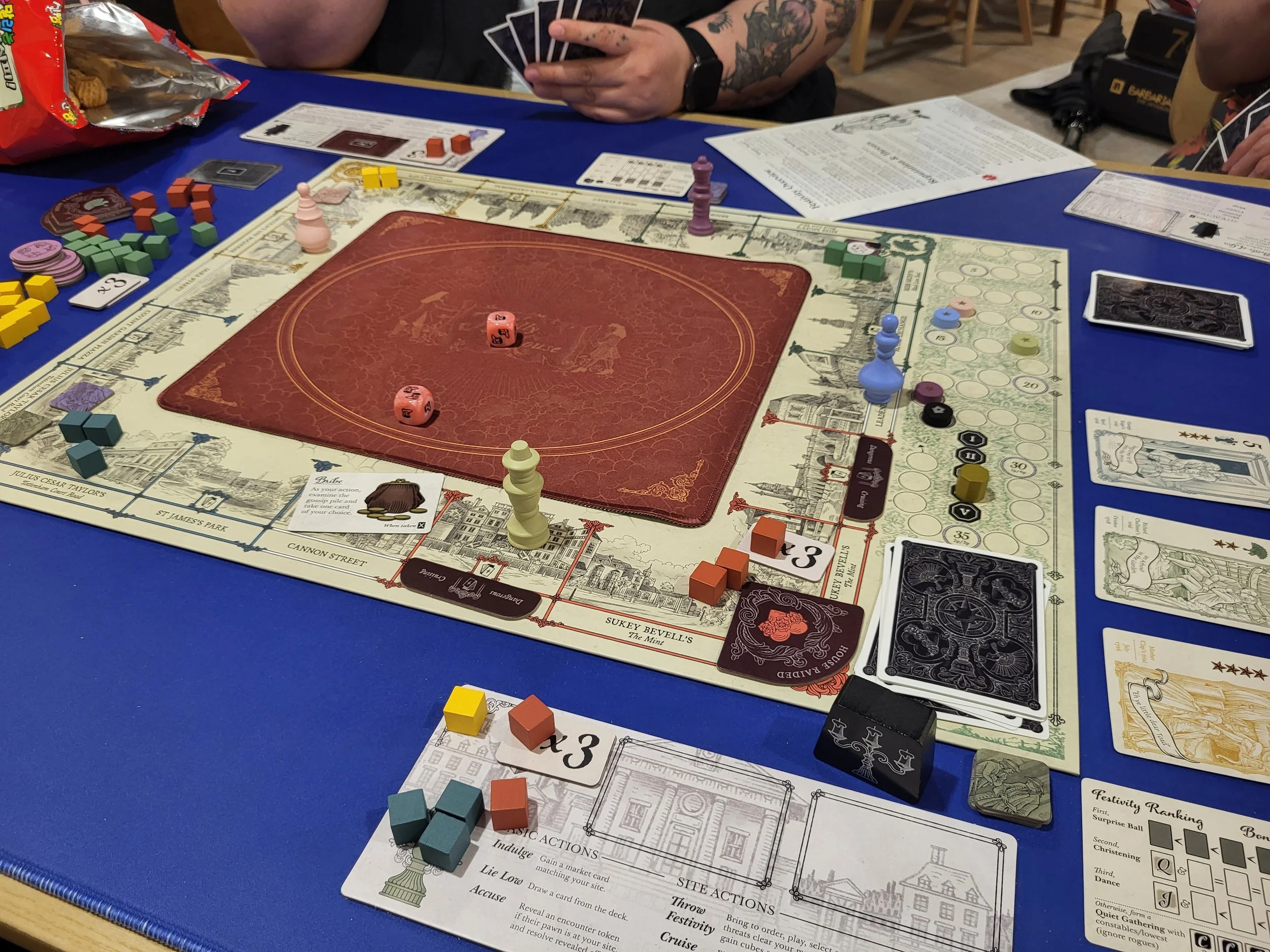
Really can’t understate how beautiful this game is, and how fun it is to push the pieces around.
That’s all a bit vague, but maybe it will make more sense if I try to dig into specifics a little more.
I think the mechanic that maybe best encompasses my complex feelings about Molly House is the indictments that players receive when the titular houses are raided. Whichever player has the most reputation in the house (something you want for scoring more joy) receives a major indictment and whoever comes second in reputation receives a minor one. You hold on to these until the end of the game, when they are revealed and affect your final score. There are several different flavors of indictment, but in general you are going to roll a die and depending on the result you will suffer a penalty. Probably, this is a loss of joy (victory points), affecting your final score (possibly enormously), but some major indictments may result in your hanging, which (unsurprisingly) completely eliminates you from the game.
I think on some level this kind of fundamentally undermines the experience as a competitive game. Having your 2-3 hour gaming day end on “don’t roll a 7+ on a d10” isn’t the most engaging or interesting experience. However, as a historical gaming experience this is amazing. I love weird randomness in my games, especially when that randomness is putting you into a historical mindset, and I think this really succeeds at doing that.
It also ties in tightly with the game’s representation of betrayal. When a house is raided, each player puts a hidden token on one of the not yet raided houses. You can place a token indicating your continued loyalty to the community, or you can choose to do whatever the eighteenth century equivalent of turning state’s evidence was. If a house that you have decided to rat out is raided later in the game, all of your indictments will be forgiven. However, should you fail to cause a raid of that house, you’re getting an extra indictment as a failed narc.
Since the indictments are so brutal, and varied, when you get one you could be staring down the barrel of some lost VPs or you could have a 50% chance of just losing the game no matter what. That does a lot to encourage betrayal. However, the game’s framing around community joy and survival, plus it’s semi-cooperative nature, plus you’re playing a game about historical queer persecution in a time when many queer people are persecuted by their home countries, does a lot to nudge you towards taking one for the team and risking death over a shot at victory. Does it matter if you win? Isn’t that being overly selfish? Is it more important to you to win a boardgame or to be an ally?
This creates this whole meta experience about what integrity means to the people playing the game and can make the betrayal hurt so much more than someone being a Cylon in Battlestar Galactica, for example. It also creates a strong incentive to play against the game as a game – to discard the purpose of trying to win in exchange for maintaining the community. You could even play it purely cooperatively and throw out any consideration for who actually wins, because if the community survives you’ve won. I quite like how open Molly House is to subversive play like this, but to roll back to my earlier point, it kind of hurts it as a game that I want to play over and over again with the same group. Seeing how a new set of players respond to these pressures is so engaging, but running the same group through them again and again has diminishing returns.
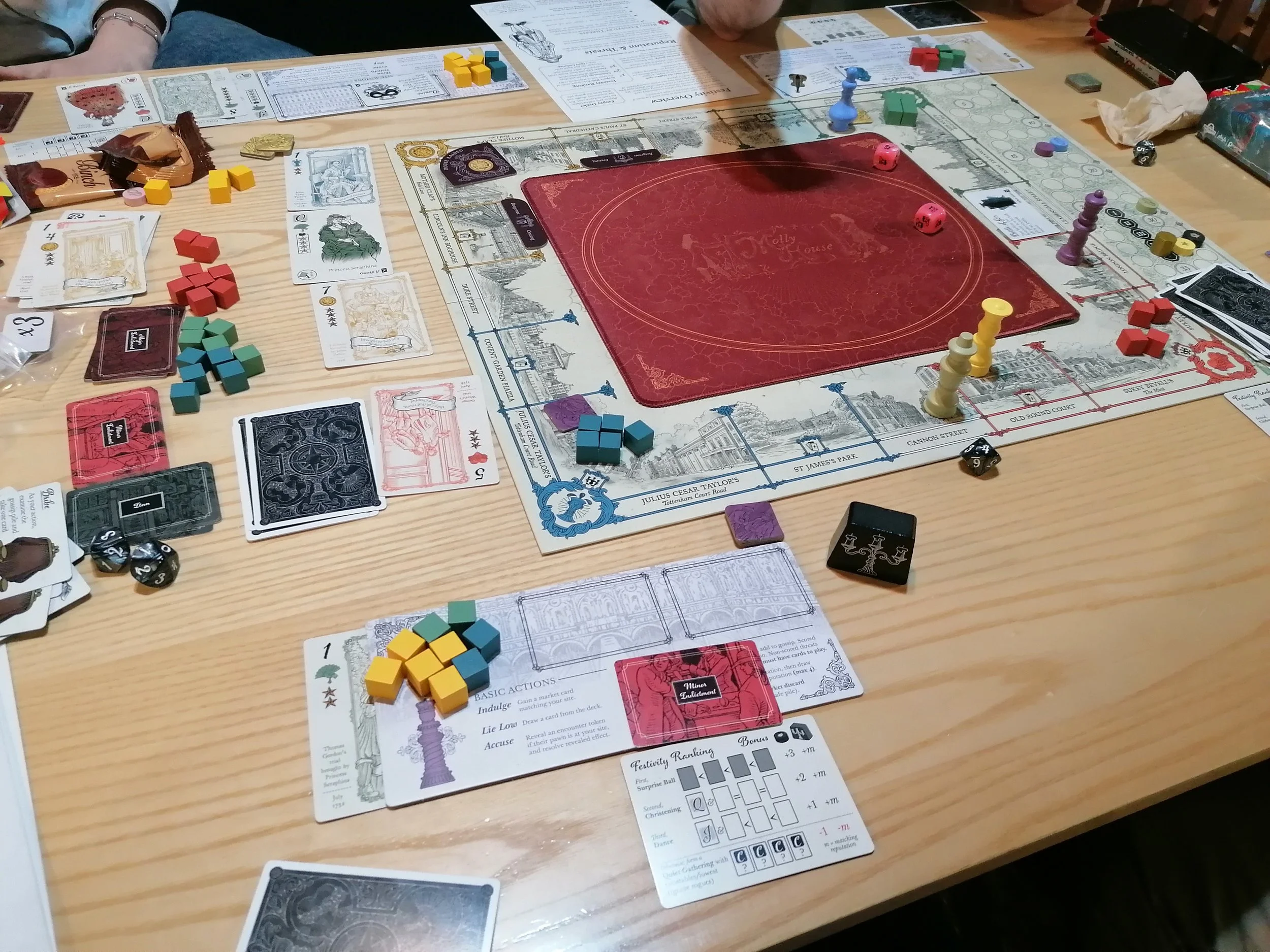
There is, of course, an entire system for accusing other players of betraying the community and exposing them as a collaborator. I’m sure there are people for whom this is a core part of the experience of playing Molly House, but for me it feels overwrought. This is not Shadows Over Camelot or Battlestar Galactica (am I dating myself with those games?) where accusing traitors is the core of the experience. Yes, having a system for creating greater suspicion is cool and all, but the extra rules weight for how an exposed collaborator functions is just a lot more on a game that already has a lot of moving parts, and for not a lot of gain in my opinion.
Which brings me to maybe my single greatest complaint about Molly House: I really hate its rulebook. I found this game incredibly challenging to learn, and eventually had to rely extensively on teaching videos on YouTube, which is something I hate doing (I struggle to process audio vs. reading rules). It isn’t a good reference rulebook either, which creates problems when there are so many different elements in the game. No single rule is particularly complicated, but it is very important that you know how those elements interconnect to ensure that the game runs as intended. Minor errors or forgotten rules can have cascading effects on the experience. While obviously more of an initial problem, this also makes me more reluctant to play it again. If I let too much time pass between plays – something that is very common, since my main interest is in playing it with new groups – then I have to relearn the game, and learning it was miserable.
There are also elements of Molly House that I’m basically neutral on. The roll and move around the board in a manner that vaguely reminds me of Talisman is fine – I enjoy roll and move when done well. I wouldn’t say it’s particularly interesting here, but it also isn’t detrimental to my experience. Similarly, the acquisition of items to add to your meagre inventory is also fine. These items can add some interesting wrinkles to the parties, but I also don’t know that they feel so tight and integrated as to make the experience significantly greater for their inclusion.
I can’t write about Molly House and completely ignore what is arguably its core mechanism: throwing parties. Parties are kind of simple in that you’re basically assembling one of a few types of pseudo-Poker hands. The game throws a few lovely wrinkles on that though – the first being that you must select the highest possible value hand at the end of the party. A higher hand represents a bigger party – quiet parties might let you avoid the attention of the law but won’t boost community joy. You can’t win the game on quiet salons.
You also can’t successfully party alone – you need other players to join in if you want the biggest parties that will secure the most joy for the community and yourself. That means collaborating with your fellow players, which in turn probably means sharing the joy with them as well. If you’re too selfish other players will choose not to contribute, or maybe even to try and sabotage, your future bashes.
The players aren’t the only ones who show up, though, and it is the community cards that add the wrinkle I enjoy the best. Random cards will be drawn from the deck into the possible cards for the party. Maybe you can ignore these cards, but because you have to build the best possible type of hand the community could show up and turn your quiet party where you’re trying to avoid the attention of The Society into an attention grabbing fake baptism that ultimately leads to a raid on the Molly House. This is the kind of thematic chaos I look for in a historical game.
It should be no surprise that I don’t have a neat little conclusion to this review, which has basically been me meandering through my thoughts on Molly House I still stand by my selection of it as the most interesting game I played last year, but I also don’t think I will keep my copy. I don’t have much of an interest in getting it down to play again and again, and it’s hard to justify a spot on my limited shelf space for a game I might only pull down if there’s someone I really want to show it to. I would probably be better served giving it away to someone else to let them experience it whether I am present or not. It’s a game that I think almost everyone should try, but it is hard to imagine myself ever truly loving it.
(Hey, if you like what I do here, maybe consider making a donation on Ko-Fi or supporting me on Patreon so I can keep doing it.)