
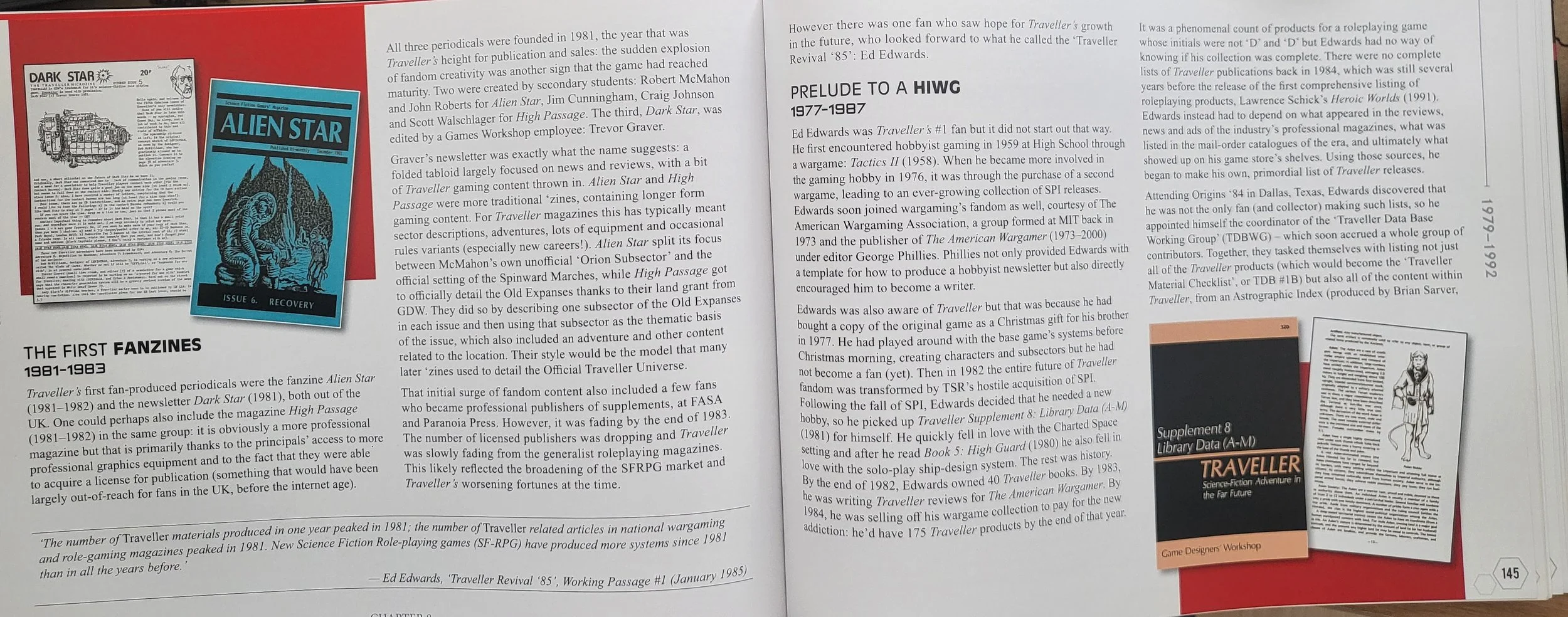
I’ve never played Traveller, which makes it a little weird that I decided to read a pretty lengthy history of the game. However, I have an ongoing fascination with the history of tabletop roleplaying games (TTRPGs) and I want to expand from my knowledge from the histories of Dungeons and Dragons to other roleplaying systems. I had heard good things about This is Free Trader Beowulf, and Shannon Appelcline has an impressive reputation within the field of historians of TTRPGs, so I decided to grab a copy even if I have no personal relationship with the system (outside of an ongoing joke from university friends about how you can die in character creation, I can’t claim we were very original). Overall, I enjoyed This is Free Trader Beowulf, but I also found my lack of connection to the system held back my enjoyment and I often wished it was a slightly different book than it is. I can’t strictly criticize it for that difference – the book is what it’s author wants it to be – but I do want to explore that some here in case you, dear reader, are like me (or, if not, that you at least can learn if this book is for you).
This is Free Trader Beowulf takes an era-by-era approach to the history of Traveller – starting with its earliest origins and following a mostly chronological progression of the game from the 1970s to the current day. Traveller has had a bumpy history, moving between multiple writers and publishers with some spin offs (e.g. GURPS Traveller), and as a relative novice I had never really understood the different versions and eras. This is Free Trader Beowulf held my hand and walked me through this confusion and helped to explain who was behind what part of Traveller and why it bounced around – for example, explaining to me what the hell MegaTraveller was. In this way, the book does what it says on the cover: I have a much clearer idea of the development of Traveller over the decades. I do wish it spent a little more time on the creation – as a huge fan of Playing at the World I would read whole books about how the ideas for TTRPGs came to be – but again I can only complain so much about wanting a book to be different from what it is.
My favorite sections were probably the chapters that were devoted to the robust fan culture that rose up around Traveller, and how those fans often transitioned to writers of the game they loved. These chapters help to expand the book’s scope beyond the strict confines of Traveller’s publishers and into the people who played it. I do think it still focuses a little too much on the publications and the management of the fan clubs. I would love to learn more about what these people actually said about the game (the discourse around it, if you will). Still, it was really interesting to see how closely intertwined Traveller’s fans were with the game’s production, and the difference that GDW’s approach to its fans made when compared to how hostile TSR often was to D&D’s fans (and the idea that those fans might be writing and publishing content for the game).
If I have a mild criticism of This is Free Trader Beowulf, it is that it leans heavily into lists of books that were published for Traveller in its various eras (along with boxes outlining releases that never came to be). This is valuable information to have, and represents a useful historical archive, but this is where my lack of personal connection to Traveller felt like it held back my enjoyment of the book. Early on I was interested to see how Traveller expanded, but as the book progressed, I cared less and less about what splat books came out for a certain era or version of Traveller. I would much rather have learned more about the people who wrote the books and the audience who read them – there isn’t none of that in the book, but I would have liked more.
Now, this is a personal complaint rather than a failing of the text. From the checklists of books present at the end of each chapter, I can infer that this listing of books is part of the purpose of This is Free Trader Beowulf and probably there are people who want that, and I’m happy for them. But, if you are like me, maybe this book won’t click with you as well because of this.
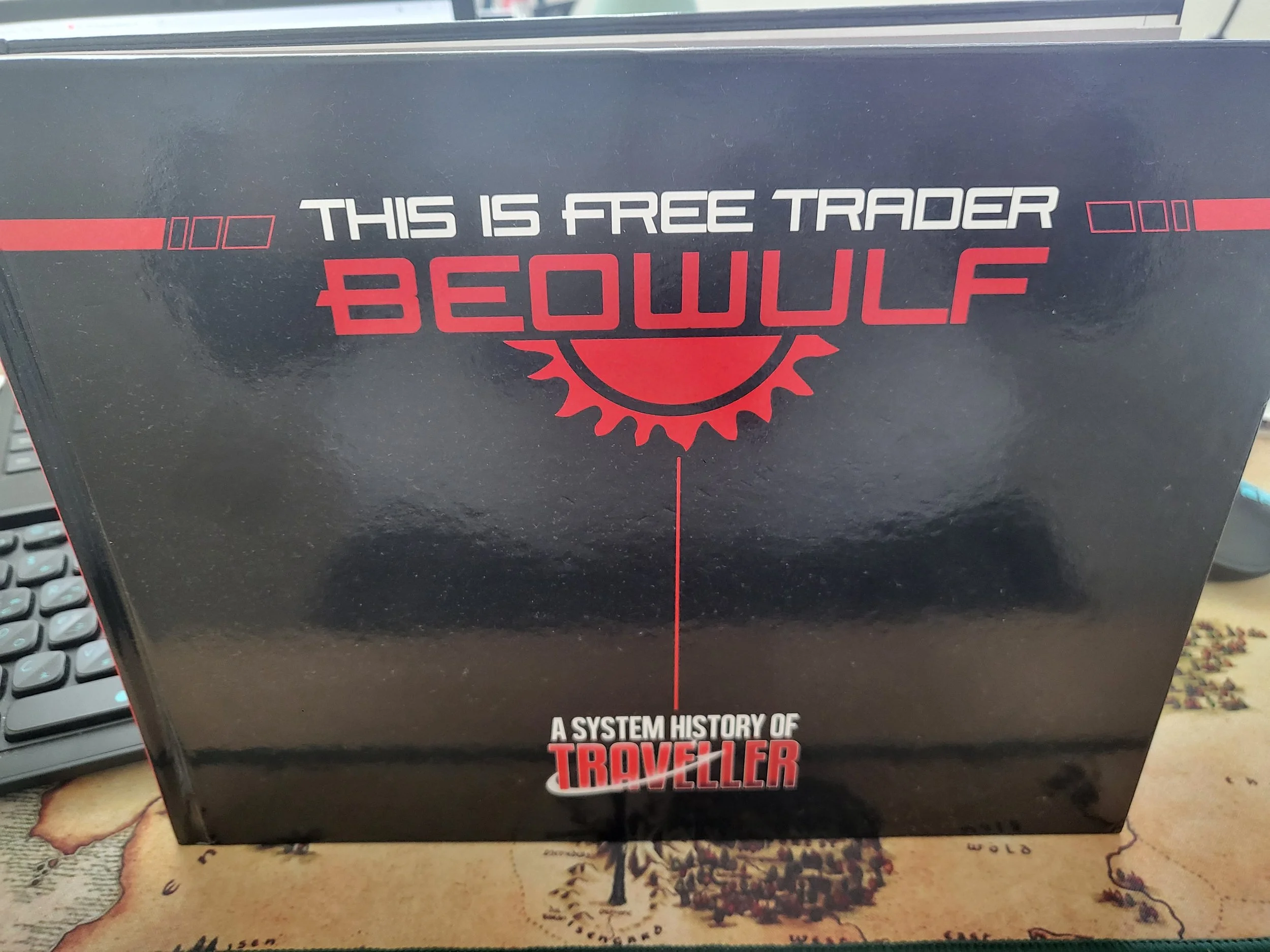
I also have some gripes with the book as a physical product. First of all, it’s laid out as a sort of coffee table book, where it’s much wider than it is tall. I find this very awkward to hold and read, and I do not like it. Also, it has not been through a thorough enough copy edit/proofread by the publisher. No fault of this lies with the author, it’s just part of the writing process, but it’s the publisher’s job to correct them and there are a few glaring proofreading errors in the text and I hate to see it in any book, and especially in a book that costs as much as this does. These aren’t world ending problems, but they were frustrating.
The formatting/proofreading errors are especially disappointing because the rest of the book is gorgeous. Since it is published by Mongoose Publishing (the current publisher of Traveller) it includes lots of official Traveller art and other materials to look at. Including the visuals of Traveller helps to show how those aesthetics were developed over the game’s history, and those aesthetics are such a big part of Traveller’s identity. I love the splash pages of art and the general layout of text and images. With the wide format it meanders a bit into coffee table book range, and maybe if I had treated more like that I wouldn’t have minded the format thing as much. But, if you love classic Traveller art, or are just curious what a Traveller module from 1982 looked like, this book has you covered.
Overall, I enjoyed This is Free Trade Beowulf, and I would generally recommend it to fans of Traveller (but maybe they are the group who least need my recommendation). I know a lot more about the history of GDW and the legacy of Traveller as a venerable TTRPG, which is what I wanted out of reading this book. However, I did grow a little tired of the lists of books as I was reading it, so the earlier sections held my attention better than the end. I will confess, I actually stopped reading the sections on books that were never finished for each era, because at about the halfway point I no longer cared. But caveats aside, look, it was interesting and I’m glad I read it.
(Hey, if you like what I do here, maybe consider making a donation on Ko-Fi or supporting me on Patreon so I can keep doing it.)