
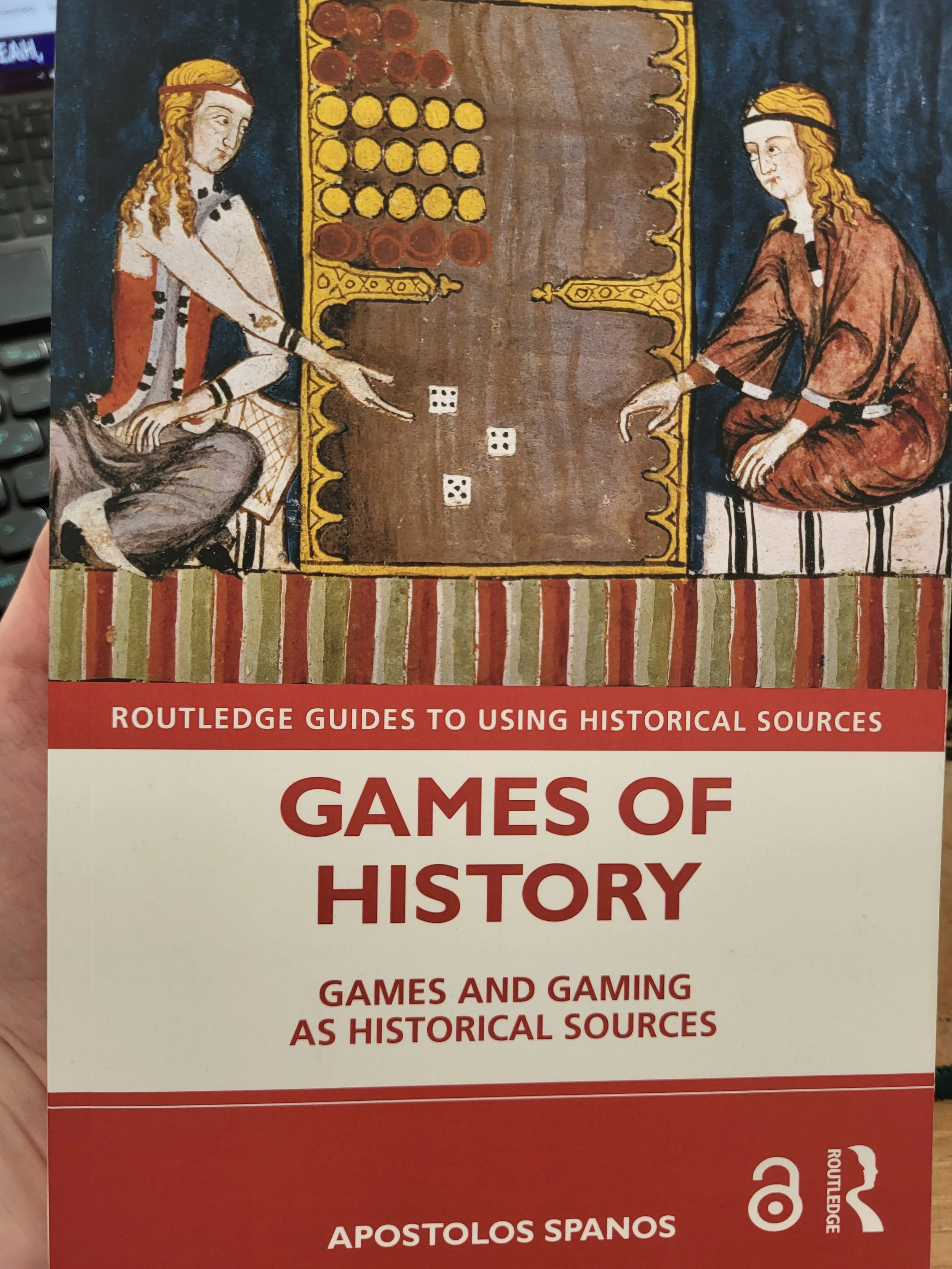
This is a difficult book to review. I did not particularly like it, but that doesn’t necessarily mean that it doesn’t succeed. Games of History is meant to be an introductory text to the methodology of using historical games to explore the societies that made them. It is not a history of games or game design, but rather a guide to how historians can better use games as evidence for understanding historical cultures. Spanos argues that this source material is often neglected by historians, and outside of a few very famous examples I would say he has a point. The history of games is often siloed off and does not intermix with other histories as much as it ought.
As an introductory text for students and scholars, I’m afraid that I think Games of History is kind of a failure. Its problem is fundamental: the book is just not very well written. It is incredibly dense, the kind of academic writing I associate with Oxford Dons of yesteryear. The opening chapters deal extensively with different theoretical frameworks for analyzing games as sources, which when combined with the dense writing makes for a periodically impenetrable and universally unenjoyable reading experience. I have read books this dense and found them valuable before, and there is information in Games of History that I found useful, but it hurts this volume’s hopes of being an introduction. If I struggled to make my way through the book, I can only imagine how a first-year university student would feel.
The book’s strongest points are when it uses examples. Spanos’ explanations of more abstract concepts were a struggle, but when he is writing about specific examples many of the disparate threads come together much more clearly. The final three chapters of the book are case studies, and they are among the book’s best. If he focused more on the specific, and spent less time on the abstract, I think his arguments would be easier to follow.
Somewhat surprisingly, the best chapter is probably the one on games and metaphysics. I certainly expected the combination of the already abstract and frequently dense field of metaphysics with Spanos’ writing to be difficult to follow, but this chapter is focused and an engaging account of games as tools of mysticism and the relationship between religious institutions and games across different periods. It combines historical examples with theory into an enjoyable and interesting read. If only the rest of the book was up to this standard.
I want to emphasize, that I’m not criticizing Spanos actual arguments very much here. I’m sure specialists could nit-pick some of his points, but the book is meant to introduce readers to the field and in that regard, it is hard for it to go too wrong. It should challenge you to think differently, and to some extent it succeeds at that. Unfortunately, it is just a chore to read, which hurts its practical usability as a textbook.
On the plus side, it was published Open Access, so anyone can grab a copy and easily take sections that are most useful. For those who are interested in this area, I would recommend the chapter on metaphysics and the final three case studies, and only after those would I plum the remaining depths.
(Hey, if you like what I do here, maybe consider making a donation on Ko-Fi or supporting me on Patreon so I can keep doing it.)